

TL;DR
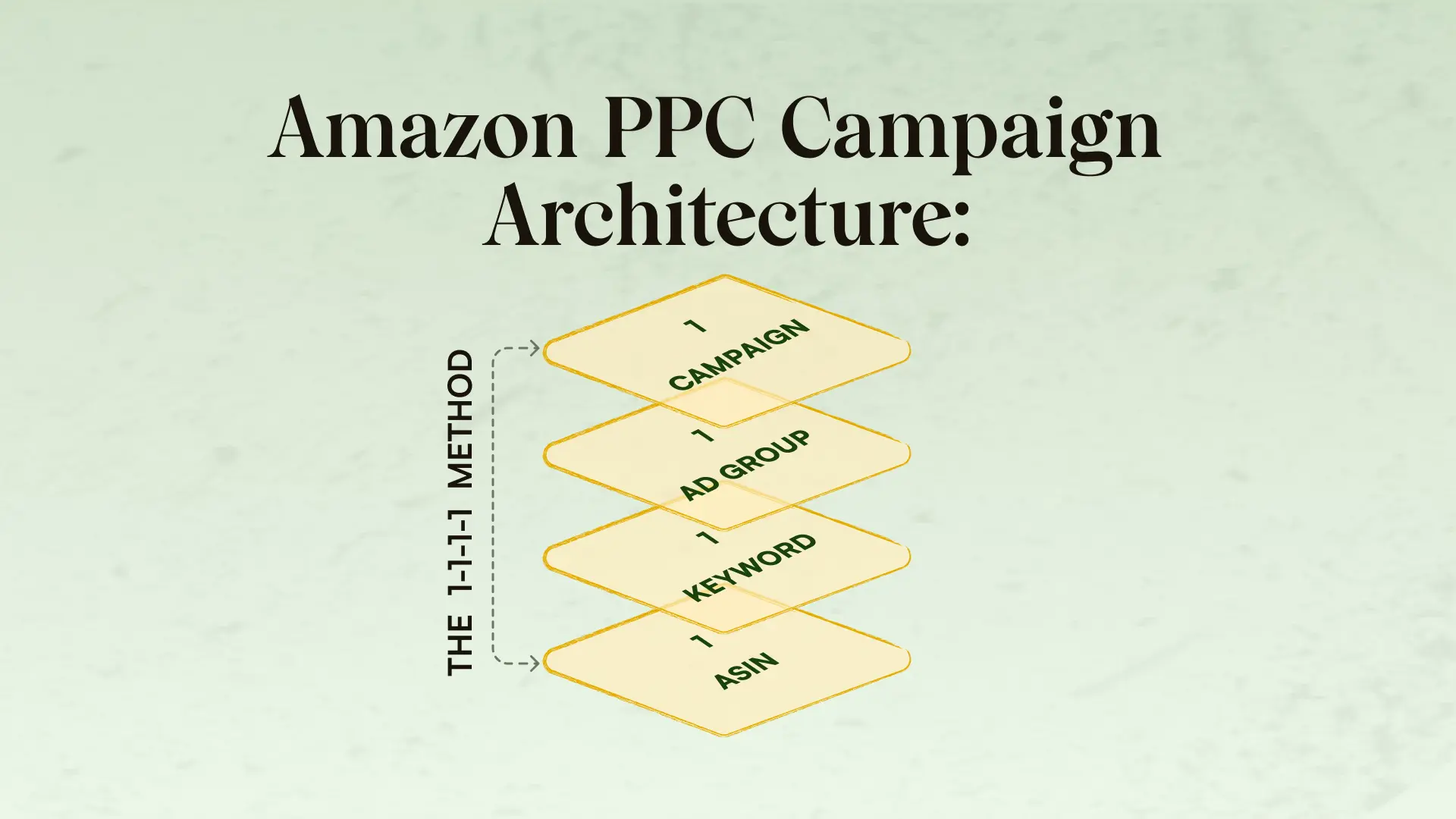
The best Amazon PPC campaign structure is 1-1-1-1: one campaign, one ad group, one keyword, and one ASIN.
With this method, each campaign has a single keyword that targets a single product. This way, you have full clarity in attribution, complete control of the budget per keyword, and clean data for every scaling decision. The structure applies to Sponsored Products campaigns, which Amazon Ads makes available to professional sellers and vendors, in Seller Central and Vendor Central respectively.
Yet, most Amazon accounts are built backwards, with multiple keywords sharing campaigns, ASINs sharing budgets, and match types sharing ad groups. According to Amazon's 2025 annual report filed with the SEC, its advertising services revenue reached $68,635 million in 2025, up from $56,214 million in 2024. That figure covers sponsored ads, display, and video advertising worldwide.
This article covers the 4 structural failures of this approach, and how to fix them using the Olifant Digital 1-1-1-1 Scaling Method that sits behind the $100M+ in annual Amazon client revenue we manage across 50+ Amazon accounts. ACoS (advertising cost of sales) is ad spend divided by ad-attributed sales.
Which 4 structural failures make Amazon PPC scaling impossible?
| Structure | What it hides | The fix |
|---|---|---|
| Many keywords, one ad group | Blended ACoS hides which keywords actually convert | One keyword per campaign |
| Many ASINs, one campaign | Amazon sends the budget to the hero product | One ASIN per campaign |
| Mixed match types | Bids are set on pooled match-type data | One match type per campaign |
| Auto with no negative bridge | Auto wins the impressions the manual campaign needs | Negative exact bridge |
Failure 1: Multiple keywords in one ad group (attribution blur)
12% ACoS, 8 keywords. Bringing in 70% of all conversions.
55% ACoS, 35 keywords. Using up to 40% of the daily budget.
Both sit in the same ad group, reporting one blended 28% ACoS.
If you have one ad group that contains 40 to 80 or even 200 keywords that share a single daily budget cap, the blended ACoS becomes useless for decision-making.
This is because an ad group that runs at 28% ACoS can look healthy until you separate the data. For example, it can turn out that 8 keywords are running at 12% ACoS, bringing in 70% of conversions, while 35 keywords are running at 55% ACoS and using up to 40% of the budget.
Amazon allocates the budget on keywords with higher impression share, even if they’re less efficient at converting. This can mean a keyword costing $3 could use up the daily cap before the keyword costing only $1.20 gets a single impression.
The blended ACoS doesn’t tell you when your worst-converting keywords are starving your best-converting keywords of budget.
What our own accounts show. That example isn't made up. In a 30-day snapshot of 45 Amazon ad accounts we manage (the ones with enough campaigns to compare), the median account's most efficient quarter of Sponsored Products campaigns ran at 24% ACoS or lower, and its least efficient quarter at 65% or higher, while the account as a whole reported a blended 30%. Much of that spread is planned: launch, rank-push and competitor campaigns are meant to run above target. The point is that you can only see it, and steer it, when each campaign stands on its own.
💡Pro Tip: If possible, download 60 days of keyword-level data from the Campaign Manager and sort by spend in descending order before you restructure your ad groups. The attribution blur among the top 10 keywords by spend does the most damage, so fix these first.
Failure 2: Multiple ASINs in one campaign (the budget drift problem)
If you have a campaign set up to target 12 ASINs with a shared budget, Amazon’s algorithm will find the product that’s most likely to convert and focus the spend on that product.
A hero product with 300 reviews and 14% conversion rate will burn through most of the daily budget in a matter of days and the other ASINs will get few impressions and no real performance data.
You can’t tell from the Campaign Manager that there’s a problem, because the blended ACoS of the campaign looks healthy, due to the one product that’s converting.
The other ASINs are budget-starved. They lack the spend to create sales velocity. Without that, they can’t build the organic ranking signal they need to compete and this structural problem worsens every week.
By assigning each ASIN its own campaign and dedicated budget, you remove Amazon’s ability to make that allocation decision for you. Every scaling decision becomes a deliberate choice you make.
💡Pro Tip: If a campaign’s blended ACoS looks good but individual ASINs haven’t improved in organic ranking over 60 days or more, budget drift is probably the culprit. In this case, pull the spend per ASIN from the Campaign Manager for the last 30 days and check if one product is using over 50% of the campaign budget. If so, split that ASIN into its own campaign.
Failure 3: Mixed match types in one ad group (bid conflict)
Amazon Ads offers 3 keyword match types: broad, phrase, and exact. If you have exact and broad match versions of the same keyword within an ad group, you lose the ability to make reliable bid decisions.
For example, the search for “organic protein powder for women” can be matched to any of the 3 match types. While the Search Term Report will show you which query brought up the ad, it won’t tell you which match type won the serve.
If that search converts, there’s no way to know whether that conversion came from your exact match keyword or a phrase or broad match variation that was running on the same query.
This means your bid adjustments run on pooled data. Any keyword-level ACoS figure can be a mix of all 3 match types.
By splitting match types into different campaigns, each bid decision has a clean data set. This way, your exact match bids reflect exact match performance, while your broad match bids reflect broad match performance, with no cross-contamination between them.
💡Pro Tip: If you're auditing for bid conflict, you’re looking for any ad group where the same root keyword appears more than once with a different match type. Each is a bid decision on mixed data. Separate the match types into their own campaigns so that each builds its own clean performance history.
Failure 4: Auto campaigns without negative bridges (cannibalization loop)
Promote the converting search term to a manual exact campaign, then add it as a negative exact to the auto campaign. Without that negative bridge, both campaigns keep bidding on the same impression.
If you have an auto campaign and a manual exact match campaign targeting the same ASIN without a negative keyword bridge in between, they’ll be fighting for the same impressions.
Auto campaign wins the auction on a broad close variant, achieves the conversion, and seems to be doing well.
The manual campaign is starved of data because the auto campaign keeps winning the impressions first. This is where you should be getting that clean attribution and dedicated budget.
Auto campaigns are crucial for keyword discovery. They uncover converting search terms that should be promoted to manual exact match campaigns.
That promotion process doesn’t include adding the converting term as a negative exact match to the auto campaign. That’s when the cannibalization loop starts.
Without that negative bridge, the auto campaign continues to fight for the same impression, the manual campaign never pulls reliable data, and the account continues to attribute performance to the wrong structure.
There’s a ranking cost for organic as well. Auto broad matching builds sales velocity that sends out a diffuse signal to Amazon’s algorithm across many loosely related terms. The same conversions coming through manual exact match concentrate the velocity on a specific keyword, creating a stronger ranking signal as a result.
💡Pro Tip: Run the Search Term Report weekly for the previous 7 days, and identify converting search terms that don’t yet have a manual exact match campaign. Add each one as a negative exact to the auto campaign and create a dedicated 1-1-1-1 campaign for it. This weekly process is how auto-campaign discovery becomes manual-campaign precision over time.
How big the weekly harvest really is. In a 30-day snapshot of 63 accounts we manage, the median account had 84 search terms that drove at least one sale, but only about 6 auto-campaign search terms with two or more orders. That is the real promotion list: one or two new exact campaigns a week, not a rebuild every Monday. The same weekly rhythm feeds organic rank, which we cover in how to rank #1 on Amazon.
We pair the harvest with a simple cut rule: our team pauses a keyword when it has zero sales after 14 days and has spent twice what a single sale earns before ad costs. With both in place, the median account we manage had about 4% of Sponsored Products spend in campaigns with no sales over 30 days.
What is Olifant Digital’s 1-1-1-1 Scaling Method?
What does each 1 control?
- 1 campaign holds the budget
- 1 ad group holds one match type
- 1 keyword carries the bid
- 1 ASIN takes every click and conversion
The campaign is the budget container. There’s one campaign per keyword and ASIN combo, which means you can decide how much you spend on each keyword-product pairing and upspend on one without impacting the others.
As such, the total budget is spent on one keyword and ASIN, preventing Amazon’s serving algorithm from reallocating the budget internally.
With one keyword per ad group, every click, conversion, and ACoS in that campaign can be tied back to that specific keyword and bid decisions are made with full data.
By setting up each ASIN in its campaign, the performance data is isolated to that single product. This way, any efficiency differences between products are immediately visible, instead of getting lost in a blended number.
Consistent naming is what keeps this structure navigable at scale.
Our naming convention puts four things in every campaign name:
- Ad type
- Match type
- Target keyword
- ASIN
For example: SP | EXACT | organic protein powder | B0XXXXXXXX. Set the convention before launch, because renaming live campaigns breaks the reporting history you compare against.
Using this approach, you can audit a complete account with 200 campaigns in under 30 minutes in the Campaign Manager.
How the 1-1-1-1 Scaling Method solves all 4 structural failures
If you have one keyword for your campaign, you can trace every click and conversion back to that keyword, completely removing the attribution blur. For example, if you have a keyword that’s performing below the target ACoS but has a strong conversion rate, you can double that keyword’s campaign budget, knowing that the increase goes only to that keyword on that ASIN without affecting anything else.
Then, one ASIN per campaign forces budget allocation to be a conscious decision for each product. With a blended campaign, you increase the budget on each keyword and ASIN all at once leaving you with no control over where the extra spend goes.
Because there’s only one match type for each campaign, the bid decision is also made on clean, isolated data for that query pattern, resolving the bid conflict.
It also makes placement bidding precise. Across 60+ accounts we manage, top-of-search clicks ran at a median 26% ACoS in a 30-day snapshot, against 36% for the rest of the search results and 39% on product pages. In a 1-1-1-1 campaign you can raise the top-of-search adjustment for one keyword on one product without lifting bids anywhere else in the account.
For the first time, it’s also possible to measure the Amazon flywheel itself cleanly. This is because you need to separate performance by keyword and ASIN to measure the relationship between PPC-driven sales velocity, organic rank improvement, and TACoS decline accurately. In a mixed structure, this signal is diluted beyond any possible measurement.
It also reinforces reliability in the management of negative keywords. Each of the auto-discovery-promoted search terms has its own campaign. This makes the performance of that term immediately visible, rather than lost in a crowded ad group where it can’t be separated from everything else running alongside it.
The objection: "Won't this create hundreds of campaigns?"
Yes, and that’s good.
The 1-1-1-1 structure will result in more campaigns, if you have more ASINs and keywords. For example, for an account with 20 ASINs and 30 keywords per ASIN, you’ll have 600 campaigns.
It can be intimidating at first. In practice, you build toward this over 60 to 90 days as the Search Term Report harvest promotes converting terms into dedicated campaigns.
Think about what you actually received from those 20 blended campaigns:
- A blended ACoS that told you nothing useful about any of the keywords in particular.
- Budget decisions that affected all ASINs of the campaign at the same time.
- Performance data that you couldn’t trust.
All of these issues are replaced with 600 clearly named 1-1-1-1 campaigns telling you exactly how much it’s spending and converting, as well as whether you should scale or pause.
How do you build the rest of the account around 1-1-1-1?
1-1-1-1 is the core for proven keywords. Four more layers sit around it, each in its own campaigns so its data stays clean.
Competitor ASIN targeting as its own layer
Run product targeting on competitor listings in separate campaigns, following the Amazon Ads targeting guide. These shoppers are already on a product page in your category, so intent is high. Keep them apart from keyword campaigns, or their cost per sale blends into your keyword numbers. For Spade to Fork, we targeted competitors with lower ratings and higher prices in their own campaigns, part of a campaign rebuild that grew ad sales 132%.
Sponsored Display as a retargeting layer
Use Sponsored Display to reach shoppers who viewed your product and didn't buy. You reach warm viewers instead of bidding harder on search. Across the accounts we manage, 78% of Sponsored Display sales came from new-to-brand customers at a median 21% ACoS in a 30-day snapshot.
Split the budget by match type: 60/30/10
A good starting split: 60% to exact match on proven terms, 30% to phrase match and competitor ASIN targeting, and 10% to broad discovery. Adjust it per account once you see where profitable sales come from.
Pick a bidding strategy per campaign
Amazon offers three: dynamic bids down only, dynamic bids up and down, and fixed bids. Down only is the safer default for new and discovery campaigns. Up and down suits proven exact campaigns with steady conversion, since Amazon can raise the bid by up to 100% for top-of-search placements. Fixed bids keep tests clean. Because 1-1-1-1 puts the budget at campaign level, group each product's campaigns in one portfolio to cap total spend per ASIN.
How do you audit your Amazon PPC campaign structure in 20 minutes?
- Export: Pull 60 days of campaigns, ad groups and keywords from Bulk Operations.
- Attribution blur: Count keywords per ad group. More than one is a candidate.
- Budget drift: Count unique ASINs per campaign. More than one is a candidate.
- Bid conflict: Find one root keyword sitting in an ad group under two match types.
- Auto-to-manual bridge: Find converting search terms with no manual exact campaign behind them.
The whole audit is run via Bulk Operations in the Campaign Manager and no external tools are needed.
Step 1: Export the data
- Go to the Campaign Manager → Bulk Operations
- Download all campaigns, ad groups, and keywords for the last 60 days
Step 2: Check for attribution blur
- Filter the export by entity type "Keyword"
- Use a COUNTIF formula to count keywords per ad group
- Any ad group with more than one keyword in an exact-match structure is a candidate for attribution blur
Step 3: Check for budget drift
- Filter by entity type "Ad" to identify campaigns with more than one ASIN
- Add a COUNTIF formula to count unique ASINs per campaign
- Any campaign with more than one ASIN is a candidate for budget drift
Step 4: Check for bid conflict
- Look for the same root keyword appearing in multiple rows within the same ad group with different match type values
- Any ad group with mixed match types on the same root keyword is a candidate for bid conflict
Step 5: Run the auto-to-manual bridge
- Pull the Search Term Report for the last 30 days
- Find converting search terms in auto campaigns that don't have a corresponding manual exact-match campaign
On a well-organized account, this audit takes 20 minutes. On a complex, mixed-structure account, it takes meaningfully longer, which itself is diagnostic information.
💡Pro Tip: An agency that can tell you exactly what you’re doing wrong in your account after 20 minutes with your Bulk Operations export knows what it’s doing. If an agency responds to this audit with vague language about “ongoing optimization” rather than specific structural answers, it’s a red flag.
Where to look first. Spend is concentrated. In the median account we manage, the top 10% of Sponsored Products campaigns take 52% of the spend, and the top 10 search terms take 28%. Audit those first, because that's where a structure problem costs the most.
How do you move a mixed Amazon PPC campaign structure to the 1-1-1-1 Scaling Method?
- Days 1 to 14: Build 1-1-1-1 campaigns for your 10 to 15 highest-converting keywords and run them alongside the old ones, unchanged.
- Day 14 onward: Lower the bids on those same keywords in the mixed campaigns to move traffic across without a cold start.
- Days 30 to 60: Migrate the next 40% of keywords by revenue, taking the old campaigns down to minimum bids.
- Days 60 to 90: Move the remaining keywords, or park them on low-budget maintenance. Auto campaigns stay on throughout.
When you rebuild your entire account, you risk losing historical performance data as well as disrupting organic ranking. A staged transition avoids both.
Take the first 10 to 15 keywords with the highest conversion volume from the Search Term Report and create 1-1-1-1 campaigns around those keywords first. Run them simultaneously with the old mixed campaigns for 14 days. Don't change anything to the old structure so that the new campaigns have enough data to go on before any traffic is moved.
After 14 days, start reducing your bids on the same keywords in the mixed campaigns. This slowly directs traffic to the clean structure without a cold start gap.
Don’t kill the old campaigns immediately. As the 1-1-1-1 campaigns gain traction, bring your bids down to the minimum.
From there, migrate in tiers over 60 to 90 days. Move the top 20% of keywords by revenue in the first 30 days, the next 40% from day 30 to 60, and the remaining keywords in the last phase (or put them into low-budget maintenance).
Throughout the process, never turn off auto campaigns. They’re responsible for finding keywords and must keep doing so throughout the migration, no matter where you’re at.
💡Pro Tip: Define the naming convention before you start the migration. Choose your structure upfront and implement it from the first campaign. This way, every campaign you add from that point will be immediately identifiable without the need for a third-party tool to navigate the account.
Three more structure mistakes we find in agency-run accounts
The four failures above are the most common. When we take over an account from another agency, three more show up again and again:
- Chasing broad, high-volume keywords. They carry the highest cost per click and the lowest purchase intent. High-intent long-tail terms usually convert better for less. Balanced Tiger's previous agencies chased broad, competitive terms; after we rebuilt around long-tail 1-1-1-1 campaigns, ACoS dropped 50% and revenue grew 171% in two months.
- No negative keyword routine. Without a set weekly process, wasted spend on irrelevant search terms builds up quietly. Our negative keywords guide covers the process.
- Reporting on ACoS instead of TACoS. ACoS compares ad cost with ad sales only, so a healthy blended number can hide products that lose money. TACoS compares ad cost with total sales, organic included. When Onsen Secret came to us, ACoS-only reporting had hidden the real problem; once we reported TACoS per product, profit tripled, adding $95,934 per month. More in TACoS vs ACoS.
How Olifant Digital applies 1-1-1-1 in client accounts
171% revenue increase for Balanced Tiger in 2 months, alongside a 50% ACoS reduction, after the 1-1-1-1 rebuild.
The work we completed for Balanced Tiger and MatchaBar are good examples of our 1-1-1-1 Scaling Method in action.
Balanced Tiger came to us after other agencies ran broad, competitive keywords within mixed campaigns. This made it impossible to identify which keywords were converting and which were wasting money without results. Both became visible immediately after the 1-1-1-1 rebuild.
We used the 1-1-1-1 Scaling Method to gain clarity in tracking our performance. This way, we could identify what worked, scale data, and innovate with dedicated testing campaigns, all without compromising on ROI.
The result was a 171% revenue increase and 50% ACoS reduction in just 2 months.
As for MatchaBar, the brand had worked with multiple agencies that left behind mixed-structure campaigns with no clear record of what was working.
We rebuilt every campaign using the 1-1-1-1 Scaling Method, giving us complete visibility into performance and allowing us to scale what worked and cut what didn’t. This rebuild was the prerequisite for the daily optimization work that added $114,305 to MatchaBar's monthly Amazon revenue.
| Brand | What we rebuilt | Result |
|---|---|---|
| MatchaBar | Every campaign rebuilt on 1-1-1-1 | $114,305 added in monthly Amazon revenue |
| Balanced Tiger | Long-tail 1-1-1-1 campaigns, non-converting keywords cut | Revenue up 171%, ACoS down 50% in two months |
| Wedge Guys | Account structure rebuilt | Amazon sales up 391%, ACoS down 17% |
| Onsen Secret | TACoS reported per product | Profit tripled, $95,934 added per month |
| Spade to Fork | Campaigns restructured per ASIN, competitor ASIN targeting added | Ad sales up 132%, revenue up 46% in 44 days |
The same structure runs across the accounts we manage today. Amazon store sales, January to September 2026 versus the same months of 2025: Dreamfarm UK +328%, Eye on Ball +113%, BenchFoods +84%, Novalogy (AYO) +66% and Dreamfarm US +45%.
"Working with Olifant has transformed our business. They have a marketing strategy for every quarter, and it's clear what we should be working on together." Graham Fortgang, Founder, MatchaBar
Key takeaways
- 1-1-1-1 isolates every keyword-product pair. After its 1-1-1-1 rebuild, Balanced Tiger grew revenue 171% and cut ACoS by 50% in 2 months.
- Real accounts show the spread. In the median account we manage, campaign ACoS runs from 24% to 65% behind a blended 30%.
- A healthy blended ACoS can mislead. A 28% average can mask 8 keywords converting at 12% ACoS beside 35 keywords spending at 55%.
- Budget drift starts above 50%. When one product takes over 50% of shared campaign spend for 30 days, give it its own campaign.
- The negative exact bridge stops cannibalization. Each week, move converting auto terms to manual exact and block them in auto as negative exact.
- Rebuild in stages over 60 to 90 days. Move your top 10 to 15 converting keywords first to protect historical data and organic ranking.
If you would rather hand this structure to a team, our best Amazon PPC agencies list shows which agencies build accounts this way.
Frequently asked questions
How often should I restructure my Amazon PPC account?
Major restructures are typically needed once or twice a year, usually when a new product line is being launched, you’re moving into a new category, or the current structure is giving blended data that can’t be acted upon. More minor changes, such as adding campaigns for new products, optimizing budget allocation, and updating negative keyword flows, should be part of a regular monthly review.
What is the ideal ACoS for Amazon PPC?
| Campaign type | ACoS target | What you are buying |
|---|---|---|
| Brand defense | 5 to 10% | Cheap protection of your own terms |
| Performance | At break-even | Volume that pays for itself |
| Expansion | Just above break-even | Reach from broad and phrase match |
| Auto-discovery | Above break-even | Search term data |
There’s no single answer. First, you need to calculate your break-even ACoS based on your profit margin after Amazon fees and the cost of goods. Then, set goals for each campaign type: brand defense at 5 to 10% ACoS, performance at or near break-even, expansion (broad and phrase) slightly above break-even, and auto-discovery above break-even (you are paying for search term data).
What should I expect from an Amazon PPC agency when it comes to campaign structure?
Any agency managing your account should show you the exact campaign structure they use, explain the reasoning behind each structural decision, and provide a clear log of the changes made along with its reasons. If an agency can’t tell you how many campaigns your account has, why each campaign exists, and what match-type logic it’s following, the structure is either missing or too mixed to manage with confidence.
What’s the difference between a campaign and an ad group in Amazon PPC?
The campaign holds the daily budget, while the ad group holds the products, the targets, and a default bid you can override per keyword. Amazon Ads confirms that you set a daily budget for each campaign. It also states that an ad group's keywords, product targeting, and bids apply to all products within that ad group. In the 1-1-1-1 Scaling Method, each campaign holds one ad group, one keyword, and one ASIN, so budget and bid control a single pair.
Why do most Amazon PPC agencies get account structure wrong?
Most agencies build for speed, not for readable data. They group several products in one campaign, mix match types in one ad group, chase broad high-volume keywords, skip a weekly negative keyword routine and report on ACoS instead of TACoS. Each of these blends the numbers, so budget follows the auction instead of your margins. A 1-1-1-1 structure, a weekly harvest and TACoS reporting per product fix all five.
Should I run automatic or manual Amazon PPC campaigns?
Run both: auto campaigns handle keyword discovery, while manual exact campaigns give each converting term clean attribution and a dedicated budget. Each week, pull the Search Term Report for the previous 7 days and promote converting terms to manual exact campaigns. Then build the negative exact bridge: add each term as a negative exact in the auto campaign, so both campaigns stop competing for one impression.
Is the 1-1-1-1 Scaling Method right for your account?
The strongest Amazon PPC campaign structure gives each keyword and product its own campaign, ad group, and budget, which is exactly what 1-1-1-1 does. It turns blended numbers back into clean data for attribution, budget, and bid decisions. Start by auditing your top 10 keywords by spend, because that is where attribution blur does the most damage.
If your campaign structure is blending keywords, ASINs, or match types in a way that makes it impossible to understand what is working, you're guessing.
Olifant Digital reconstructs Amazon PPC accounts following the 1-1-1-1 Scaling Method. Get your free marketing plan and we’ll show you exactly where your structure is costing you. Our services start from $2,000 per month and are custom for each project, based on the complexity and workload required. Every engagement is backed by our 60-day guarantee: if we don't improve your performance, you don't pay.
.webp)
Alex is the founder and CEO of Olifant Digital, where his team manages over $100M in annual Amazon client revenue across 50+ brands, and he runs a 7-figure Amazon brand of his own. That operator background shapes how the agency works: every tactic is tested with his own money before it reaches a client account. He oversees PPC methodology, creative, and conversion rate across all client accounts to make sure Olifant Digital scales brands profitably.


.png)
Mike reviews every Amazon article on this blog for strategic and technical accuracy before it publishes. As Director of Amazon Growth at Olifant Digital, he sets marketing strategy across client accounts and personally audits PPC at every stage of growth. He brings 8 years of daily Amazon operations across 7 and 8-figure brands including Beauty by Earth, Ekster, and Bullstrap, the kind of hands-on depth most agency directors delegate away.