

What is the difference between TACoS and ACoS?
TACoS vs ACoS comes down to scope. ACoS measures ad spend against ad-attributed sales only, while TACoS measures ad spend against total revenue, including organic sales. Use ACoS to judge individual campaigns and TACoS to judge the business: for a mature ASIN, a healthy TACoS sits between 5% and 15% and should fall over time.
Olifant Digital is a full-service Amazon and e-commerce marketing agency for established brands that want profitable growth, managing $100M+ in annual Amazon client revenue across 50+ Amazon accounts. TACoS is the number we report first.
Most agencies choose to report ACoS by default because it represents the easiest number to pull from Seller Central.
TACoS, on the other hand, requires pulling the total ad spend from Campaign Manager and total revenue from Business Reports. This process makes the agency accountable for the whole account, organic sales included.
If your current agency is only showing you ACoS reports, but your margins are not moving, the issue is what the report leaves out.
This article covers what each metric measures, how to calculate TACoS, and 5 signs your agency is optimizing for the wrong metric.
TL;DR
ACoS judges campaigns, TACoS judges the business. ACoS divides ad spend by ad-attributed sales; TACoS divides ad spend by total revenue.
TACoS is easy to calculate. $8,000 in ad spend ÷ $50,000 in total revenue × 100 = 16% TACoS.
Benchmarks depend on product stage. Expect 20% to 30% or higher at launch and 5% to 15% for a mature ASIN.
Flat TACoS after 12 months is a warning. It means ads are covering ground organic rank should hold.
TACoS-first reporting moves profit. Onsen Secret tripled profit and added $95,934 in monthly revenue after reporting moved to TACoS.
TACoS vs ACoS: what each metric measures
What ACoS tells you
ACoS is a useful metric on a campaign level, but it's a narrow one that only counts the sales that have happened from an ad click. Amazon Ads' own guide calculates ACoS by dividing ad spend by ad revenue, then converting it to a percentage.
This metric completely ignores organic sales and doesn't provide information if your paid activity is building your business or it's eroding your long-term rank.
You can think of ACoS as a speedometer that only measures one lane of the highway, while the rest of the traffic goes uncounted. This is the same scenario that is happening on your account.
Agencies work in the following way: they cut the broad keywords, shift the budget toward branded terms, and tighten targeting. By doing this, they achieve bringing ACoS down to a number that looks great on paper, but none of these actions guarantee that your revenue will grow.
In fact, they can push it in the opposite direction while the report continues to look fine.
What TACoS tells you that ACoS can't
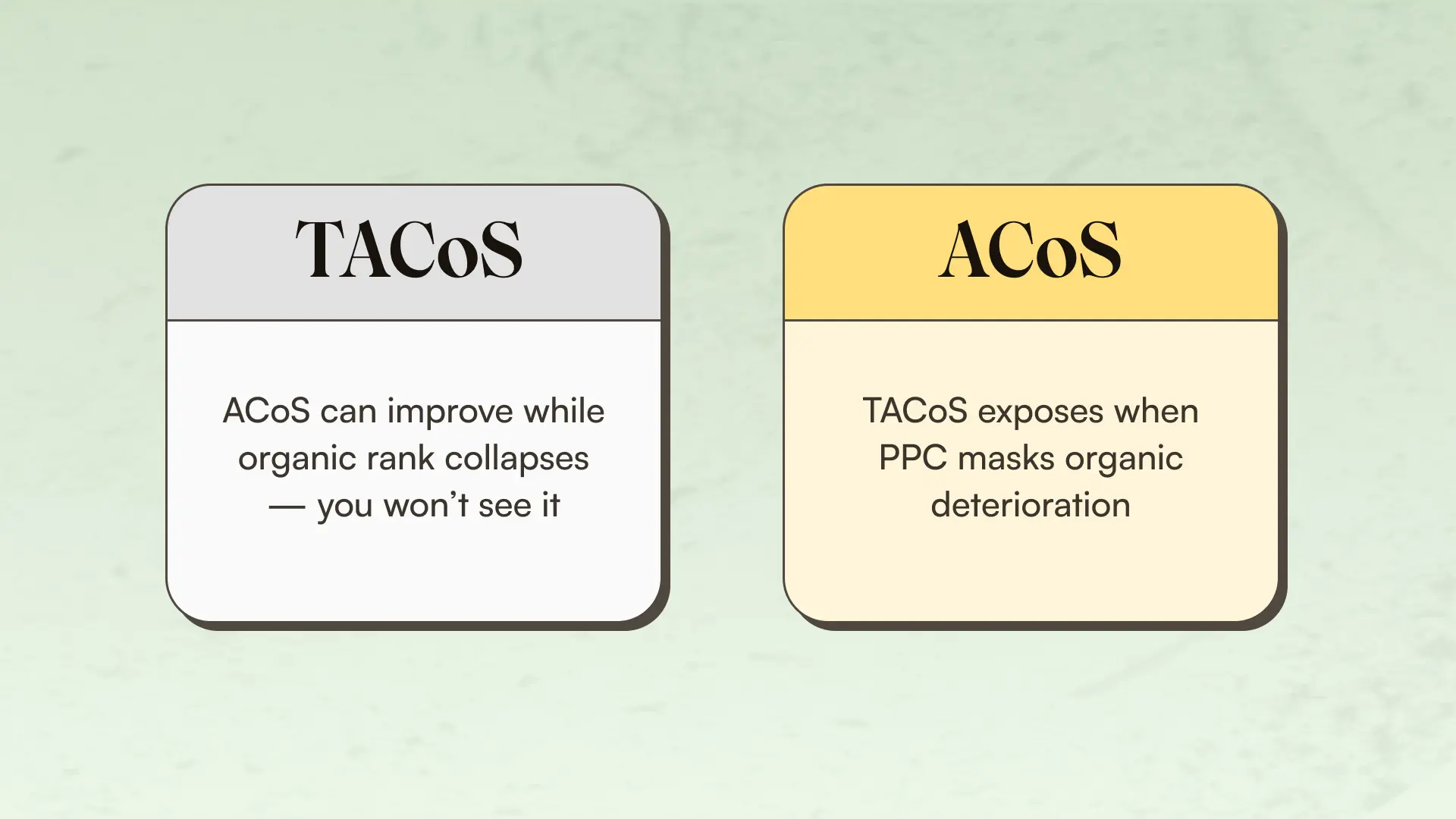
ACoS: Ad spend measured against ad-attributed sales only. Organic revenue is not counted at all. Judges campaign efficiency.
TACoS: Ad spend measured against total revenue. Shows whether ads are building organic rank. Judges business growth.
TACoS shows you the exact relationship between your ad spend and your entire business, including sales your agency's campaigns never touch. When TACoS is falling over time, it means your ads are doing what they should: building your organic rank, reducing ad dependency, and making your business more efficient as it grows.
When TACoS appears flat or climbs while ACoS looks healthy, it means your ads are holding the account together. They aren't growing it.
Advertising is a growing share of Amazon's business. According to Marketplace Pulse's tracking of Amazon's reported results, Amazon-wide advertising services revenue grew 22% to $68.63 billion in 2025, up from $56.22 billion in 2024. TACoS is the number that shows how much of your own revenue that spend is taking.
This is the distinction that separates a strategy that scales from one that stalls.
Why ACoS alone is a misleading metric
The branded keyword problem
Branded ads rarely create demand. They add a cost to a sale that was already coming your way.
Branded keywords convert because the shopper already knows your product and has decided to buy.
From our accounts: branded campaigns ran a median 13% ACoS across the accounts we manage, far below any other campaign type. Shift budget toward brand terms and the blended ACoS drops fast, which is why an ACoS-only report can improve while the business stands still.
Here, the ads intercepted a purchase that was already coming your way and added a cost to a sale that was happening regardless.
TACoS exposes this, because a branded spend that is not growing the organic rank or new customer acquisition will keep your ad cost high in relation to the revenue.
If the branded spend consumes more of your total revenue without building organic rank and TACoS doesn't move, it's a clear signal that is not possible to see in an ACoS report. Margin is already thin: Marketplace Pulse reports that for many sellers, total Amazon fees now exceed 50% of revenue. Branded spend that adds cost to a sale you already had comes straight out of what's left.
ACoS misses sales your ads create on other products
ACoS credits an ad only with the sales Amazon attributes to it. Shoppers often click one product and buy another from the same brand.
From our accounts: in every one of the 11 accounts we checked during audits, 10% to 68% of ad sales landed on a different product from the one in the ad, mostly a sibling variation. Campaign ACoS undercounts that value. TACoS catches it, because it divides spend by all revenue.
When organic growth stalls but ACoS still looks healthy
ACoS can look healthy for months, while the organic rank is slipping in the background.
What agencies typically do is they cut the broad keywords, tighten targeting, and reduce what looks like wasted spend. As a result of this, the campaigns start to look better on paper, but the report never shows if that was the reason why your organic position was holding.
What you actually want to see is ACoS holding steady, while TACoS slowly drops. When this happens, it means your organic sales are gaining more traction, so you are not depending on paid spend to keep things running.
How to calculate TACoS and what a good number looks like
The formula
Pull total ad spend from Campaign Manager
Pull total revenue from Business Reports
Divide spend by revenue, then multiply by 100
$8,000 ÷ $50,000 × 100 = 16%. Same period, both reports.
To calculate TACoS, you need to divide your total ad spend by your total revenue and multiply by 100.
This number is not surfaced automatically in Seller Central, so you need to pull 2 separate reports: the total ad spend from the Campaign Manager and total revenue from Business Reports (both covering the same time period).
Once you have these numbers, the calculation is straightforward. If you spent $8,000 on ads, and you earned $50,000 that month, it means your TACoS is 16%. This is a number that tells you more about your account health than any campaign-level metric your agency is likely reporting.
TACoS benchmarks: launch phase vs mature ASIN
Launch phase: 20% to 30% or higher. Ads carry the revenue while organic rank is still being established.
Mature ASIN: 5% to 15%. Organic visibility is holding rank and ads add to it.
12 months live, not falling: Flat or climbing. Ads are covering ground that organic rank should be holding.
TACoS benchmarks shift based on the lifecycle of your product. This means during the launch phase, it's normal to have TACoS of 20% to 30% or higher because that is the time when your ads are carrying most of the revenue load while the organic rank is still being established.
As the organic visibility grows, TACoS should fall without a dramatic reduction in ad spend, which is because more of your revenue will be coming from searches that you are winning without having to pay for.
For a mature ASIN, healthy TACoS typically sits between 5% and 15%. If your product has been live for 12 months or more, and this number is not declining, it means that your ads are covering ground that organic rank should be holding and that your business is more dependent on paid spend than it should be at that stage.
When to switch from ACoS to TACoS as the main metric
There is no single rule, but when two or three of these signals show up together, the switch is overdue:
Organic is 20% or more of your total Amazon revenue.
ACoS looks healthy but revenue has stopped growing.
Spend keeps rising and profit does not follow.
Nobody can show you the organic versus paid split, trended over 90 days.
What your 90-day TACoS trend tells you
| Trajectory | What the numbers do | What it means |
|---|---|---|
| Healthy | TACoS falls, revenue grows | Organic share is compounding. Keep scaling. |
| Acceptable | TACoS steady, revenue grows | Paid and organic grow together. Watch the organic share. |
| Warning | TACoS rises with revenue | Ads are buying sales, not rank. Fix listings before adding spend. |
| Critical | TACoS rises, revenue flat | Budget will not fix it. Go to ASIN level. |
Read it per product as well as for the account. Strong products can average out weak ones, so an account-level TACoS can look fine while single ASINs are already critical.
TACoS targets we set on real accounts
The 5% to 15% range is a starting point. We set each brand's target from its margin, its stage and how much of its sales are already organic:
| Brand | TACoS target | Why |
|---|---|---|
| Cycling Deals (7-figure bike accessories) | 10% | Mature catalog where more than half of sales are organic, so ads defend rank instead of buying it |
| Wedge Guys (golf wedges) | 20% | Premium-priced golf wedges, with the target set from product margin |
| Bullstrap (leather phone and watch accessories) | 15% to 25% | A range rather than a point, so spend can rise in peak season and fall back after |
From our accounts: the right pattern is ACoS holding or falling while total sales grow faster. On Inito, an 8-figure fertility-tech brand, Sponsored Products ACoS went from 17.4% to 15.1% after we took over in August 2026, while year-over-year Amazon growth went from 82% to 114% (Seller Central).
What TACoS-first management looks like in practice
Onsen Secret: tripled profit after shifting from ACoS to TACoS
+$95,934: Monthly revenue added at Onsen Secret after reporting moved from ACoS to TACoS, with profit tripled.
Onsen Secret is a premium Japanese skincare brand. When they came to us at Olifant Digital, they had scaling trouble, which was compressing their margins. Their account looked manageable on ACoS, but the actual profit was getting worse.
We shifted their reporting framework to TACoS, concentrated the spend on products that were proven converters, and optimized the listings before scaling PPC. Due to this change, their listings started to earn traffic on their own, their organic rankings improved, and the ad dependency started to fall.
Once these results started to accumulate, TACoS dropped and organic revenue grew, which led to a tripled profit. Their monthly revenue increased by $95,934.
"Systematic approach. I see them as business partners and not just an agency."
Doron Santo, CEO at Onsen Secret
Balanced Tiger: 171% revenue growth, ACoS cut 50% in 2 months
Balanced Tiger makes vegan protein bars with functional mushrooms. Before they started working with Olifant Digital, their previous agencies were chasing broad and highly competitive keywords that inflated their ACoS and drained budgets without any sustainable returns.
After we shifted to high-intent long-tail keywords and implemented the 1-1-1-1 Scaling Method (one keyword, one match type, one target, one ad group), we were able to see the complete performance visibility at the product level and made TACoS tracking clean and accurate.
ACoS dropped by 50%, and their monthly revenue grew 171% in the first 2 months.
"Extremely effective. Excellent communication and project management on their side to implement widespread changes over a short period of time."
Adriano Bordoli, CEO at Balanced Tiger
Spade to Fork: profitable TACoS across the full catalog in 44 days
Onsen Secret: Profit tripled. Spend concentrated on proven converters, listings fixed first.
Balanced Tiger: Revenue up 171%. Long-tail keywords and one keyword per campaign, per ASIN.
Spade to Fork: Profitable in 44 days. Product-level campaigns aligned to TACoS targets.
Spade to Fork is an organic gardening brand that came to us because their ACoS was climbing year over year with no product-level profitability tracking in place. This made it impossible to tell which ASINs were contributing to the overall health of the account and which ones were quietly draining it.
After we introduced product-level campaigns aligned to TACoS targets and moved to daily optimization, within 44 days, Spade to Fork achieved profitable TACoS across their entire catalog, top-performing ASINs and long-tail ASINs alike. Their Amazon sales grew by 46% and ACoS dropped 19%.
"Olifant works extremely closely with our account, and I am impressed with their support and know-how. I feel that our brand is in safe hands."
Jeff Kathrein, CEO at Spade to Fork
Five signs your agency is optimizing for ACoS over profit
The report leads with ACoS and stops there
ACoS keeps dropping but your margin does not move
Ad spend grows while organic rank stays flat
Every win is a cut, never revenue added
No one can show you a 90-day TACoS trend
There are 5 signs that show your agency is not optimizing correctly, and you don't have to pull campaign data to spot these signs. All the answers show up in your reports and in how your account manager responds when you push back.
What does your report actually show? If the report leads with ACoS and it stops there without providing TACoS, your agency reports what's easy to pull. TACoS is what's useful.
Is ACoS improving, but the margin remains unchanged? If ACoS has been dropping for 3 or more months without your net margins moving, it means the campaigns are being optimized for something that does not reach your bottom line. This is a sign that your account is running inside a closed loop and it's not connected to actual profitability.
Is the ad spend growing while the organic rank stays flat? Over time, PPC should be building organic momentum. If it's not, it means the spend is only maintaining position.
How are wins defined in your report? If every positive update is an ACoS reduction, ask what they cut to get there, and whether the total revenue moved in the same direction.
Can your agency show you a TACoS trend? If they can't, they are managing campaign performance in isolation, which is completely different from managing your business, and it's an important distinction to understand before the next budget conversation.
How Olifant Digital reports TACoS
Every product gets its own target ACoS and target TACoS, set from its margin. Weekly reports lead with TACoS and the organic versus paid split, then ACoS by campaign. Our in-house platform, Olifant AI, analyzes every account daily and flags spend, budget and scaling decisions against each brand's profit margin target, so our senior specialists act the same day. Olifant Digital's services start from $2,000 per month and are custom for each project, based on the complexity and workload required, and every engagement comes with a 60-day guarantee: if we don't improve your performance, you don't pay.
Key takeaways
ACoS shows campaign efficiency; TACoS shows whether ads grow total revenue.
Calculate TACoS from 2 reports covering the same period: total ad spend and total revenue.
A mature ASIN should hold TACoS between 5% and 15%, and the trend should point down.
Ask your agency for a 90-day TACoS trend. If they can't produce one, they're managing campaigns in isolation.
Spade to Fork reached profitable TACoS across its full catalog in 44 days once campaigns were aligned to TACoS targets.
Final thoughts
ACoS is a limited metric, and it becomes a problem when it's the only one that is reported by your agency. It is at this point when your agency is being judged on campaign performance, while your business growth sits in a different conversation.
Brands that are growing profitably on Amazon know exactly where their money is going and what it is producing. This is exactly the clarity level that TACoS provides.
If your reports show healthy ACoS but you're experiencing margins that are not moving, or your current agency can't provide a TACoS trend for the past 90 days, we'll surface exactly what your current reporting is leaving out: Get your free marketing plan.
Frequently asked questions
What does TACoS mean on Amazon?
TACoS stands for total advertising cost of sale. It's your total ad spend divided by your total revenue, ad-attributed and organic combined, multiplied by 100. A falling TACoS means organic sales are growing faster than ad spend, which is the sign your ads are building the business.
What is a good ACoS on Amazon?
A good ACoS on Amazon is one that sits below your product's profit margin after Amazon fees and cost of goods sold. If you have a margin that after all costs is 30%, an ACoS that is below 30% means that your ads are profitable on a campaign level. Use our Amazon ACoS calculator to find your break-even point.
Keep in mind that this calculation only tells you whether individual campaigns are paying for themselves, and it's not telling you whether your total business is growing.
This is why you should read ACoS alongside TACoS every time.
Is it better to have a high or low ACoS?
A lower ACoS is better at the campaign level, as long as total revenue keeps growing. You can push ACoS down fast by cutting broad keywords and shifting budget to branded terms, and that can shrink sales while the report looks fine. Check TACoS alongside it. If ACoS falls while TACoS holds flat or climbs for 90 days, the cuts are costing you growth.
Can TACoS replace ACoS entirely?
No, TACoS can't entirely replace ACoS, and it shouldn't. ACoS is useful for evaluating individual campaign efficiency and for understanding which ad types and keywords are generating the ad attributed revenue.
TACoS on the other hand, gives you the business-level view that ACoS can't provide on its own. The 2 metrics have different purposes. ACoS informs tactical decisions at the campaign level, while TACoS shows whether those decisions move the business in the right direction overall.
Why does my agency only report ACoS?
Your agency only reports ACoS because it's the default metric in Seller Central and also the easiest number to pull and present. Reporting TACoS requires combining data from 2 separate sources, which represents additional work for agencies.
When TACoS is part of the report, it also becomes much harder to show a clean number, while the margins are quietly declining in the background.
.webp)
Alex is the founder and CEO of Olifant Digital, where his team manages over $100M in annual Amazon client revenue across 50+ brands, and he runs a 7-figure Amazon brand of his own. That operator background shapes how the agency works: every tactic is tested with his own money before it reaches a client account. He oversees PPC methodology, creative, and conversion rate across all client accounts to make sure Olifant Digital scales brands profitably.


.png)
Mike reviews every Amazon article on this blog for strategic and technical accuracy before it publishes. As Director of Amazon Growth at Olifant Digital, he sets marketing strategy across client accounts and personally audits PPC at every stage of growth. He brings 8 years of daily Amazon operations across 7 and 8-figure brands including Beauty by Earth, Ekster, and Bullstrap, the kind of hands-on depth most agency directors delegate away.