Introduction
In September 2026, Sponsored Products made up a median of 85% of the ad spend and 86% of ad sales across the ad accounts that we manage. In 19 of the 30 accounts that ran both ad types, Sponsored Brands had a higher ACoS than Sponsored Products and its clicks typically cost more, but a median of 87% of the sales were from shoppers that are new to the brand.
These numbers are not coming from a survey but are coming from the campaign-level Amazon Ads reports of the 66 ad accounts that Olifant Digital manages, and each of these accounts had at least 200 Sponsored Products clicks in September 2026.
Most of these accounts sell in the US, while the rest sell in the UK, Europe, Canada, Mexico and Australia. If you are still getting familiar with the three ad types, here is a brief overview.
- Sponsored Products ads promote one product at a time inside search results and on product pages.
- Sponsored Brands ads sit at the top of the search results, and they show your logo, headline, and several products, or a video.
- Sponsored Display ads reach shoppers on product pages and shoppers that are outside of Amazon, based on what they have previously viewed or bought.
If you have already read our Amazon ads benchmarks post, then you have seen the dataset that we used for overall click-through rate, conversion and cost per click.
Part of the Amazon PPC guide · Chapter 1: PPC basics
This article also looks at the same data, however, this time, from a different angle. We put the three ad types side by side inside the same accounts, so you can answer one practical question: which ad type should you spend on?
Key findings
- Sponsored Products does most of the work. For the 46 accounts that had all three reports, it made up a median of 85% of total ad spend and drove 86% of ad sales.
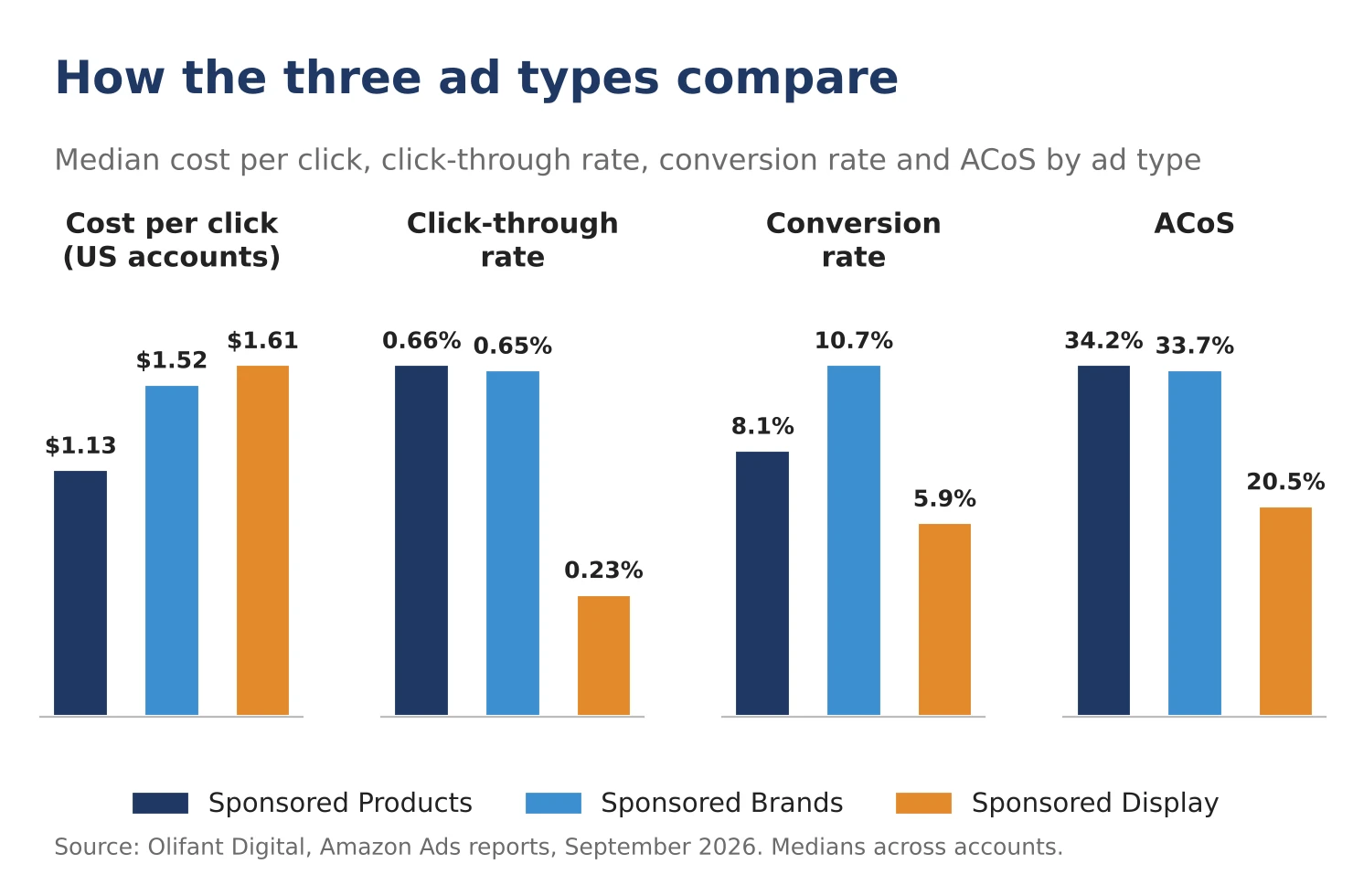
- Sponsored Brands clicks are costing more. In the US accounts, the median cost per click for Sponsored Brands was $1.52 in comparison with $1.13 for Sponsored Products. Sponsored Brands had the more expensive click in 19 of the 25 accounts that ran both.
- Sponsored Brands rarely beats Sponsored Products on ACoS. ACoS, or advertising cost of sales, is the amount you spend on ads out of your ad sales, and lower is better. Sponsored Brands had a lower ACoS in only 11 of the 30 accounts that ran both types of ads. Looking at the two by account, Sponsored Brands ACoS was a median 16% higher than that of Sponsored Products.
- Sponsored Brands is a new-customer engine. 87% of Sponsored Brands sales were from new-to-brand shoppers across 30 accounts. Among 17 accounts, that share was 78% for Sponsored Display.
- Sponsored Display is small and hard to read. Of 46 accounts, only 14 spent $100 or more on it. Where it did run, its reported ACoS was a low median of 21%. However, its CTR was lower than Sponsored Products in all 17 accounts that ran it, at about a third of the level at the median.
How do the three ad types compare on cost and results?
Every value in the table below is an account-level median. An account is counted for an ad type only if it spent $100 or more on that type in September. We only show cost per click for US dollar accounts so that we don’t get mixed up with different currencies.
In case you need it, here’s a quick guide to the metrics. Cost per click (CPC) is what you pay every time a customer clicks your ad. The click-through rate (CTR) is the percentage of shoppers who view the ad and click on it.
Conversion rate is the percentage of those clicks that actually result in an order, and ROAS, or return on ad spend, is how much in sales you get back for every dollar you spend.
| Metric (median) | Sponsored Products | Sponsored Brands | Sponsored Display |
|---|---|---|---|
| Accounts in sample | 66 | 30 | 17 |
| CPC (US accounts) | $1.13 (n=42) | $1.52 (n=25) | $1.61 (n=12) |
| Click-through rate | 0.66% | 0.65% | 0.23% |
| Conversion rate | 8.1% | 10.7% | 5.9% |
| ACoS | 34.2% | 33.7% | 20.5% |
| ROAS | 2.93 | 2.97 | 4.87 |
| New-to-brand share of sales | not reported | 86.8% | 77.6% |
At first glance, Sponsored Brands and Sponsored Products look pretty much the same on ACoS, and Sponsored Display looks like the clear winner.
We would be wary of that reading. The three columns don’t have the same set of accounts at all. Only part of the accounts run Sponsored Brands (30) and Sponsored Display (17), against 66 for Sponsored Products.
The ad types also count sales over different attribution windows, which we detail in the methodology section below. That is why we also compared the ad types of the same account in the next section.
Sponsored Products vs Sponsored Brands: which wins in the same account?
This is the fairest test we could make. We looked at those 30 accounts that spent $100+ on each ad type and compared Sponsored Brands vs Sponsored Products account by account.
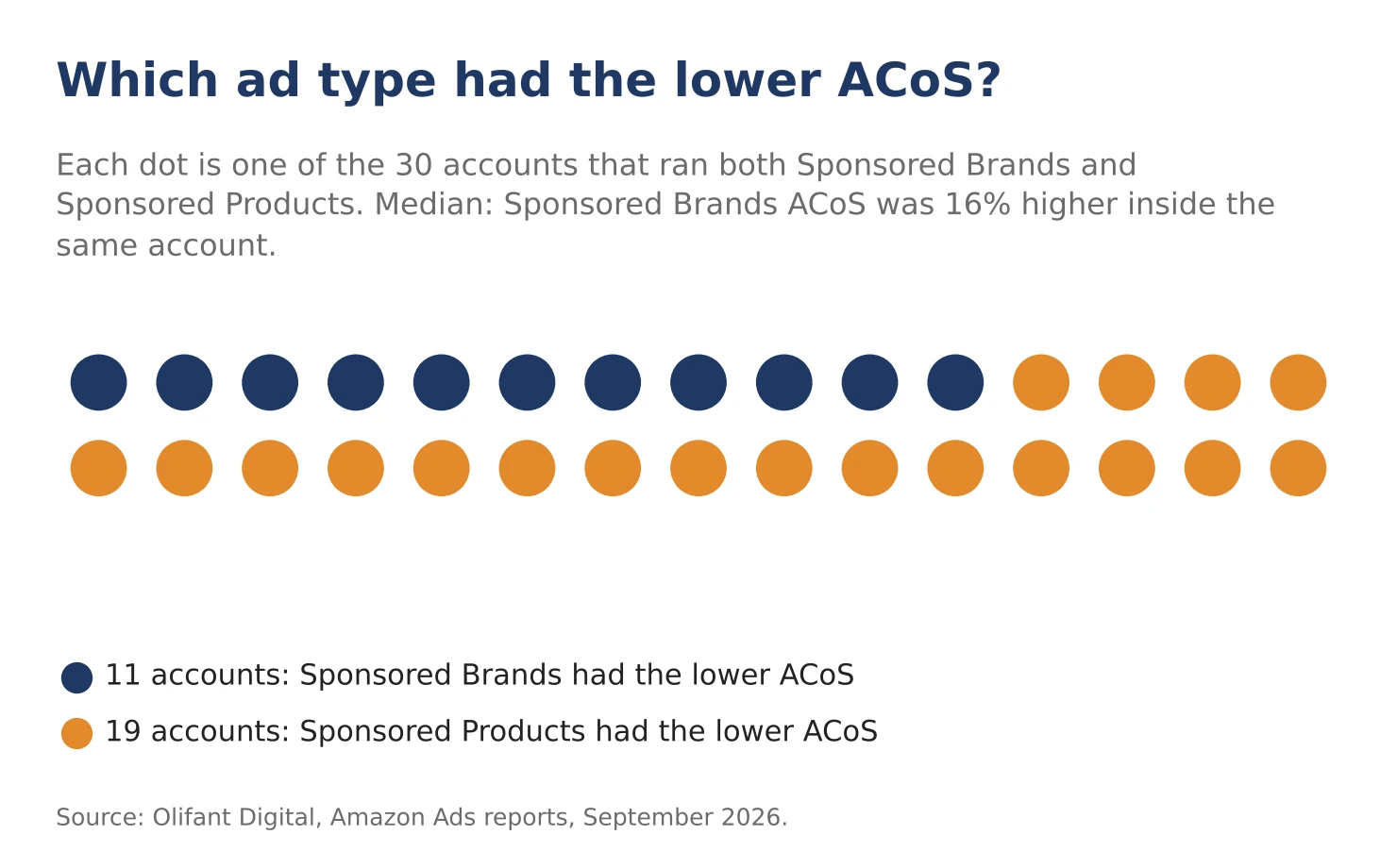
| Same-account comparison (SB vs SP) | Median ratio | SB better in |
|---|---|---|
| ACoS (n=30) | SB is 16% higher | 11 of 30 accounts |
| CPC, US accounts (n=25) | SB is 36% higher | 6 of 25 accounts |
| Conversion rate (n=30) | about equal | 15 of 30 accounts |
| Click-through rate (n=30) | about equal | 15 of 30 accounts |
To summarize, Sponsored Brands converts about as well as Sponsored Products when they’re run in the same account. You just pay more per click, so the ACoS is typically a bit higher.
That’s not to say Sponsored Brands is a bad buy. Half of its accounts were between 78% and 91%, with a median of 87% of sales from people who hadn’t bought from the brand in the last year. Sponsored Products doesn’t report any new-to-brand sales, so we can’t compare the two on this metric. But that’s a bigger percentage than any other ad type in our data.
We explain why this metric is important in our post on Amazon's new-to-brand strategy. If you’re interested in which Sponsored Brands format works best for acquiring new customers, our article on Sponsored Brands video and new-to-brand explains why video is often the winner.
Sponsored Brands vs Sponsored Display: which is the better second ad type?
For most of the brands we manage, the second ad type is Sponsored Brands. In September, 30 of the 46 accounts spent $100 or more on Sponsored Brands. Only 14 of 46 spent $100 or more on Sponsored Display, and of those 14, 13 ran all three ad types.
8 out of 13 accounts that were running had lower ACoS for Sponsored Display; however, it had a lower click-through rate than Sponsored Brands on 11 of the 13 accounts that we looked at, which is about a third as much.
Display ads will show up on product pages and on other sites that are outside of Amazon, where people are browsing rather than looking for something specific. Therefore, fewer of them click.
With low ACoS, there comes a warning label. With Sponsored Display, you can attribute a sale to an ad that a shopper saw but didn’t click, depending on how you set up your campaign. This can happen, for example, when your campaign is billed on viewable impressions.
This makes its reported ACoS look better than the real additional sales that it generates. We dive deeper into this type of question in our post on Amazon PPC incrementality.
So we read it as follows. Sponsored Display can be a valuable, low-cost follow-up for shoppers who already know you, but for most of the brands we manage it’s not where the next dollar should go.
How do brands split their budget across ad types?
For this part we used only the 46 accounts for which we had all three reports. In this case, a zero in the data actually means the account spent nothing on that ad type.
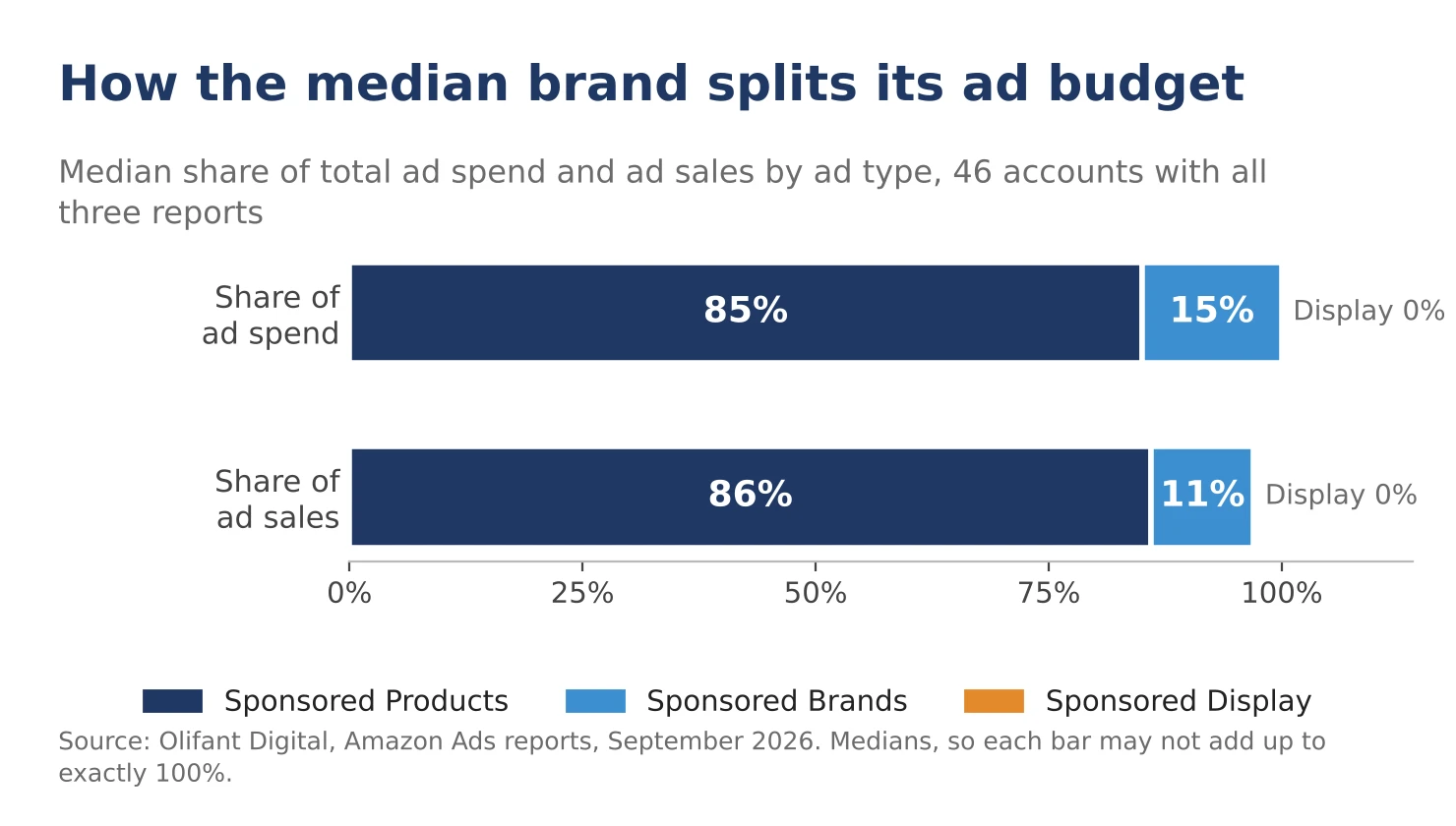
Two things are clear here. First, Sponsored Brands represented a larger share of spend (14.6%) than sales (10.7%), which is expected given their higher cost-per-click.
Second, the median account spent nothing on Sponsored Display, and even the top quarter of accounts spent less than 1% of their budget on it.
The overall median blended ACoS (for all 3 types of ads) was 33.3%.
Which ad type should you spend on?
This ranking is the order we would take based on what we see in our accounts.
1. Begin with Sponsored Products. Every account in our data runs it (we only included accounts with 200+ Sponsored Products clicks); it’s got the cheapest clicks and it’s bringing in most of the sales. If your Sponsored Products campaigns are not profitable yet, fix them before you add any other ad type. Our guide to Amazon PPC campaign structures is a great starting point.
2. Add Sponsored Brands when Sponsored Products is stable. Expect a slightly higher ACoS and more expensive clicks. And most of the sales will be from new customers in return. So judge it on new-to-brand sales and repeat purchases, not on ACoS alone.
3. Use Sponsored Display last, and test it with a small budget. Be cautious about its reported ACoS. Run it to retarget or protect your product pages and see if your overall sales actually change.
How much you spend on each type of ad depends on your margin and your goals. A growth-focused brand can afford a higher Sponsored Brands ACoS, while a profit-conscious brand should allocate the majority of its budget to Sponsored Products.
Either way, you need to know your break-even point first, and our post on what a good ACoS really is, walks you through that. For budget splits within Sponsored Products, check out our guide on Amazon PPC budget allocation.
If you want to dig deeper into a two-way comparison of when display ads make sense, we have a separate guide on Sponsored Products vs Sponsored Display.
What this means for your brand
If you're running only Sponsored Products, you're in excellent company. It’s 85% of spend for the median account we manage. Your next test should be Sponsored Brands, not Sponsored Display.
It’s common for your Sponsored Brands ACoS to be higher than your Sponsored Products ACoS. It was higher in 19 out of 30 of our accounts so take a look at the new-to-brand share before you decide to cut it.
If Sponsored Display is showing a great ACoS, check how many of those sales actually came from a click. A low click-through rate with a low ACoS is often a sign that the ad is receiving credit for views.
Look at the spread, not just the median. Sponsored Products ACoS in the middle half of accounts was between 22% and 49%. Your category and your margin matter much more than any average.
How we collected this data
- Source: Amazon Ads campaign reports for Sponsored Products, Sponsored Brands and Sponsored Display pulled with read-only access from the accounts we manage at Olifant Digital.
- Period: 1-30 September 2026.
- Sample: 66 accounts that had 200+ Sponsored Products clicks in September. 42 of these are US accounts; the rest of them are in the UK, Germany, France, Italy, Spain, Belgium, Sweden, Canada, Mexico and Australia.
- Thresholds: An account only counts for an ad type if it spends $100 or more on it in local currency. The conversion rate and CPC also need 30+ clicks. This leaves 66 Sponsored Product accounts, 30 Sponsored Brands accounts and 17 Sponsored Display accounts.
- Missing reports: Amazon throttled the Sponsored Brands report for 20 accounts. We took those out of the Sponsored Brands numbers and the budget split, so the split is based on 46 accounts.
- Medians, not averages: Every value is the median across accounts, so one big account cannot skew the result. The ranges indicate the middle half of accounts.
- CPC: US dollar accounts only.
- Attribution varies: For sellers, Amazon credits Sponsored Products sales within 7 days of a click, and Sponsored Brands and Sponsored Display sales within 14 days. Sponsored Display can also attribute views, and both of these make Sponsored Brands and Sponsored Display ACoS look better than Sponsored Products.
- Limitations: This is one month of data. The Sponsored Display sample of 17 accounts is small. Sponsored Products does not report new-to-brand sales and we don’t name any brands. You can see more of our data studies on our research page.
Chapter 1 of the Amazon PPC guide
PPC basics
- Is Amazon PPC Advertising Worth It: Data-Backed Truths Every Seller Needs Before Spending
- How long does it take for Amazon PPC to work: Key insights
- What Is a default bid In Amazon advertising explained
- What's a good ACoS on Amazon? The honest answer most articles won't give you
- TACoS vs ACoS: what each metric shows and which one your agency should report (2026)
- Amazon sponsored products vs sponsored display: When to use each
- Amazon sponsored products management: What it looks like today
Frequently asked questions
Is Sponsored Products or Sponsored Brands better on Amazon?
The two types of ads do different jobs, so neither one wins in every case. Sponsored Products is a better choice for effective sales from shoppers who are already seeking a product like yours.
Sponsored Brands is better for introducing your brand to new customers because the ad displays your logo and more than one product at a time.
Sponsored Brands had a higher ACoS in 19 of 30 accounts, but 87% of their sales were new-to-brand. Remember, sellers need to enroll their brand in Amazon Brand Registry before they can even run Sponsored Brands.
Do Sponsored Brands clicks cost more than Sponsored Products?
Yes, as a general rule. The median US Sponsored Brands CPC was $1.52 versus $1.13 for Sponsored Products and the more expensive click in 19 of the 25 accounts that ran both. We think placement is part of it.
The prominent Sponsored Brands slot is above the search results and there are fewer of these than Sponsored Products placements, with advertisers bidding more aggressively for them.
Is Sponsored Display worth it?
It can be worth it as a small add-on, but rarely as a main channel. Of the 46 accounts we have, only 14 spent $100+ on it. It had a low ACoS (21% median) but about a third of the click-through rate of Sponsored Products, and some of the sales may be from views.
If you want to test it, try one narrow campaign, such as retargeting shoppers who have viewed your product pages, and see if the total sales of those products actually increase.
How should I split my Amazon ad budget between ad types?
We find that most of the brands we manage spend around 85% on Sponsored Products and around 15% on Sponsored Brands and little or nothing on Sponsored Display. Take it as a guide, not as a rule.
If you have a new product launch, you’ll usually need more of a Sponsored Brands budget to get noticed. An established brand with strong reviews can lean harder on Sponsored Products.
We would look at the split monthly and compare it to new-to-brand sales and total sales, not just ACoS.
What is a good ACoS for Sponsored Brands?
The median Sponsored Brands ACoS in our accounts was 33.7%, with the middle 50% ranging from 28% to 57%. That range is wide because brands have very different goals with Sponsored Brands.
To determine your target, begin with your break-even ACoS, which is your profit margin before ad spend. Then figure out how far above break-even you’re willing to go to get a new customer, based on how often that customer returns to buy again.
Get a second opinion on your ad mix
Each account is different and the right split of ad types will depend on your margin and your goals.
If you’d like our team to look at how your Sponsored Products, Sponsored Brands and Sponsored Display budgets work together, get your free marketing plan from Olifant Digital and we will review your ad mix with you.

Alex is the founder and CEO of Olifant Digital, where his team manages over $100M in annual client revenue across 50+ brands on Amazon and ecommerce. He sets the agency's strategy and methodology, audits client accounts, and reviews the team's work to make sure every brand is on track to hit its growth and profitability goals. He also leads team training, so the performance data and lessons from across all accounts shape how every account manager runs their clients.



Mike reviews every Amazon article on this blog for strategic and technical accuracy before it publishes. As Director of Amazon Growth at Olifant Digital, he sets marketing strategy across client accounts and personally audits PPC at every stage of growth. He brings 8 years of daily Amazon operations across 7 and 8-figure brands including Beauty by Earth, Ekster, and Bullstrap, the kind of hands-on depth most agency directors delegate away.