

Introduction
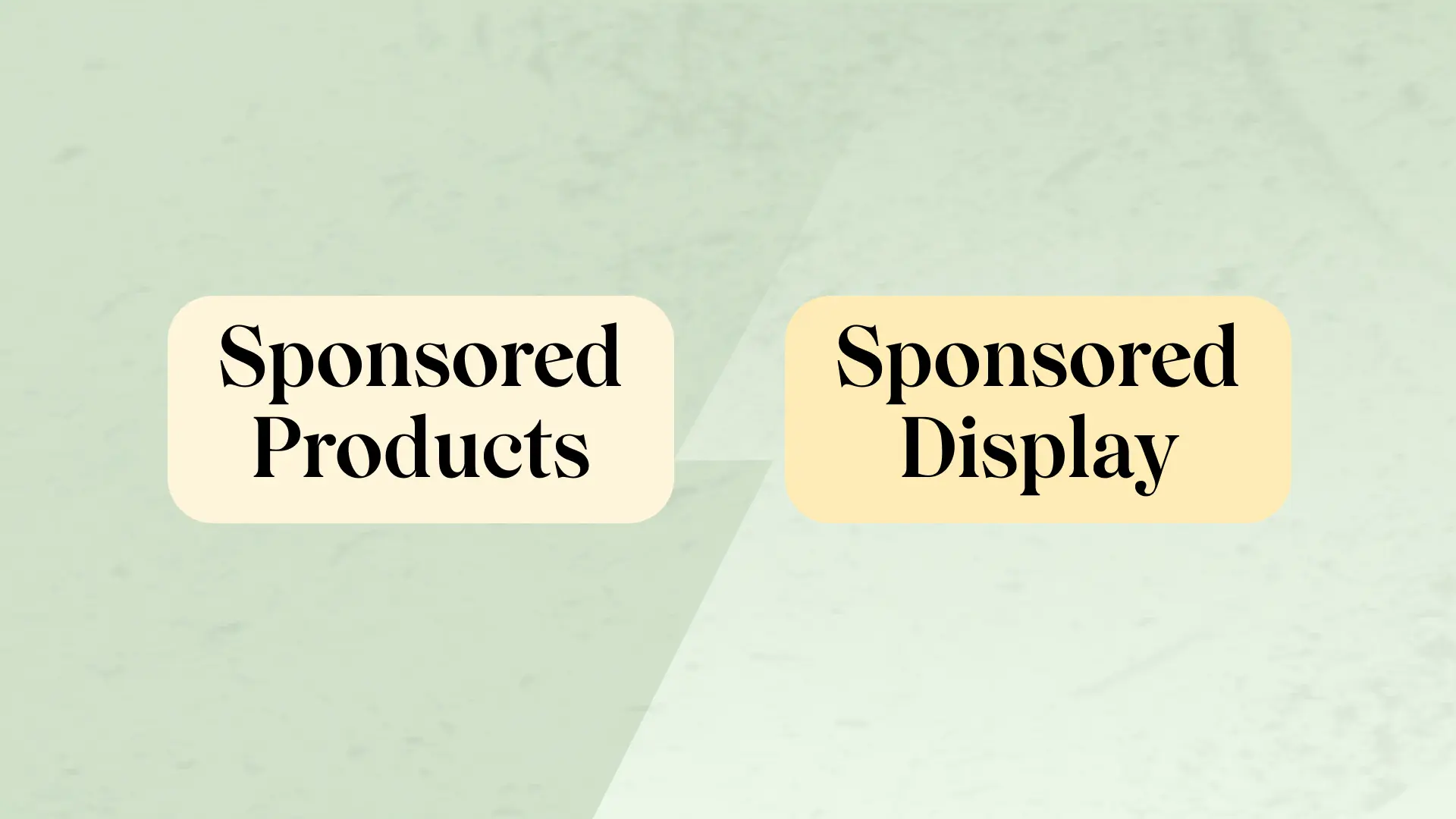
Sponsored Products targets shoppers who are searching on Amazon right now. By contrast, Sponsored Display targets shoppers who’ve already visited a product page and left without buying or who are shopping in a category, but not in the search phase yet.
They're not substitutes. Instead, when used correctly together they serve different buyer states in the same account.
When is each format right, when should they be combined, and when is neither right because the problem’s origin is elsewhere? This article explores all three, along with 2026 benchmarks and suggestions for budget allocation by growth stage.
How sponsored products and sponsored display differ
| Feature | Sponsored Products (SP) | Sponsored Display (SD) |
|---|---|---|
| Primary placement | Search results, product detail pages | Product detail pages, competitor pages, third-party sites and apps |
| Targeting method | Keywords, product and category targeting | Audiences (views, purchases, interests), product targeting |
| Funnel position | Bottom of the funnel (high purchase intent) | Mid-funnel (consideration, retargeting) |
| Cost model | CPC | CPC or vCPM |
| Brand Registry required | No | Yes, for audience targeting; product targeting available without |
| Best for | Capturing existing search demand | Retargeting, competitor conquesting, off-Amazon awareness |
Sponsored Products and Sponsored Display differ in three key ways. They target different stages of the buying journey, use different customer targeting methods, and appear in different placements.
Sponsored Products is keyword-driven. If a shopper searches for a stainless steel water bottle, for example, the ad shows up right in those results.
As such, it doesn’t create demand, but captures it. That’s bottom-of-the-funnel, high-intent traffic and the heart of every profitable Amazon PPC account.
By contrast, Sponsored Display is behavior- and audience-driven. It targets shoppers based on their browsing, purchasing, or engagement activity across Amazon product pages and third-party websites and apps. This is middle-of-the-funnel territory, which includes consideration, retargeting, and brand building.
Sponsored Products: The active intent engine
How Sponsored Products works: Placement, targeting, and mechanics
Sponsored Products ads appear in Amazon's search results and on product detail pages. Such placements cover the top of the search, the middle, and the rest of the search positions, reaching the buyer at the moment they’re actively comparing options.
There are two targeting types: keyword targeting (which includes exact, phrase, and broad), and product and ASIN targeting.
Keyword targeting captures the buyer at the moment they search for a specific product in that category, while product and ASIN targeting places the ad on competitor product pages and reaches buyers who are already in comparison mode.
The search query is the intent signal, because the buyer has told Amazon what they want. Sponsored Products intercepts them at the exact moment, making it a great format for conversion.
Attribution is last-click and advertising cost of sales (ACoS) is measurable at the campaign, keyword, and ASIN levels.
Sponsored Products is available to all Professional plan accounts in Seller Central. No video creative or Brand Registry is needed.
When to use sponsored products
Sponsored Products is the main foundation behind every profitable Amazon PPC account. It should get the majority of the advertising budget in these three main scenarios:
Launching a new product
When you launch a new product, Sponsored Products can generate the initial velocity for a new ASIN that has no sales history and organic rank.
The right approach starts with automatic campaigns, which will allow Amazon's algorithm to figure out which search terms convert. The Search Term report shows you the terms that are generating orders at or below your target ACoS after seven to 14 days.
Next, the search terms that convert are moved into exact-match campaigns and another separate Sponsored Products campaign targets competitor ASINs and runs at the same time. It’s what puts the product on the competitor's detailed pages the moment the shopper compares the options.
During that period, we regard an ACoS of 25 to 40% as normal, as the goal is to get reviews, not profit.
Defending market share
A product that appears on the first page of organic searches still needs Sponsored Products to stay there. This is because competitors will bid on branded keywords for similar products and will appear on high-traffic listings.
The exact-match campaigns on branded keywords are what grab that high-intent traffic at a low ACoS (usually between five and 15% based on what we’ve seen) because shoppers already know what they want.
For product campaigns, we target the top 10 to 20 competitor listings and intercept their traffic by showing our product as an alternative on the competitor detail pages. The best placement on the page is protected with placement bid adjustments that increase Top of Search bids by 25 to 50% on core exact-match keywords, based on our experience.
For existing products, we set the target ACoS to range between 15 and 25%.
Clearing excess inventory
Long-term storage fees shift the objective from margin to movement. In this scenario, Sponsored Products is one of the most effective tools to clear the inventory, because it reaches shoppers who are actively looking to buy.
High-volume broad and phrase-match keywords expand your reach. A coupon of 10 to 15%, along with Sponsored Products visibility, is what lifts the click-through rate (CTR) and drives urgency at the point of decision.
When sponsored display is the right format
Sponsored Display is the engine of growth because it reaches those shoppers that Sponsored Products don't reach like those who browsed but didn't buy.
Sponsored Display is worth its budget in these three ways:
Retargeting window shoppers
When a shopper lands on a product page, reads the bullets but leaves without buying, Sponsored Display targets those shoppers for up to 30 days after the first visit.
This group is an audience that’s already interested in the product and doesn’t need another introduction. Instead, they require a second interaction.
Conquesting competitor listings
Sponsored Display products allow you to advertise directly on competitor detail pages. The ad appears as an alternative on a competitor's listing, right when the shopper is browsing.
Sponsored Display works best when there’s a perceivable benefit, such as a lower price, more reviews, or a better value package. If the advertised product doesn’t win by a clear margin, the shopper will compare and stay with the original listing.
We’ve found that strategic conquesting works best when you focus on 10 to 15 specific ASINs where you can quantify the advantage you’ll get, not the top 100 listings in the category. This is why you need to conduct a weekly performance check to remove ASINs that are poorly performing.
Building awareness off Amazon
Sponsored Display also doubles up as a self-serve format that can extend reach off Amazon through the Amazon Ads network, with off-Amazon placement as one of its modes.
It reaches websites, apps, and platforms through the Amazon Ads network and uses Amazon audience data to target. For instance, a shopper who looked at a category on Amazon yesterday sees the product today while reading a blog post.
Typically, Sponsored Display placements that are off-Amazon will have a lower ROAS than on-Amazon placements. This is what we expect, because our aim is awareness, not immediate conversion.
These campaigns should be evaluated on new-to-brand (NTB) metrics and assisted conversions, not last-click ROAS.
They’re best for new product launches, seasonal campaigns where you want to build awareness ahead of peak demand, and categories with long purchase cycles like furniture, electronics, or specialty equipment.
When neither works
There are cases where neither Sponsored Products nor Sponsored Display will generate a positive ROI, no matter how well the campaigns are managed. In those circumstances, not only does spending not work, but it worsens the underlying problem.
The listing isn’t ready
Ads only amplify what’s already there. If a page doesn't convert, it's usually because it has poor main images, thin bullet points, no A+ Content, and fewer than 15 reviews.
If the listing is converting at 5% versus a category average of 12 to 15% and the average CPC is $1.20, the cost per sale generated by the ads is $24 before we even consider COGS, FBA fees, and referral fees. At that conversion rate, paid traffic is expensive before you've even added a single unit cost.
You need to have professional photography ready, benefit-driven bullet points written, A+ Content created, and at least 15 to 20 reviews from either organic sales or the Vine program before you can even start any paid campaigns.
PPC on a poor listing doesn't just waste money. It also trains Amazon’s algorithm on a low-converting ASIN, which means future advertising is more expensive.
The margins can’t support it
Calculating break-even ACoS is important before you launch any campaign. This is the percentage of the sales price which is the product margin. For example, if a product costs $15 and sells for $25, the margin is $10 and the break-even ACoS is 40%.
Sponsored Products’ average ACoS is 20 to 35%, depending on your margin. If you’re running a product with a margin of less than 15%, you’ll lose money on paid advertising regardless of how well the campaigns are run. In this case, improving unit economics (either through supplier negotiations or price adjustments) or moving to a higher-margin product is always a top priority.
The Buy Box isn’t owned
Sponsored Products requires eligibility for the Buy Box. If you lose the Buy Box to other sellers, your Sponsored Product ads won’t run. If the Buy Box ownership you see in the Seller Central Business Reports is less than 90%, our recommendation is first to determine why before you start investing money into Sponsored Products campaigns.
Some solutions include:
- Matching the lowest FBA price
- Having clean account health metrics
- Switching from FBM to FBA
Sponsored Display doesn't require a Buy Box for all placements, but conversions still suffer when another seller wins it.
Category economics don’t support PPC
There are some Amazon categories where CPC is over $3.00 and the conversion rate is under 8%. At those numbers, the cost per acquisition is over $37 without even adding COGS, FBA fees, or referral fees.
Given the tight category economics, the better route is organic ranking via SEO-optimized listings and external traffic via social media.
First build organic velocity, then test PPC at small budgets if the math supports conversion rates.
How sponsored products and sponsored display work together
SSponsored Display first introduces the brand. A shopper scrolling a competitor listing sees a Sponsored Display product targeting ad and clicks through but doesn’t buy.
Days later, the Sponsored Display retargeting campaign displays the product on a third-party site the shopper visits.
The shopper then searches for the category on Amazon. The exact-match campaign for Sponsored Products wins the top-of-search placement. The shopper sees the brand from the previous impression, clicks, and converts.
You can see the conversion in the Sponsored Products campaign metrics, but the sequence started with Sponsored Display.
The two formats also feed into one another for intelligence targeting. Search Term reports for Sponsored Products tell you the exact words your high-converting customers use.
Sponsored Display audience campaigns target shoppers with similar behavior who haven’t yet searched by keyword. Sponsored Display impression data also provides new audience segments to help inform Sponsored Products’ keyword strategy.
Our analysis shows that managing Sponsored Products and Sponsored Display together on a weekly basis, and linking them, works better than running them as stand-alone campaigns with individual performance targets.
How Olifant Digital structures Sponsored Products and Sponsored Display across managed accounts
As a full-service Amazon agency managing over $100M in annual client revenue across 50+ accounts (with every account handled by senior account managers with 7+ years’ experience), this is how and when we use Sponsored Products and Sponsored Display.
Sponsored Products is what builds the traffic, the review velocity, and the organic ranking that make Sponsored Display retargeting worth running. As such, if you run Sponsored Display without first having an established Sponsored Products foundation, it’s like setting up a remarketing campaign before the brand has any organic awareness.
Sponsored Display serves as a retargeting layer once Sponsored Products campaigns have built enough audience data. For a new ASIN, this period typically means after 60 days of Sponsored Products operation.The kind of targeting we choose depends on the commercial goal. For example:
- To maximize profit, we use retargeting views with a low CPM.
- Competitor ASIN targeting is used for market share capture.
- We use purchase retargeting for CPG repeat-purchase accounts to drive Subscribe & Save conversions.
However, before any format is considered, we first run every managed account with our 1-1-1-1 method. We also first check the conversion rate against the category median and review count against competitors. Then, if needed, the listing is fixed and reviews are built first.
The skincare brand Onsen Secret is a textbook example of what can go wrong when Sponsored Display is used on ASINs that haven’t yet built up organic traffic driven by Sponsored Products. In this case, the retargeting audience was too small to justify the CPM spend.
The shift to TACoS-first reporting showed that Sponsored Display spend on low-traffic ASINs wasn’t producing significant return. We rationalized Sponsored Display to the mature, high-traffic ASINs and focused Sponsored Products on the growth ASINs. The result was that profit tripled and $95,934 added in monthly Amazon revenue.
Budget allocation by growth stage
| Growth stage | Sponsored Products | Sponsored Brands | Sponsored Display | Notes |
|---|---|---|---|---|
| New (0-6 months) | 95% | 5% | 0% | Focus entirely on SP to build rank and sales history. SB for branded headline only. |
| Growing (6-18 months) | 85% | 14% | 1% | Begin small SD retargeting tests once SP campaigns are profitable. |
| Established (18-36 months) | 65-70% | 15-20% | 10-15% | SD earns real budget for retargeting and conquesting. SB scales with video ads. |
| Mature (36+ months) | 55-60% | 20-25% | 15-20% | Full-funnel coverage. Consider Amazon DSP for programmatic at scale. |
As your Amazon business matures, the optimal combination of Sponsored Products, Sponsored Brands, and Sponsored Display will evolve. The following numbers are based on observed ranges across our managed accounts.
Sponsored Display testing begins only after Sponsored Products campaigns are profitable and stable.
If Sponsored Products isn’t generating a positive ROAS, adding Sponsored Display spreads budget across a less efficient channel without addressing the underlying problem.
For established and mature brands, the shift toward Sponsored Display makes sense when:
- Sponsored Products campaigns hit diminishing returns on core keywords.
- Detail page traffic is high, but conversion rate indicates many shoppers are leaving without buying.
- Specific competitor ASINs with a measurable price, review, or value advantage were identified.
2026 benchmarks at a glance
| Metric | Sponsored Products | Sponsored Display |
|---|---|---|
| Average CPC | $0.75-$2.50 | Highly variable based on audience competition |
| Average ACoS | 20-35% | 30-50% |
| Average CTR | 0.3-0.6% | 0.1-0.3% |
| Average CVR | 10-15% | 5-10% |
To help you with your PPC campaigns, here are benchmarks for Sponsored Products and Sponsored Display:
If ACoS is running way higher than the category average, it’s usually the listing conversion rate that’s the problem, not the bidding strategy. This is why before changing the bids, you need to review the images, bullets and A+ Content.
Final thoughts
Sponsored Products is the core of any profitable Amazon PPC account. It captures high intent search demand, drives organic ranking, and produces predictable ROAS. This is where every account builds its PPC structure first.
The expansion tool is Sponsored Display. It retargets shoppers who viewed a product page but didn’t buy, takes over competitor listings, and builds brand awareness outside of Amazon search results. It receives its budget allocation when Sponsored Products campaigns are profitable and steady.
That said, neither ad type substitutes a strong listing. With weak images, thin bullets, low review counts, and margins that can’t absorb average CPCs, PPC only worsens the problem. That's why the brands that win in 2026 aren’t the ones that spend the most money on ads. They’re the ones choosing the right ad type for the appropriate growth stage, using a listing that converts the traffic for which they paid.
If you want a custom PPC strategy tailored to your specific products, margins and growth objectives, get a free marketing plan from Olifant Digital. We’ll build a strategy that works for you. If you’re not happy in the first 60 days, our 60-day money-back guarantee refunds your management fees.
Frequently asked questions
Can sponsored products and sponsored display run simultaneously?
Yes. For established brands, it’s recommended to run Sponsored Products and Sponsored Display at the same time. This is because they target different buying stages and don’t compete for the same impressions. Sponsored Products captures the bottom-of-the-funnel search demand, whereas Sponsored Display is for mid-funnel retargeting, competitor conquesting, and off-Amazon awareness.
Is brand registry required for sponsored display?
Yes, you must have Brand Registry to reach the Sponsored Display audience.
Is sponsored display worth it for smaller sellers?
Sponsored Display delivers consistent results once Sponsored Products campaigns are profitable and you have enough traffic on your detail pages to build a significant retargeting audience. Sponsored Display doesn’t work reliably with a product listing with fewer than 500 sessions a month as a retargeting pool, based on our findings. Once monthly sessions exceed 1,000 and the Sponsored Products ROAS remains steady, we’ve found allocating 1 to 5% of the budget to Sponsored Display retargeting is a reasonable starting point.
.webp)
Alex is the founder and CEO of Olifant Digital, where his team manages over $100M in annual client revenue across 50+ e-commerce brands. He sets the agency's strategy and methodology, audits client accounts, and reviews the team's work to make sure every brand is on track to hit its growth and profitability goals. He also leads team training, so the performance data and lessons from across all accounts shape how every account manager runs their clients.


.png)
Mike reviews every Amazon article on this blog for strategic and technical accuracy before it publishes. As Director of Amazon Growth at Olifant Digital, he sets marketing strategy across client accounts and personally audits PPC at every stage of growth. He brings 8 years of daily Amazon operations across 7 and 8-figure brands including Beauty by Earth, Ekster, and Bullstrap, the kind of hands-on depth most agency directors delegate away.