Introduction
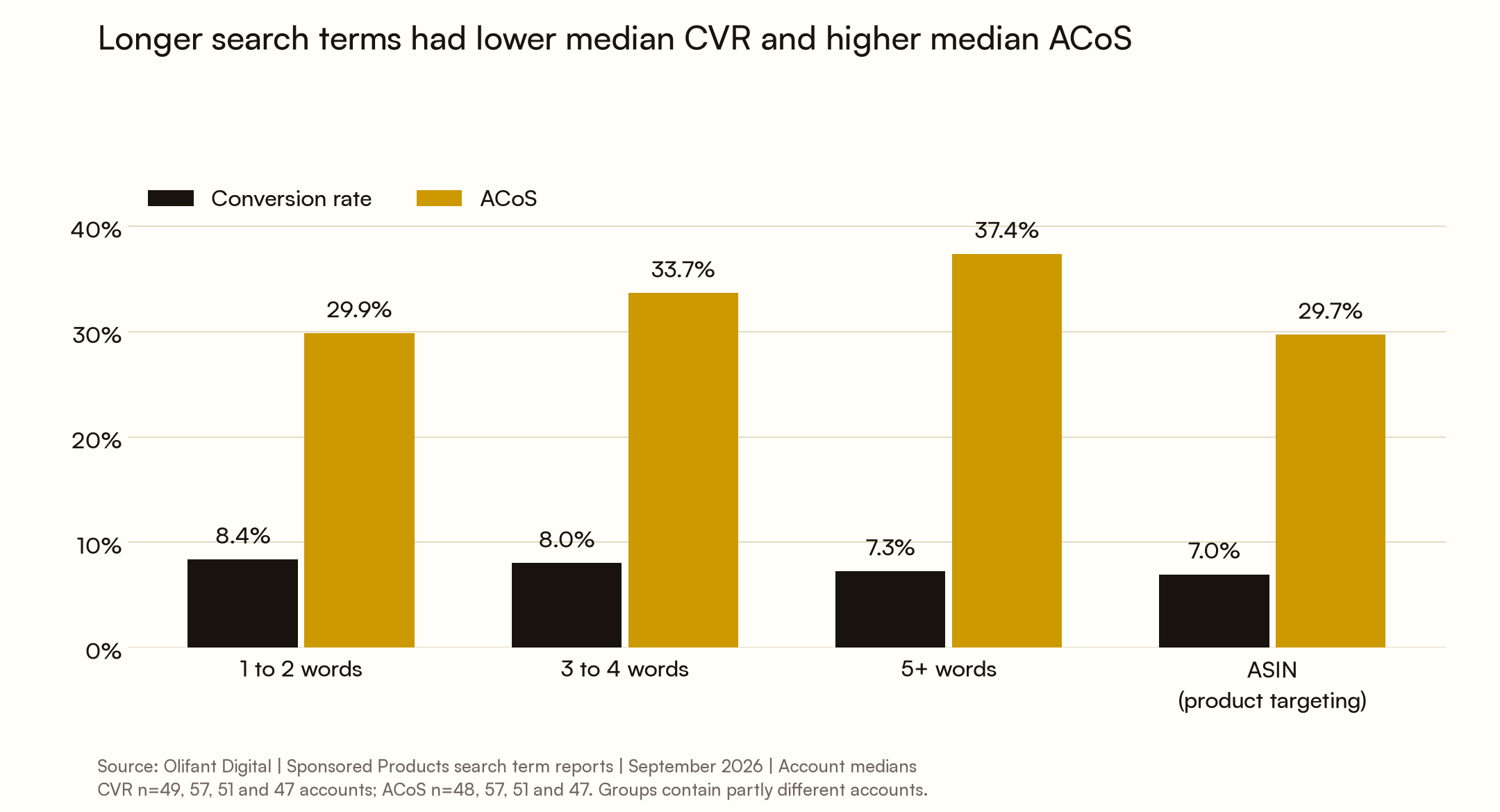
Longer Amazon searches did not consistently convert better in our September 2026 Sponsored Products data. Across eligible account groups, median conversion rates were 8.4% for 1 to 2 word terms, 8.0% for 3 to 4 word terms and 7.3% for terms with 5 or more words. Within the 44 accounts with enough clicks in both the shortest and longest groups, longer terms converted worse in 23 and did not convert worse in 21. Search term length alone is therefore a weak rule for choosing bids or budgets.
The longest terms also had the highest median ACoS of the three length groups (37.4%). In our US accounts, their median cost per click was $1.23, compared with $0.99 for the shortest terms. To get these numbers, we analyzed one month of Sponsored Products search term reports from 58 Amazon ad accounts. These accounts belong to 44 brands and sell in 9 marketplaces.
We grouped every search term by its number of words. Then we compared conversion rate, ACoS, cost per click and share of spend for each group.
You have probably heard that long-tail keywords are cheaper on Amazon and that they convert better than short ones. In the accounts we manage, longer searches gave no reliable advantage on either measure. Keep one thing in mind as you read: we measure the number of words in a search, and that does not tell us how rarely a term is searched.
Longer terms are still useful, and the sections below show where they help.
Key findings
- Longer terms did not convert better. The median conversion rate was 8.4% for 1 to 2 word terms, 8.0% for 3 to 4 words and 7.3% for 5+ words.
- Inside the same account, the result was close to even. In the 44 accounts with enough clicks in both groups, 5+ word terms converted worse than 1 to 2 word terms in 23 and better in 21. The median ratio of long to short conversion rate was 0.96.
- Longer terms had a higher median ACoS. Median ACoS was 29.9% for 1 to 2 word terms, 33.7% for 3 to 4 words and 37.4% for 5+ words. In the same-account comparison, the longer group had the higher ACoS in 28 of 43 accounts.
- Clicks on longer terms were not cheaper. In our US accounts, the median cost per click was $0.99 for 1 to 2 word terms and $1.23 for 5+ word terms. Across all marketplaces, the longer group had the higher cost per click in 31 of 44 accounts.
- 3 to 4 word terms had the largest share of spend and orders. They received a median 42.6% of ad spend and 42.1% of ad orders.
- Estimated non-branded searches were close to parity inside accounts. Median conversion rates were 6.4%, 5.4% and 4.5% from the shortest to the longest group. In the same-account comparison, the median ratio of long to short conversion rate was 0.99.
Do long-tail keywords convert better on Amazon?
In the accounts we manage, longer searches did not convert better as a rule. We split search terms into three groups by word count: 1 to 2 words, 3 to 4 words, and 5 or more words. ASIN searches that came through product targeting sit in their own row, because they are product codes and nobody typed them as words.
For every account, we added up the clicks, orders, spend and sales in each group. Then we took the median across accounts, so that one large account could not pull the whole result in its direction.
A group counted for an account only if it had at least 100 clicks. This is why the number of accounts changes from row to row in the table below.
| Search term length | Accounts (n) | Conversion rate | ACoS | CPC vs account average |
|---|---|---|---|---|
| 1 to 2 words | 49 | 8.4% | 29.9% | 1.02x |
| 3 to 4 words | 57 | 8.0% | 33.7% | 1.03x |
| 5+ words | 51 | 7.3% | 37.4% | 1.06x |
| ASIN (product targeting) | 47 | 7.0% | 29.7% | 0.84x |
Sample sizes: the accounts column applies to conversion rate and cost per click. ACoS is undefined when a group has no attributed sales, so the 1 to 2 word ACoS median uses 48 accounts. The other ACoS medians use the same accounts as conversion rate.
The length groups contain partly different accounts, so the medians above do not compare like with like. A stricter test compares short and long terms inside the same account.
We ran that test on the 44 accounts with at least 100 clicks in both the 1 to 2 word group and the 5+ word group. Terms with 5+ words converted worse in 23 accounts and better in 21. The median ratio of long to short conversion rate was 0.96, so the typical gap inside an account was small.
The fair reading is that longer searches do not convert better as a rule. In about half of the accounts they converted worse, and in the other half they converted better.
Are long-tail keywords cheaper on Amazon?
In our data, clicks on longer searches were not cheaper. The usual thinking is that fewer advertisers bid on long phrases, so those clicks should cost less. In our US accounts, the median cost per click went up with search length.
| Search term length | US accounts (n) | Median CPC (USD) | CPC vs account average (all marketplaces) |
|---|---|---|---|
| 1 to 2 words | 34 | $0.99 | 1.02x |
| 3 to 4 words | 40 | $1.12 | 1.03x |
| 5+ words | 37 | $1.23 | 1.06x |
The same-account comparison points the same way. Across all marketplaces, 5+ word terms had a higher cost per click than 1 to 2 word terms in 31 of 44 accounts. The median ratio of long to short cost per click was 1.07.
ACoS moved in the same direction. In the 43 accounts where both groups had attributed sales, the 5+ word group had the higher ACoS in 28. ACoS is ad spend divided by attributed revenue, so it also depends on order value. It is a different measure from cost per order.
This study does not show why longer searches cost this much. Search term reports show what shoppers typed and what each click cost. They do not show how many advertisers competed for each search.
Where does the ad budget actually go?
The largest share of spend and orders sat in the middle, with 3 to 4 word terms. A search such as “insulated water bottle kids” or “phone case with stand” would fall into this group.
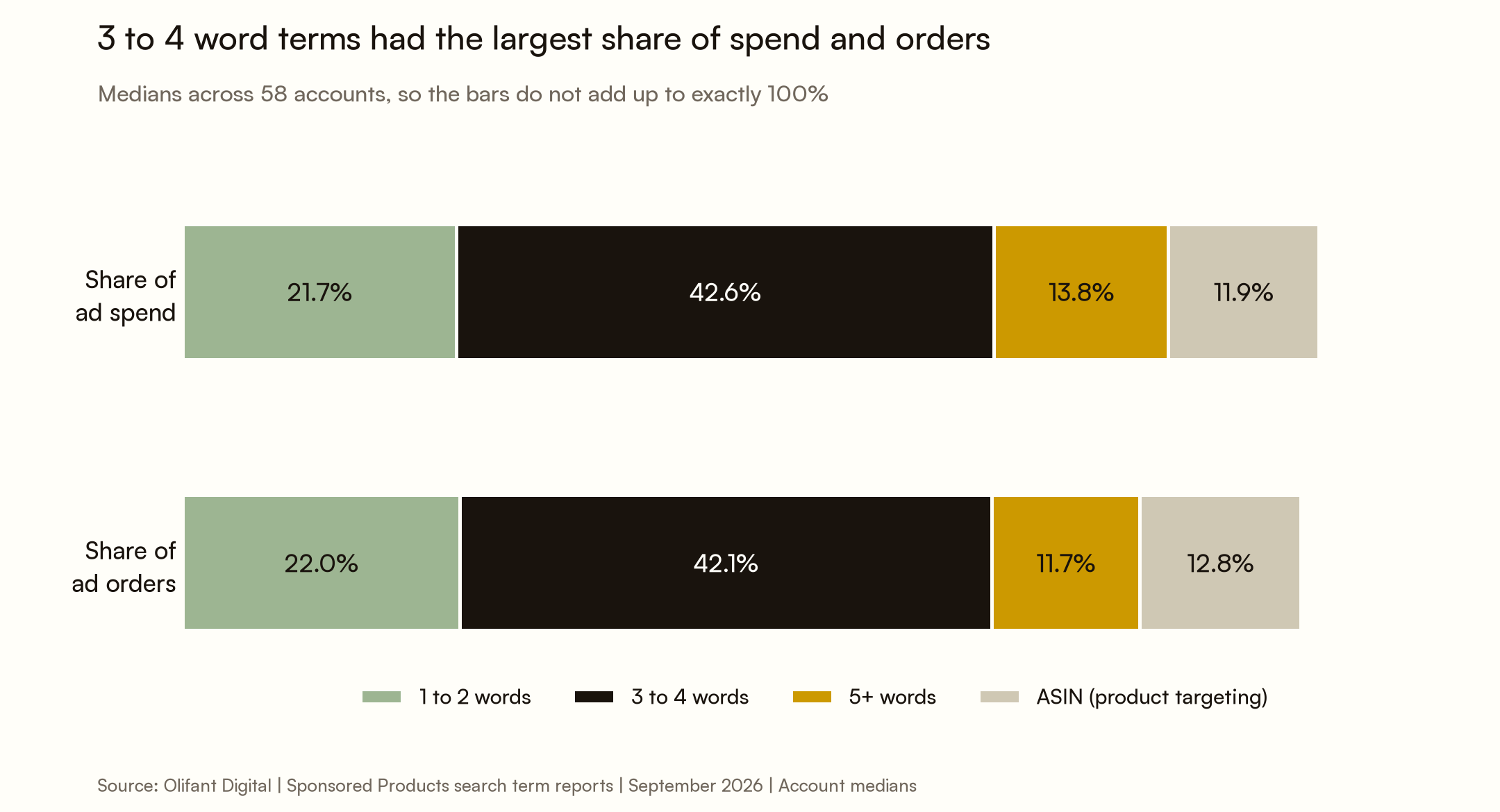
| Search term length | Share of unique search terms | Share of clicks | Share of spend | Share of orders |
|---|---|---|---|---|
| 1 to 2 words | 12.1% | 21.2% | 21.7% | 22.0% |
| 3 to 4 words | 44.2% | 41.1% | 42.6% | 42.1% |
| 5+ words | 23.1% | 11.9% | 13.8% | 11.7% |
| ASIN (product targeting) | 15.2% | 15.2% | 11.9% | 12.8% |
Each share is a median across all 58 accounts, so the columns do not add up to exactly 100%. A unique search term is counted once per account. Clicks, spend and orders include every report row.
Terms with 5+ words made up a median 23.1% of unique search terms and 11.9% of clicks. Many different long searches brought a small number of clicks each. These shares describe where spend went in September. They are an observation, and you should set your own budget split from your own results.
Does branded search change the result?
Brand searches matter here because they behave very differently from other searches. In our data, estimated branded terms converted at a median of 11.0%, compared with 5.1% for estimated non-branded terms. They were also more common among short searches.
If many short terms are brand terms, that could explain part of the higher conversion rate of short terms. So we estimated which searches were branded.
We marked a term as branded if it contained a word from the account’s brand name or a known alias. This is a simple text match. It can miss misspellings and product line names, and it can wrongly tag a generic search that happens to contain a brand word. Please read the branded and non-branded figures as estimates. The match found at least 30 branded clicks in 40 accounts, and the brand analysis uses those accounts.
In these accounts, estimated branded terms made up a median 39% of the clicks on 1 to 2 word searches, 25% on 3 to 4 word searches and 18% on 5+ word searches. Short terms carried more brand traffic.
| Group (40 accounts) | Accounts (n) | Conversion rate | ACoS | Share of spend | Share of orders |
|---|---|---|---|---|---|
| Estimated branded terms | 36 | 11.0% | 16.7% | 26.1% | 43.3% |
| Estimated non-branded terms | 38 | 5.1% | 52.1% | 73.9% | 56.7% |
Shares are medians across the 40 accounts and leave out ASIN searches.
After that, we ran the same length test on estimated non-branded searches only.
| Estimated non-branded search term length | Accounts (n) | Conversion rate | ACoS |
|---|---|---|---|
| 1 to 2 words | 32 | 6.4% | 48.0% |
| 3 to 4 words | 36 | 5.4% | 49.5% |
| 5+ words | 30 | 4.5% | 53.6% |
The group medians still go down as terms get longer: 6.4%, 5.4% and 4.5%. These rows again contain partly different accounts. Inside the 27 accounts with enough non-branded clicks in both the shortest and the longest group, 5+ word terms converted worse in 14 and better in 13. The median ratio of long to short conversion rate was 0.99, which is close to parity.
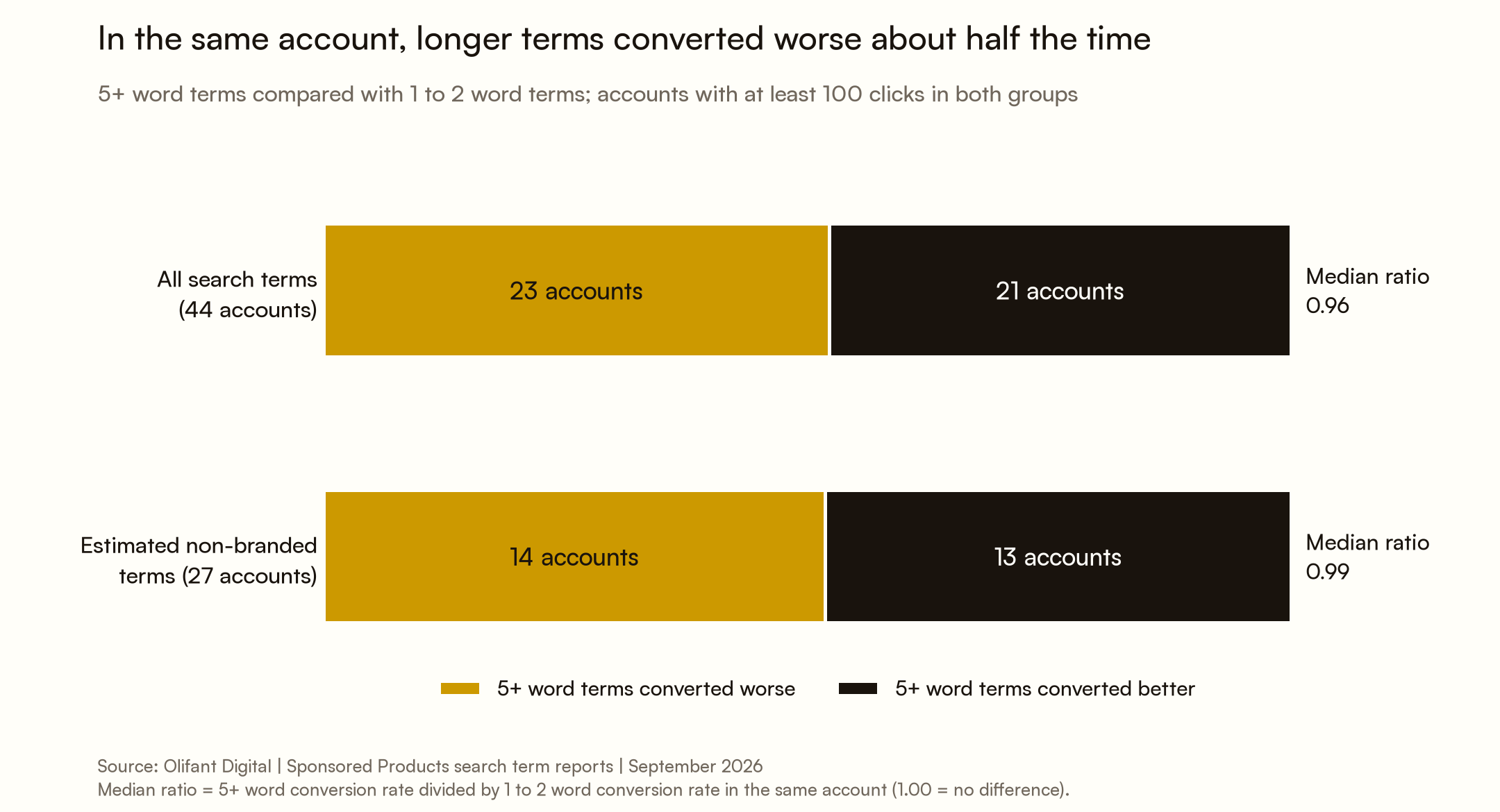
ACoS leaned the same way as before. The longer non-branded group had the higher ACoS in 16 of those 27 accounts.
Taking out the estimated brand terms did not give longer searches an advantage. Inside a typical account, short and long non-branded terms converted at close to the same rate.
Is a longer search the same as a long-tail keyword?
Not exactly. “Long tail” usually describes searches with low search volume. We grouped terms by word count, which is a proxy for length. A 5-word search can be popular, and a 2-word search can be rare.
The idea that long-tail terms convert better is common in search marketing advice, where a longer phrase is often read as a sign of a more specific need. Our data can test one narrow version of that idea: whether searches with more words converted better or cost less in Sponsored Products. In September 2026, in the accounts we manage, they did not do either consistently.
This study did not measure why. We did not look at search volume, shopper intent, match types or how closely each product matched the search. Those questions need a separate analysis.
What this means for your brand
Longer search terms are still useful when you judge them on their own results.
- Do not expect longer terms to be cheaper. In our data, clicks on 5+ word terms did not cost less, and their median ACoS was the highest of the three length groups. Set each bid from the term’s own conversion rate and your margin.
- Use converting long searches as product research. When a long search converts, it shows you which feature, size or use case a shopper asked for. You can add those words to your listing and to your exact match campaigns, and our guide to Amazon keyword harvesting shows you how to do it.
- Judge terms by their own numbers. Longer terms converted worse in about half of the accounts and better in the other half. Go through your search term report by length and keep what works for your products.
- Review terms that spend without orders before you exclude them. Check whether the search fits your product, how many clicks it has had, and the conversion rate you need at your margin. Add a negative keyword when the search clearly does not fit your product.
- Split brand and non-brand terms before you judge anything. Estimated brand terms had a median ACoS of 16.7%, compared with 52.1% for estimated non-brand terms. When the two are mixed, the blended number hides how each one performs. Our articles on what ACoS means and how to reduce ACoS go into this in more detail.
- Include 3 to 4 word phrases in your keyword research. They carried the largest share of spend and orders in our accounts. That share shows where spend went, so test these phrases against your own targets. Our Amazon keyword research guide walks you through finding them, and our article on how many keywords to put in a campaign helps you set them up.
For more original data, see our Amazon Top of Search placement benchmarks and the other studies in our research library.
How we collected this data
- Source: Amazon Sponsored Products search term reports from the Amazon Ads accounts Olifant Digital manages. Sales and orders use Amazon’s 7-day attribution.
- Period: September 1 to 30, 2026. This is one month of data. Prime Big Deal Days, on October 6 and 7, 2026, falls outside it.
- Sample: 66 accounts had search term data. We left out 8 accounts with fewer than 500 ad clicks in the month, which leaves 58 accounts from 44 brands. Some brands run several regional accounts.
- Marketplaces: US (40 accounts), UK, Germany, France, Spain, Italy, Canada, Mexico and Australia.
- Length group: We group searches by whitespace-separated word count, which is a proxy for query length rather than a measure of how rarely a term is searched. ASIN searches from product targeting are shown separately.
- Thresholds: A length group counts for an account only when it has at least 100 clicks, so n changes by row. The brand analysis uses accounts with at least 30 estimated branded clicks.
- Medians: We calculate each metric inside each account and then take the median across accounts, so one large account cannot change the result on its own. Share columns are medians too, so they do not add up to exactly 100%.
- Metric eligibility: ACoS medians exclude groups with no attributed sales; CVR includes them. The 1 to 2 word row therefore uses 49 accounts for conversion rate and 48 for ACoS.
- Same-account comparisons: These use accounts with at least 100 clicks in both the 1 to 2 word group and the 5+ word group: 44 accounts for all terms and 27 for estimated non-branded terms. Each ratio divides the 5+ word value by the 1 to 2 word value inside the account. One account had no attributed orders in its 1 to 2 word group, so the all-terms conversion ratio and ACoS comparison use 43 accounts.
- Unique search terms: Each distinct search term is counted once per account. Clicks, spend and orders add up every report row, including a term that appears under several campaigns or targets.
- Branded searches: Branded-search estimates use account-name tokens and selected aliases, so classification is imperfect. The non-branded group can contain missed brand searches, and the branded group can contain generic searches.
- Click-through rate: We do not report click-through rate by length. Search term reports mostly list searches that received at least one click, so the impressions of searches with no clicks are missing. A click-through rate built from them would be overstated, most of all for rare searches.
- Currencies: Dollar CPC uses US accounts only. Cost comparisons across marketplaces use each account’s own average as the base, or ratios inside the account.
- Limitations: This study covers one month of data and Sponsored Products campaigns only. It counts orders attributed to ads, so organic sales are not included. All of the accounts belong to brands we manage, so the results describe those brands and may differ for other sellers on Amazon. We did not run a controlled test. The figures describe what happened and do not prove that search length caused it.
Frequently asked questions
Do long-tail keywords convert better on Amazon?
Not as a rule in our data. Median conversion rates were 8.4% for 1 to 2 word terms and 7.3% for terms with 5+ words. Inside the 44 accounts with enough clicks in both groups, longer terms converted worse in 23 and better in 21.
To check this for your brand, download your search term report, count the words in each search and compare short and long terms side by side.
Are long-tail keywords cheaper on Amazon?
In the accounts we looked at, they were not. In our US accounts, the median cost per click was $1.23 for 5+ word terms and $0.99 for 1 to 2 word terms. Across all marketplaces, longer terms had the higher cost per click in 31 of 44 accounts.
If you need more control over what you pay for a specific long phrase, you can move it into an exact match campaign and give it its own bid.
What search term length works best for Amazon PPC?
There isn’t a single length that works best for every brand. In our accounts, 3 to 4 word terms had the largest share of spend (42.6%) and orders (42.1%). Short terms carry more brand searches, so it helps to look at brand and non-brand terms separately before you decide where your budget goes.
Should I still target long-tail keywords on Amazon?
Yes, keep them where they meet your targets. Go through your search term reports often and move the long phrases that bring orders into exact match.
For phrases that spend without orders, check product fit, click volume and the conversion rate your margin needs before you add a negative keyword.
Do branded searches skew keyword length results?
They can. In our data, estimated branded terms made up a median 39% of the clicks on 1 to 2 word searches and 18% on 5+ word searches. They converted at a median of 11.0%, compared with 5.1% for estimated non-branded terms.
To see this in your account, filter your search term report for your brand name and look at those terms on their own. It is also worth adding common misspellings of your brand and your product line names to that filter, since a simple name search will miss them.
See how your search terms compare
Olifant Digital is a full-service Amazon agency. We manage Amazon advertising for brands in the US and Europe, and we go through search term reports like these every week.
If you want to know how your short and long search terms compare, get your free marketing plan from Olifant Digital. Our team will look at your account and show you where your ad spend goes.

Alex is the founder and CEO of Olifant Digital, where his team manages over $100M in annual client revenue across 50+ brands on Amazon and ecommerce. He sets the agency's strategy and methodology, audits client accounts, and reviews the team's work to make sure every brand is on track to hit its growth and profitability goals. He also leads team training, so the performance data and lessons from across all accounts shape how every account manager runs their clients.



Mike reviews every Amazon article on this blog for strategic and technical accuracy before it publishes. As Director of Amazon Growth at Olifant Digital, he sets marketing strategy across client accounts and personally audits PPC at every stage of growth. He brings 8 years of daily Amazon operations across 7 and 8-figure brands including Beauty by Earth, Ekster, and Bullstrap, the kind of hands-on depth most agency directors delegate away.