

Introduction
Most sellers don't realize how expensive stockouts can be. The loss of sales during the outage is just the tip of the iceberg. The real damage is how long it takes to recover organic ranking, to get the Buy Box back, and to rebuild the sales velocity that Amazon’s algorithm had been measuring all along.
Sellers who avoid stockouts don't necessarily have more inventory. They are strategic in their planning of reorder timing, how much buffer to hold, when to pull back on PPC, and how to have an alternate fulfillment option in place before they need it.
This guide breaks down that system: the reorder math, the IPI score that caps your storage, the PPC tweaks that keep low stock from tanking your rank, and the FBM setup that lets you keep selling when FBA runs dry.
Key takeaways
| # | Key Takeaway |
|---|---|
| 1 | A stockout is not a short-term disruption. It’s a ranking reset that can take weeks to recover from, and the cost of recovery in ad spend is more than the cost of staying in stock. |
| 2 | Every prevention system is based on two formulas: your reorder point and your safety stock. Get the two right and the rest will follow. |
| 3 | Amazon uses your Inventory Performance Index (IPI) to determine how much stock you can send and it should be above 400. |
| 4 | PPC velocity is pulling your inventory down faster than historical averages would suggest. So your ad strategy and your reorder timing are the same problem at scale. |
Why stockouts are more damaging than most sellers realize
The obvious cost of a stockout is lost sales while your listing remains empty. The next cost is something sellers don't realize.
If your sales velocity is zero, Amazon’s algorithm will see you as less relevant, and your organic ranking will drop. It takes a lot of ad spend to get those rankings back after a restock.
Often, recovering your rank after a stockout costs more than you spent before it.
When your stock is exhausted, Amazon automatically puts your PPC campaigns on hold, since there is nothing left to promote.
Any ads still running in those last days before a stockout are burning spend on a listing that’s about to go dark. Most sellers see a stockout as a brief interruption, but in fact, it is a reset of rankings that takes weeks to recover from, not days.
The core inventory management formula
At the base of any stockout prevention system are two calculations. Get these right and everything else will follow.
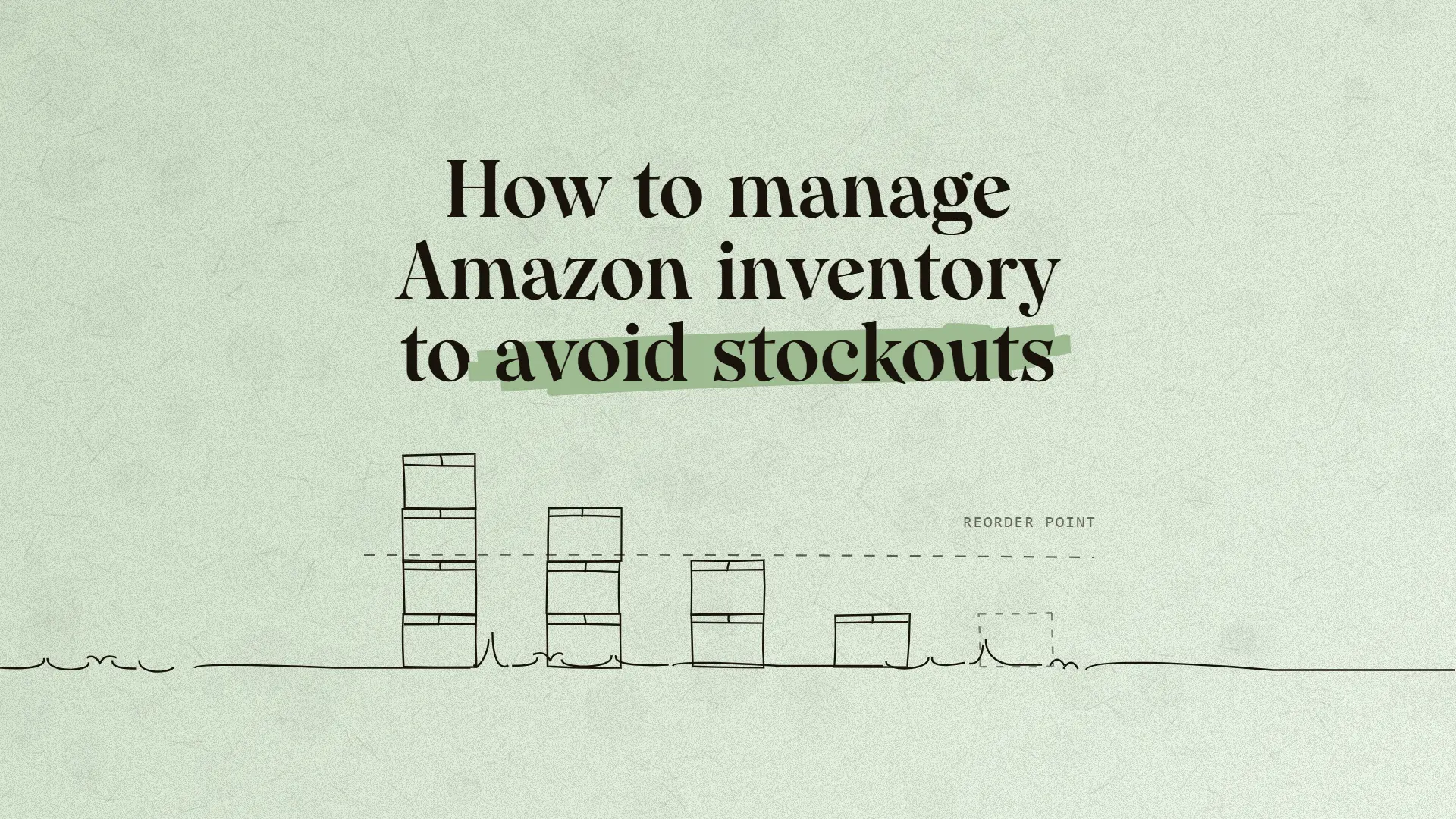
How to calculate your reorder point
Reorder Point = (Average Daily Sales x Lead Time in Days) + Safety Stock
Here is what the formula looks like with real numbers.
Let’s say you sell 20 units per day and your supplier takes 30 days to deliver stock to Amazon’s warehouse.
So you need to have at least 600 units in stock to cover the reorder window, plus some buffer for unexpected spikes in demand. When you reach that combined number in your inventory, it’s time for a new purchase order.
One common mistake that sellers make is underestimating lead time.
It is not just the delivery time, it factors in supplier production, transit, and the time it takes for Amazon to receive and process inbound shipments, which can be anywhere from 5 to 14 days. If you skip that, you’ll be reordering again too late.
How to calculate safety stock
Safety stock is the buffer between your average sales rate and your worst-case scenario.
If your sales are considerably higher than your daily average, especially in a busy season, your safety stock will need to cover that gap and multiply it across your entire lead time window.
The more gap there is, and the longer your lead time, the more buffer you will need. If you get the number right, you can absorb the demand spike without a rush reorder or running out of stock before your next shipment arrives.
Demand forecasting for Amazon sellers
Using Amazon's sales data for forecasting
The Business Reports section of Seller Central displays units that customers order by day, week, and month.
Use a 90-day rolling average as your baseline, as shorter windows don't capture trends. 30-day averages look stable until you hit a seasonal peak and suddenly your reorder point is half of what it should be.
Accounting for seasonality and promotions
| Demand signal | Effect on velocity | Planning move |
|---|---|---|
| Normal trading | Tracks the 90-day average | Reorder on your standing point |
| Seasonal peak | Up to 3x daily average | Build the multiplier into the reorder point |
| Lightning Deal or coupon | Short, sharp spike | Add buffer before the promotion starts |
| PPC push | Well above historical sales | Recalculate against the new velocity |
Figure out the high times in your category so you can build the multiplier into your reorder point calculation.
For example, if your velocity triples in Q4, you should be able to adjust the stock and reorder based on this info, not your off-season levels.
This is also critical when you run a Lightning Deal, coupon or PPC push, as this is when your sales can jump way up instead of the normal daily average.
Your regular reorder schedule doesn’t allow for that, which is why it’s important to add an inventory buffer before any promotion period starts and treat it as a separate planning event.
How PPC velocity affects inventory planning
Most sellers build their inventory based on average historical sales.
But a PPC campaign can drive sales well above that average, so your stock runs out before the reorder point formula suggests because that formula was based on those slower historical numbers, not campaign-driven velocity.
When you increase the ad spend, or you run a promotion, recalculate your reorder point against the new sales velocity; otherwise, the campaign will push you to a stockout rather than away from one.
Understanding Amazon's Inventory Performance Index (IPI)
What IPI measures and why it matters
IPI is Amazon’s grade on how you handle your FBA inventory. The range is 0 to 1000.
Amazon recommends a score of more than 400. A low score limits your storage, and if it falls below the threshold, you may not be able to ship your available inventory.
The score is based on four factors: excess inventory (slow-moving inventory taking up space), sell-through rate, stranded inventory (listings that can’t be sold) and in-stock rate.
How to improve your IPI score
• Discount or liquidate slow-moving SKUs before the peak season, not during it.
• Immediately fix stranded listings. If a listing is flagged for a policy issue, it will no longer sell, and it will affect your score negatively.
• Generate automatic removal orders for inventory in an FBA warehouse for more than 180 days.
Maintain your reorder routine each cycle to keep your in-stock rate up. The fastest way to improve a borderline IPI score is to have a good in-stock rate.
FBA vs FBM as an inventory safety net
If you already have FBM set up with the correct package dimensions, return address and shipping templates, you can switch it on within hours of running out of stock on FBA.
This will help keep your listing healthy and will also help preserve your Buy Box position and sales velocity while the FBA restock is in transit.
Most sellers don’t even think about FBM until they have a stockout. By then the setup process takes longer, and the listing has been inactive for days while you complete the setup.
So this is why it's important to get it now, when you don't need it. See our full FBA vs FBM breakdown to compare the two in-depth.
Monitoring inventory so you catch problems early
Create inventory alerts for stuck FBA inventory to identify issues early so you don’t end up with a low-stock situation that turns into a full stockout. Managed account monitoring reveals shifts in days of supply, shifts in IPI scores and stranded inventory in hours, not weeks.
Work with our team at Olifant Digital. Our account managers have 7+ years of experience monitoring these signals daily across every account we manage, stepping in before a low-stock situation can become a full stockout.
How to manage PPC during low stock
When the inventory starts to get low, the PPC strategy changes. The objective is no longer maximum sales volume - it’s all about protecting organic ranking and Buy Box until the restock comes in.
- Reduce total ad spend and pause any campaigns with a high or unprofitable ACOS. Only keeping your budget on efficient, converting keywords maximizes your profit per unit sold while you still have stock to move.
- Use exact match campaigns to protect your best-converting keywords. You want to keep the ranking signals with controlled and efficient spend, not volume.
- Reduce top-of-search bid multipliers. That slows the rate of conversion and extends your runway of inventory without completely freezing visibility.
The goal is to protect your remaining inventory and maintain a healthy sales velocity to protect your organic rank without burning spend on campaigns that eat up units faster than you can afford.
Amazon will automatically pause your ads if stock runs out completely, your visibility drops to zero and it costs much more than being in stock.
Inventory management tools and systems
| Setup | Best for | What you get |
|---|---|---|
| Spreadsheet | Just starting out | Purchase orders, lead times, units in transit |
| Amazon's free tools | Early to mid-stage sellers | Days of supply, restock recommendations, inventory age |
| Third-party software | 20+ SKUs or several channels | Forecasting, automated reorder alerts, channel sync |
Most early-to-mid-stage sellers will be fine with Amazon’s free tools.
- FBA Inventory Dashboard: Shows current inventory levels, days of supply and inbound shipment status.
- Restock Inventory Tool: Recommends when to reorder based on your sales history and lead times you set.
- Inventory Age Report: Tells you when you’re running low on stock
Third-party inventory software can give sellers with more than 20 SKUs or multiple fulfillment channels access to more advanced demand forecasting, automated reorder alerts and multi-channel synchronization.
This is the kind of software to invest in when manual tracking is not enough.
If you’re just starting out, a basic spreadsheet that keeps track of your purchase orders, lead times, and units in transit will do the job. As your catalog complexity and fulfillment complexity grow, you can add on more sophisticated tools.
How Olifant Digital managed inventory constraints for OneRoot
OneRoot is a premium honey brand that came to Olifant Digital in the middle of a supply crisis. A bad harvest had greatly reduced their available stock, leaving them with less to sell and no easy way to replenish it.
The result is predictable when you use normal PPC against a shrinking supply: the broad and auto campaigns eat up the remaining inventory, the listing quickly goes into a stockout, and the organic ranking that the brand had built drops. The deficit was far less than it would have cost to return to that rank later on.
The focus was to push the inventory they had as far as they could without sacrificing ranking or visibility. That meant the ad strategy had to be driven by stock levels, not just sales targets. Every dollar is calibrated to protect the remaining units and maintain enough velocity to defend their rank.
We developed a dynamic PPC system that updated bids daily based on real-time inventory levels and demand signals.
We reduced spending on broad and auto campaigns, protected exact match on the top converting keywords, cut down on top-of-search multipliers, and throttled the budget for any SKU that had less than 30 days of stock coverage.
This kind of inventory-aware PPC management is standard operating procedure for the 50+ Amazon accounts we manage.
That resulted in 40% sales growth despite less inventory availability. The operational discipline that was behind that result is what gave OneRoot the confidence to expand into the Japanese market in the subsequent quarter.
Kevin Park, CEO of OneRoot: “Their deep understanding of e-commerce marketing helped us grow our sales and expand into Japan.”
Read the full case study here
Frequently asked questions
How to recover your Amazon ranking after a stockout?
First, get the stock back ASAP and activate your FBM backup listing (if set up).
When it’s back in stock, increase your PPC spend on your core keywords to help rebuild your sales velocity and signal relevance to Amazon’s algorithm.
Usually, it takes 2-4 weeks of consistent sales activity to make the recovery to the pre-stockout ranking position. Thus, the longer the stockout lasts, the more ad spend you will need to invest in during the recovery phase.
How often should I review and update my reorder point?
The faster your sales, the more often you should review your reorder point. For most active sellers, a weekly review is the right cadence. It’s frequent enough to catch changes before they become a problem, but not so constant that it becomes noise.
If anything changes, such as a new supplier, an increase or decrease in average daily sales, or a planned promotion, you can review it anytime.
A reorder point that is based on data from 3 months ago will not represent your current velocity. Sellers that are preparing for Q4 or Prime Day need to recalculate at least four to six weeks before the peak period begins.
What should I do if my supplier misses a delivery deadline?
If a supplier is late with a delivery, you should flip on your FBM backup listing and keep the listing live while you wait for stock to arrive.
To slow down the burn rate of inventory for the remaining FBA units, you need to reduce or pause broad match and auto PPC campaigns. After that, you need to go back to your supplier and ask for a revised timeline and take that new number and plug it back into your calculation of how much runway you have left.
If the delay is large, you need to try to procure a smaller emergency batch from another supplier to fill the gap.
Does going out of stock affect my Amazon advertising performance long-term?
Yes, once a listing runs out of stock, its conversion rate history is reset/diluted. This can raise your cost-per-click when campaigns restart, as Amazon’s ad system prefers listings with strong recent conversion data.
In general, you’re going to be paying more for the same ad placements you were enjoying pre-stockout. This effect is more pronounced if the stockout occurs during a peak period, as those windows are hard to make up.
Ready to stop losing sales to stockouts?
If you’re losing rankings due to stockouts or if your current setup can’t keep up with your growth, get a free marketing plan from Olifant Digital.
We will examine your reorder cadence, IPI Score history, PPC efficiency during low stock, and FBM backup readiness, and we will show you exactly where the system is leaking revenue.
Olifant Digital is a full service Amazon agency and Amazon PPC agency for established brands managing $100M+ in annual client revenue across 50+ Amazon accounts. We cover every engagement with a 60-day money-back guarantee.
Related articles
.webp)
Alex is the founder and CEO of Olifant Digital, where his team manages over $100M in annual client revenue across 50+ e-commerce brands. He sets the agency's strategy and methodology, audits client accounts, and reviews the team's work to make sure every brand is on track to hit its growth and profitability goals. He also leads team training, so the performance data and lessons from across all accounts shape how every account manager runs their clients.


.png)
Mike reviews every Amazon article on this blog for strategic and technical accuracy before it publishes. As Director of Amazon Growth at Olifant Digital, he sets marketing strategy across client accounts and personally audits PPC at every stage of growth. He brings 8 years of daily Amazon operations across 7 and 8-figure brands including Beauty by Earth, Ekster, and Bullstrap, the kind of hands-on depth most agency directors delegate away.