

Short answer
Amazon PPC management agencies optimize campaigns by rebuilding campaign architecture, harvesting search terms from auto campaigns, adjusting bids by keyword, product target, and placement, managing negative keywords, reallocating budget across campaign types, and tracking TACoS instead of ACoS alone. In hundreds of account audits, underperformance almost always traces to structure: mismatched campaign types, shared budgets, and auto campaigns that never graduate their data. Adding budget to a broken foundation only makes the waste more expensive.
On a daily basis, this process also involves reviewing search term reports for new winners and wasteful ad spend, adjusting placement multipliers for Top of Search versus Rest of Search, graduating high-converting keywords from auto to manual campaigns, and reallocating budget to ASINs with the strongest conversion rates.
The best agencies combine this with listing CRO and SEO management to create the PPC-organic flywheel that reduces TACoS over time. Bid changes are crucial for a healthy account, and they need to happen daily as a core part of the optimization loop. While the structural work sets the foundation, what drives ongoing profitability is the daily bid management.
Step 1: Campaign architecture before optimization can begin
Most accounts that underperform don't have a bidding problem but have an architectural one. There is no bidding optimization that can rescue an account that has broad match, phrase match, and exact match keywords competing against each other in the same ad group or where three ASINs share one campaign and no one can tell which product is actually profitable. Agencies can spot this in the first audit and can provide the fix the account needs.
Why most self-managed accounts have the wrong foundation
Three structural failures show up at every self-managed account.
- First, broad, phrase, and exact match keywords all compete for budget within the same ad group without any separation strategy, which prevents high-performing keywords from being identified and scaled independently.
- Second, multiple products share the campaign budget, making it impossible to determine which specific ASIN generated profitable returns and which consumed budget without converting.
- Third, auto campaigns run for months and generate valuable search term data that never graduates to manual campaigns, so the account keeps paying auto-match prices for keywords that should be bid on directly.
These are the fixes any competent agency makes in the first two weeks.
The 1-1-1-1 Method: One campaign, one ad group, one keyword, one ASIN
The 1-1-1-1 method stands for one campaign, one ad group, one keyword, and one ASIN. Every click, every conversion, and every dollar of spend traces to exactly one variable, so daily optimization decisions stay clean and you always know which keyword drove a result for a specific product.
Clear structure is what makes scaling decisions obvious.
For the full account-structure teardown, see our guide to how to structure a 7-8 figure PPC account. At Olifant Digital, we used this structure to add $114,305 in monthly revenue for MatchaBar and to deliver 171% revenue growth with a 50% ACoS reduction for Balanced Tiger in two months.
Step 2: Keyword management and search term harvesting
Managing keywords is not a one-time process. It's a weekly process for high-volume accounts, and for accounts that generate more it runs daily. Agencies pull reports that show what people actually searched for when they clicked your ads and find winners that should get their own campaigns and losers that need to be blocked.
Moving winners from auto to manual campaigns
Think of auto campaigns as your testing ground and manual campaigns as your control center.
Auto campaigns run in the background, show your ads for different search terms, and collect performance data. Your agency spots which search terms get clicks and turn into sales, then moves them into separate campaigns where you set your own bids and budgets instead of letting Amazon decide.
This also helps organic ranking: when Amazon sees people searching a term, clicking your ad, and buying, it recognizes your product is relevant and over time ranks it higher organically for those terms. If you leave everything in auto campaigns, you keep paying Amazon's automatic prices indefinitely for keywords you could control at lower cost.
Negative keyword discipline: Stopping spend leaks
Negative keywords are one of the most overlooked tools in self-managed accounts and are very powerful for stopping wasted ad spend. When agencies look for budget drain, they search for three things: irrelevant search terms where shoppers look for something you don't sell; your brand name showing up in campaigns meant to attract new customers; and competitor products triggering your ads where it doesn't make sense to compete.
Two types of negative keywords work differently. Phrase match negatives block any search containing that word or phrase. For example, if a brand adds "powder" as a phrase match negative (because they sell ready-to-drink matcha, not powder), their ads will not show for "matcha powder," "organic matcha powder," or "best powder matcha." Exact match negatives only block that specific phrase in exact order.
If MatchaBar adds "matcha tea," they will still show for "matcha tea latte," "iced matcha tea," or "matcha green tea drink." This distinction matters: you block "matcha tea" because those searchers want loose-leaf tea to brew at home, but keep "matcha latte" and "matcha tea drink" active because those searchers want ready-to-drink beverages, which is what the brand sells. At Olifant Digital, we audit negative keywords every week as standard practice, because Ad Badger's 2026 Amazon advertising benchmarks found that in most accounts 15% to 25% of ad spend goes to search terms with near-zero conversions.
Step 3: Bid optimization - what good agencies actually adjust
There is a common myth that Amazon PPC agencies only raise bids. That is only about 20% of the actual work. The other 80% is fixing campaign structure, organizing keywords, moving budget to the right products, and tracking actual profitability. Bids matter, but raising them on a broken account will not fix the underlying problems. When we partnered with Elite Jumps, we did the main fixes, which included restructuring campaigns and testing better product images and copy, not just raising bids. The results were a 51% higher conversion rate and 124% revenue growth in three months.
Bid by placement: Top of Search vs. Rest of Search vs. product pages
| Placement | Shopper intent | Bid approach |
|---|---|---|
| Top of Search | Ready to buy, highest conversion rate | Base bid with a placement uplift, commonly +50% |
| Rest of Search | Still comparing, mixed intent | Base bid, no uplift |
| Product pages | Browsing a competitor listing | No negative multiplier exists: set 0% and lower the keyword bid |
Amazon shows your ads in three different places, and each one performs very differently:
If you set one flat bid for all placements, you pay the same whether your ad appears at Top of Search (where people buy) or on product pages (where people browse). Experienced agencies set a base bid and adjust by placement, typically increasing bids 50% for Top of Search because conversion rates are highest there. Amazon Ads lets you adjust Sponsored Products bids by placement only upward, from 0% to 900%, so there is no negative multiplier for product pages. To spend less there, set a 0% placement adjustment and lower the keyword bid or exclude targets that don't convert. Most sellers never look at placement reports and don't know this is possible, yet it's one of the fastest ways to stop wasting money.
Why daily optimization matters more than weekly
Checking campaigns weekly may sound reasonable until you calculate the cost. If one keyword spends $40 a day, that's $280 wasted before you catch it next week. Multiply that across 20 campaigns and you lose thousands every month. Daily checks catch problems the same day, let you react when competitors change prices, and let you scale when a product takes off. At Olifant Digital, daily checks are why Spade to Fork grew revenue 46% in 44 days while cutting ad costs 19%.
Step 4: Budget allocation across campaign types
Budget allocation is a strategic decision, and not all agencies divide it equally across campaign types. A common starting split allocates budget by ad type: 60% of spend to Sponsored Products, 30% to Sponsored Brands, and 10% to Sponsored Display. This split adjusts with brand stage, category, and account maturity, but works as a starting point for most brands doing $500K to $5M in annual revenue. The separate question of how to split budget by match type within a single ASIN is covered in our guide to how to structure a 7-8 figure PPC account.
Sponsored products: The core revenue driver
Sponsored Products is the foundation of Amazon advertising. It shows individual products to shoppers already searching specific keywords. Those high-intent shoppers are the most valuable traffic on Amazon. Sponsored Products gets the biggest budget share because it delivers the best return and, when structured with the 1-1-1-1 method, gives crystal-clear data on what is working. With proper structure, every dollar traces to the keyword, product, and sale it generated, which is what makes profitable scaling possible.
Sponsored brands: Awareness and branded defense
Sponsored Brands are the header banner ad units at the top of search results, featuring a brand logo and multiple ASINs or linking to a Brand Store. The primary application is to dominate your own brand keyword results and prevent competitors from buying placements above the fold when consumers search your brand name. The secondary application is cross-category discovery. For established brands with measurable brand-name search volume, Sponsored Brands budget is non-negotiable.
Sponsored display: Retargeting lost traffic
Sponsored Display functions as a retargeting tool. Its core function is to retarget shoppers who viewed your product but didn't buy. When someone views your detail page and leaves, Sponsored Display shows them ads as they browse Amazon. It also enables competitor ASIN targeting, placing your ad on a competitor's detail page to intercept shoppers evaluating options. The 10% budget reflects its role as a supplemental conversion tool that supports your main Sponsored Products campaigns.
Step 5: Reporting that reveals what's actually happening
The metric an agency reports reveals whether they manage for their dashboard or your profitability. Agencies that report only ROAS and ACoS manage numbers that look great even while the account quietly deteriorates. The right reporting answers one question: is advertising subsidizing the account, or is the account earning organic momentum from advertising?
Why ACoS alone is a misleading metric
Amazon Ads defines advertising cost of sales (ACoS) as ad spend measured as a percentage of ad-attributed revenue. Organic revenue is excluded entirely. A brand can report 25% ACoS and look healthy, but if TACoS is 40%, advertising is subsidizing most of the revenue and organic growth has stalled. ACoS can be improved just by cutting ad spend, which lowers sales velocity and degrades organic rank. It's a useful campaign-level diagnostic but a dangerous account-level scorecard when reported alone. To model your own break-even and target ACoS before you set bids, run the numbers through our Amazon ACoS calculator.
TACoS as the true profitability benchmark
TACoS (Total Advertising Cost of Sales) is total ad spend divided by total revenue, including both ad-attributed and organic sales. When TACoS declines over time, organic rank is improving and ad dependency is decreasing. That is the definitive indicator of a healthy, sustainable account. Our TACoS-first approach for Onsen Secret tripled their profits. We built Ekster's annual profitability of $688,406 on margin-first management measured through TACoS analysis, not ACoS tracking. If an agency can't articulate its TACoS trajectory over 90 days, it's reporting on an incomplete metric set.
Step 6: The PPC–SEO flywheel
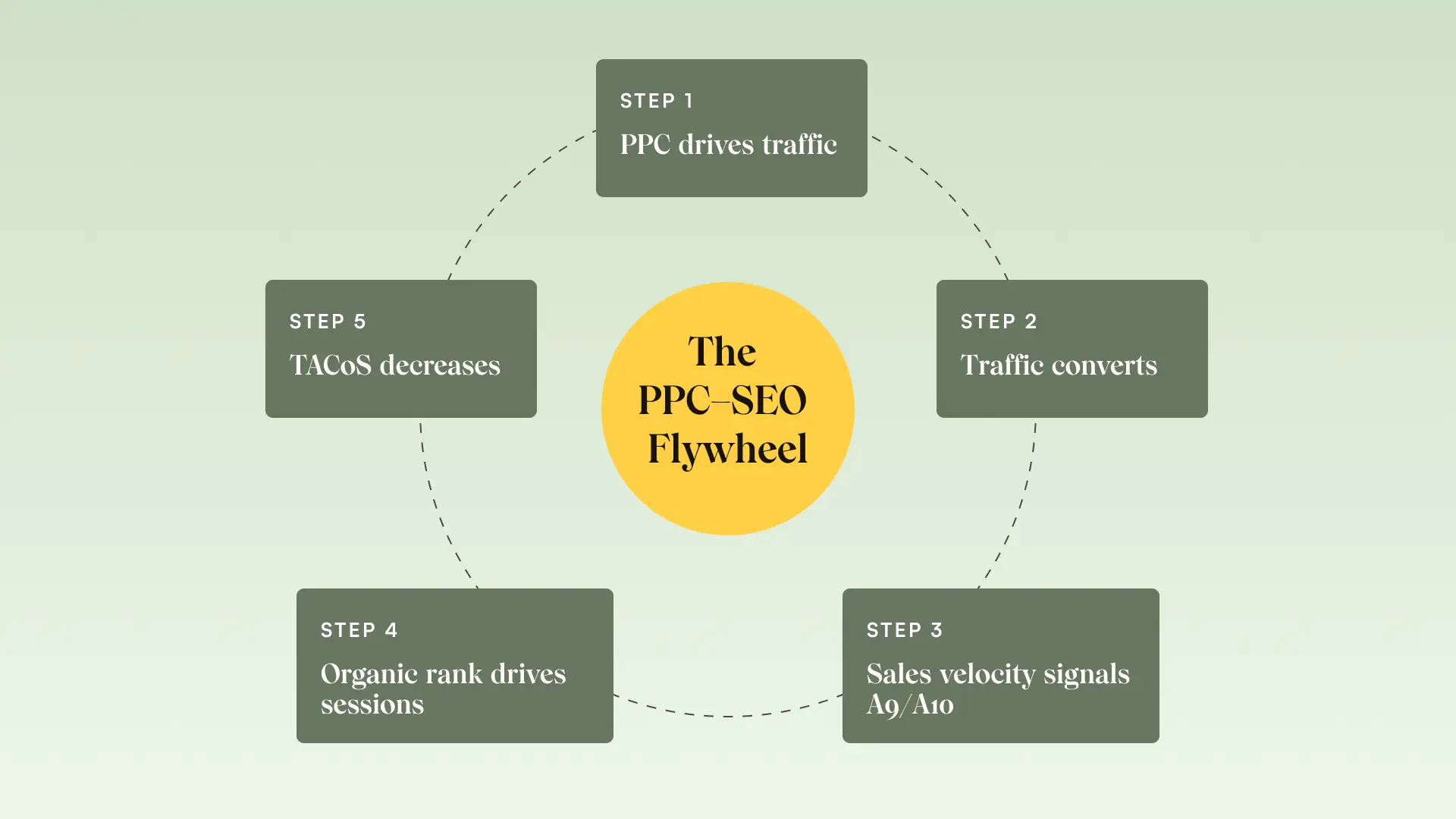
PPC and SEO can't be run separately. The flywheel works in sequence: PPC drives traffic to a well-optimized listing; the traffic converts and generates sales velocity; sales velocity signals A9 and A10 that the ASIN deserves organic rank; organic rank drives sessions that don't cost ad spend. As a result TACoS decreases, creating budget headroom to invest in new ASINs or categories. Agencies that run PPC and SEO separately break this cycle. PPC spend to a weak listing wastes traffic; listing optimization without PPC is slow ranking that may never catch up. The compounding benefit only works when both are managed together. At Olifant Digital, we coordinated Elite Jumps' PPC and SEO work, which produced a 51% CVR lift and 124% revenue growth in three months.
How Olifant Digital optimizes Amazon PPC campaigns
Our optimization process runs in a fixed sequence, and every account goes through the same steps in the same order, because the order matters. Across Olifant Digital's 50+ managed Amazon accounts, our TACoS-first approach has driven a 112% average increase in paid advertising profitability.
- Account audit first: before running a single campaign, we audit account architecture, listing quality, and keyword structure. We don't scale budget on a weak foundation, because if a listing converts at 8%, doubling spend wastes twice as much.
- 1-1-1-1 campaign build: one campaign, one ad group, one keyword, one ASIN. Performance is never ambiguous and scaling decisions are based on complete visibility.
- Daily optimization loop: bids, placements, budgets, and search terms are reviewed daily, not weekly. That 7-day lag costs brands money every week it continues.
- Weekly search term harvest: high-converting terms from auto campaigns graduate to manual exact-match campaigns; wasteful terms are negated.
- TACoS as the primary KPI: we report TACoS for every account. A declining TACoS over 90 days means organic growth is real and the flywheel is working.
- Proprietary tooling: our in-house AI platform, Olifant AI, manages bids and budgets at an hourly level, not just daily. The same campaign structure runs on every client account, so each method is validated across 50+ live accounts.
Proven results from Olifant Digital’s optimization approach
| Brand | Result | Primary fix |
|---|---|---|
| Balanced Tiger | 171% revenue growth, ACoS down 50% in 2 months | New keyword strategy and campaign structure |
| MatchaBar | $114,305 added monthly revenue | Full 1-1-1-1 rebuild, weekly image and copy testing |
| Spade to Fork | 46% revenue growth in 44 days, ACoS down 19% | Dedicated campaigns per product and competitor targeting |
| Elite Jumps | 124% revenue growth, CVR up 51% in 3 months | Campaign rebuild plus hero image, title and bullet testing |
Balanced Tiger — 171% revenue growth, 50% ACoS reduction in 2 months
The primary fix for Balanced Tiger that we did included a new keyword strategy and campaign structure.
The previous agency they used had been chasing ultra-competitive keywords, which quickly drained their budget without a meaningful increase in revenue or profit.
The first thing we fixed for Balanced Tiger was keyword strategy and campaign structure.
MatchaBar — $114,305 added monthly revenue
The complete restructuring with the 1-1-1-1 method for MatchaBar we did delivered complete performance visibility across all ASINs. The weekly A/B testing on their images and copy lifted conversion rates across the catalog simultaneously.
The daily PPC management allowed real-time reactions to the emerging trends, and our strategic product bundling managed to double the average order value.
Spade to Fork — 46% revenue growth in 44 days, ACoS down 19%
Spade to Fork’s previous setup only had a handful of campaigns per product, and that made competing and diagnosing problems almost impossible.
We launched dedicated campaigns for each of their products and added competitor targeting. This turned into one of the best-performing strategies at a (lower ad cost, and we built single-keyword campaigns for high-intent search terms.
Our daily optimization kept the overall ad-to-revenue ratio profitable across every product in the catalog.
Elite Jumps — 124% revenue growth in 3 months
When Elite Jumps partnered with us, we not only fixed their bids but also the overall structure and listing quality.
After we rebuilt the campaign architecture, we also did A/B testing on the hero images, titles, and bullets, and the result of this was an improved CVR by 51%.
At the same time, we did PPC and SEO optimization, which helped generate an organic rank lift alongside paid revenue.
What to ask any Amazon PPC agency before hiring them
There are seven important questions you need to ask an agency when you have an evaluation call. These are important for determining whether the agency does legit work, or you will end up disappointed in the end.
At Olifant Digital, we offer a free marketing plan for brands that generate $500K in annual revenue. The audit covers campaign structure, keyword architecture, bid strategy, and TACoS reporting.
To see how different agencies compare on optimization cadence and reporting, read our Amazon PPC agency rankings.
Frequently asked questions
How do Amazon PPC agencies optimize campaigns?
Amazon PPC agencies optimize the campaigns by doing daily bid adjustments, harvesting search terms from auto campaigns, managing negative keywords, refining campaign structure, and tracking TACoS as the primary profitability metric. Optimization is a constant process and not just a one-time setup.
The best agencies use PPC work with listing optimization to build the PPC-SEO flywheel that reduces the advertising dependency over time.
How often should Amazon PPC campaigns be optimized?
Amazon PPC campaigns should be optimized on a daily basis, especially on accounts that spend $10K or more per month. At a minimum, optimization should happen weekly, but this can result in burning money before the next review. At Olifant Digital, optimizations are done on a daily basis as a standard.
What is the 1-1-1-1 campaign structure?
The 1-1-1-1 structure means one campaign, one ad group, one keyword, and one ASIN. This keyword provides complete performance visibility with zero ambiguity about which keyword drives a result for a specific product.
This is the basic foundation of scalable PPC management because every data point is clean. At Olifant Digital, we used this structure to add $114,305 in monthly revenue for MatchaBar and to deliver 171% revenue growth with 50% ACoS reduction for Balanced Tiger in two months.
What is TACoS, and why does it matter for Amazon PPC?
TACoS stands for Total Advertising Cost of Sale, which is calculated as total ad spend divided by total revenue (paid plus organic). A declining TACoS means the organic rank is improving and that ad dependency is decreasing.
ACoS can look healthy while TACoS is high, which means the ads are subsidizing most of the revenue without doing any organic lift underneath. TACoS is the primary metric for account health.
What's the difference between Sponsored Products, Sponsored Brands, and Sponsored Display?
The difference between the three is the following:
Sponsored Products show your individual products when people search for the exact keywords. These are what drive most of your revenue and should get the most of your budget.
Sponsored Brands are the banner ads at the top of search results that have your logo and multiple products. The whole purpose of these is to protect your brand name in search and to build awareness.
Sponsored Display brings back those shoppers that already looked at your product but left without buying. This is a retargeting tool that captures people that have already shown interest in your products.
How long does it take to see results from Amazon PPC optimization?
Real performance trends become clear around 30 to 45 days once you have enough data, but the biggest gains come after the third month.
This is when your PPC-SEO flywheel really kicks in, and your paid ads help you rank organically.
What metrics should an Amazon PPC agency report on?
TACoS is the primary account health metric, and it should anchor every report. ACoS is useful as a campaign-level diagnostic but dangerous as a sole account scorecard.
Agencies should track keyword rank position over time, organic session growth, conversion rate change changes and impression share on target keywords. Agencies that are reporting on ROAS alone are measuring the revenue efficiency, not the profitability.
.webp)
Alex is the founder and CEO of Olifant Digital, where his team manages over $100M in annual Amazon client revenue across 50+ brands, and he runs a 7-figure Amazon brand of his own. That operator background shapes how the agency works: every tactic is tested with his own money before it reaches a client account. He oversees PPC methodology, creative, and conversion rate across all client accounts to make sure Olifant Digital scales brands profitably.


.png)
Mike reviews every Amazon article on this blog for strategic and technical accuracy before it publishes. As Director of Amazon Growth at Olifant Digital, he sets marketing strategy across client accounts and personally audits PPC at every stage of growth. He brings 8 years of daily Amazon operations across 7 and 8-figure brands including Beauty by Earth, Ekster, and Bullstrap, the kind of hands-on depth most agency directors delegate away.