Introduction
In the ecommerce ad accounts that we manage at Olifant Digital, Meta CPM on Black Friday 2025 was 2.12 times the price of a normal October day; however, the return on ad spend was 2.29 times higher too. The costly mistake is the week before, when CPM was already up 72% and ROAS was only up 20%.
The cost per thousand impressions (CPM) is what Meta charges you to show your ad to a thousand people, and ROAS is an acronym for return on ad spend. It’s the sales value that the platform reports back to you for every dollar that you put into ads. When you put them side by side, you can see whether a more expensive day is worth paying for.
In our accounts, the peak days were expensive, but they were able to pay for themselves because the sales rose more than the costs. The week before Black Friday is when brands lose the most money, since the ads cost more that week but bring only a few extra sales.
December, on the other hand, turns out to be cheaper than most brands expect. Our study is based on real ad accounts that our team manages for ecommerce brands that sell on their websites. It covers two full years (2024 and 2025) across both Meta and Google Ads, and it’s the first study in the ecommerce section of our research hub.
If you happen to be budgeting your Q4 right now, it shows you what happens to costs and returns throughout the season, so you can plan using real data instead of guessing.
Key findings
- Meta CPM nearly doubles on Black Friday. It costs approximately twice as much to reach the same number of people as on a normal October day: 2.12x in 2025 and 2.04x in 2024.
- Black Friday pays for itself. On Black Friday 2025, returns rose 2.29x while CPM rose 2.12x, so every dollar did more work on the day itself than on a quiet autumn day.
- The week before is a low point. In 2025, costs were already 1.72x a normal October day that week, but returns were only 1.20x. Costs rose in all 7 accounts we tracked in 2025.
- Google costs move far less. On Google Ads, CPC rose only 6% in November 2025 and 16% in December 2025, while conversion rate rose 19% and 26%.
- December was cheap on Meta in 2025. From December 8 to 20, CPM was back to a normal October level (0.98x), and after Christmas it fell to 0.85x, while returns stayed at 1.28x and 1.50x. In 2024, December costs stayed above October.
How much does Meta CPM rise on Black Friday?
On Black Friday, the Meta CPM in our accounts was twice that of a normal October day in both years (2.04x in 2024 and 2.12x in 2025), which means that reaching the same number of people cost you almost twice as much as it did a few weeks earlier.
In the chart below, you can see how this cost has moved through the whole season, and every period is measured against the average October day of the same year. Cyber 5 is the five-day stretch from Thanksgiving Thursday through Cyber Monday.
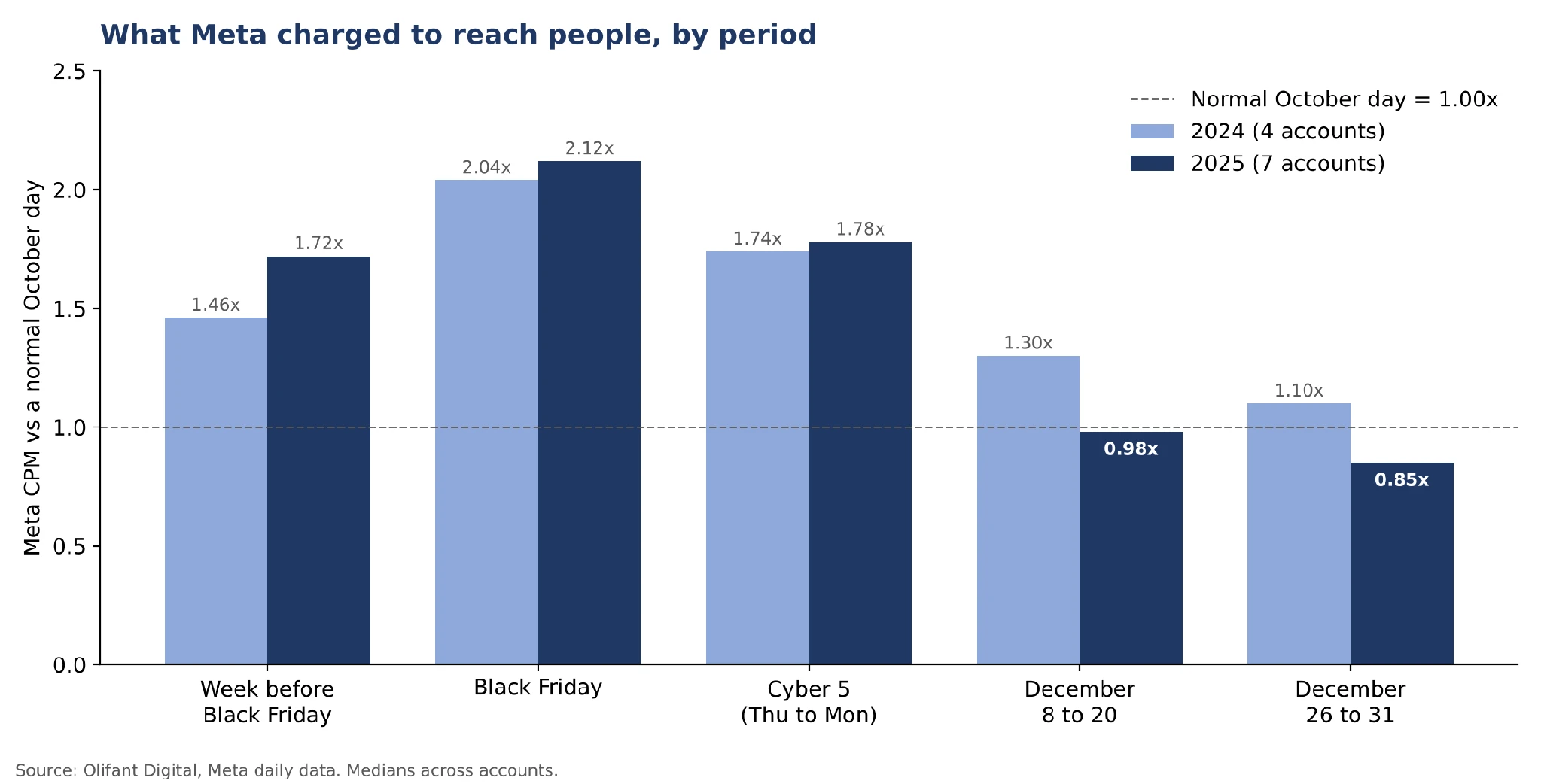
The pattern is close to the same in both years. The costs climb in the run-up and peak on Black Friday, and then they tend to ease off through December. The rise on the day itself was also consistent across accounts: CPM was higher on Black Friday in 6 of 7 accounts in 2025, so if you sell online and advertise on Meta, expect to pay more on Black Friday regardless of what you sell.
The week before Black Friday is the most expensive week for what you get
In 2025, you paid 72% more to reach people in the week before Black Friday; however, your return only went up by 20%. This discrepancy is the gap that makes this week the worst value of the season.
Every account in our 2025 sample (7 of 7) had higher costs that week. In the accounts that we run, this period is the point where large retailers start their early deals and the auction fills up with advertisers. Many shoppers are still browsing and saving products for later, so they see more ads but don’t buy yet.
The run-up also got more expensive from one year to the next, from 1.46x in 2024 to 1.72x in 2025, so you should not plan this week based on what it cost two years ago.
You should not turn off the ads completely for that week but instead use the week before to warm people up at a sensible budget with teasers, early access sign-ups, and retargeting, rather than making it your biggest push of the year.
Does higher CPM mean worse results?
No, it does not. On peak days, higher CPM came with even higher returns.
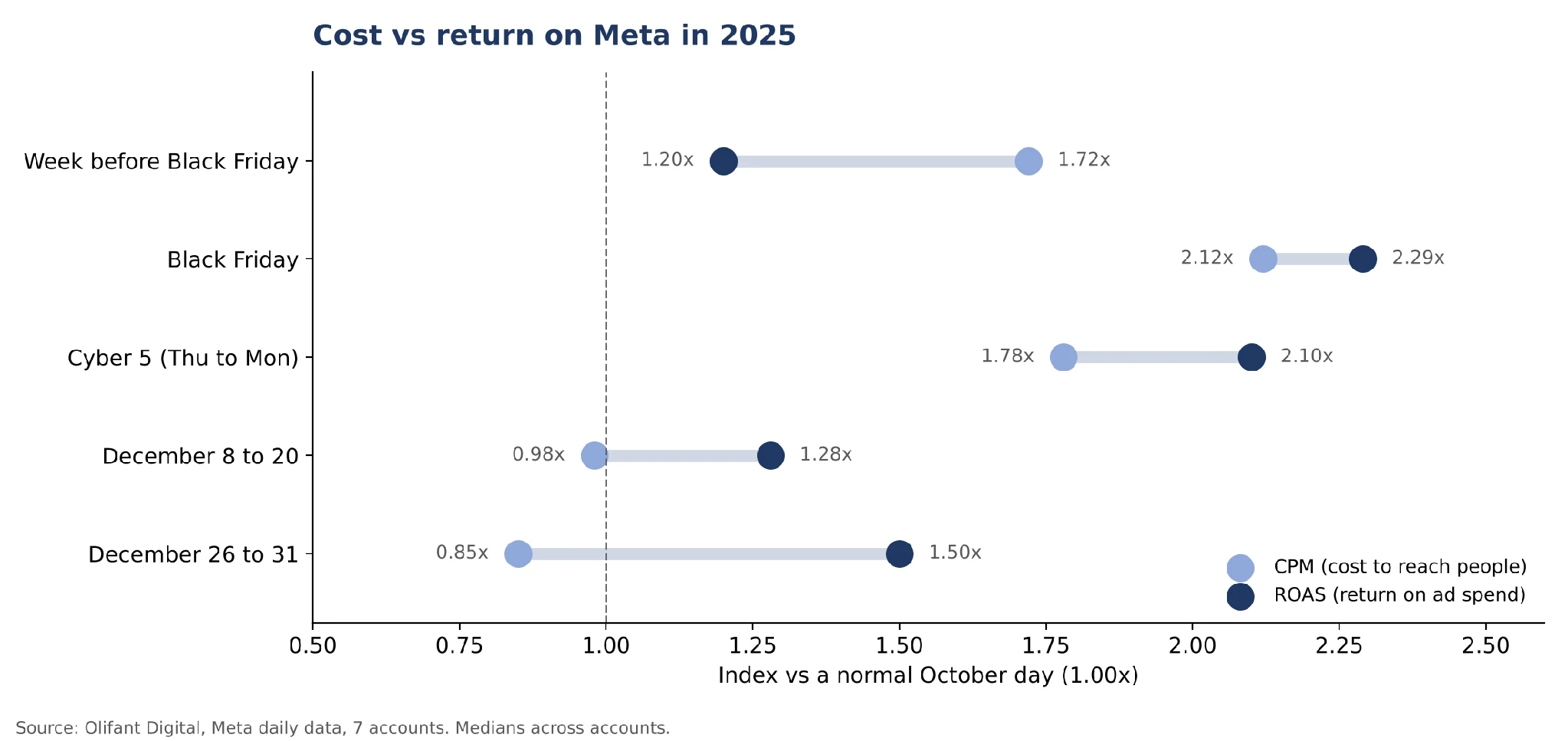
You need to think of it like this. If the price of showing your ad doubles, but the sales that are coming back from that same spend more than double, then it means that each dollar is working harder than on a normal day, even though the bill looks scary.
This is the same thing that happened on Black Friday (2.12x CPM, 2.29x ROAS) and across the Cyber 5 weekend (1.78x CPM, 2.10x ROAS) in our accounts.
The main reason for these results is the shopper. People on these days come and they are ready to buy, often with a list that is already written, and they expect a deal, so they convert far better than on an ordinary day. A higher price per impression is easy to live with when far more of these impressions turn into orders.
The chart also shows the one period where the picture flips. In the week before Black Friday, the cost dot is well to the right of the return dot, and this period is the only time in the season when you pay more than you get back.
Google Ads in Q4: costs rise less, conversion rate rises more
Google Ads behave differently from Meta in Q4. The costs tend to rise, while the conversion rate does so a lot more.
CPC, or cost per click, is what you pay every time someone clicks your Google ad. The conversion rate is the share of those clicks that end in a purchase. In the next chart, we compare each month with the average of September and October.
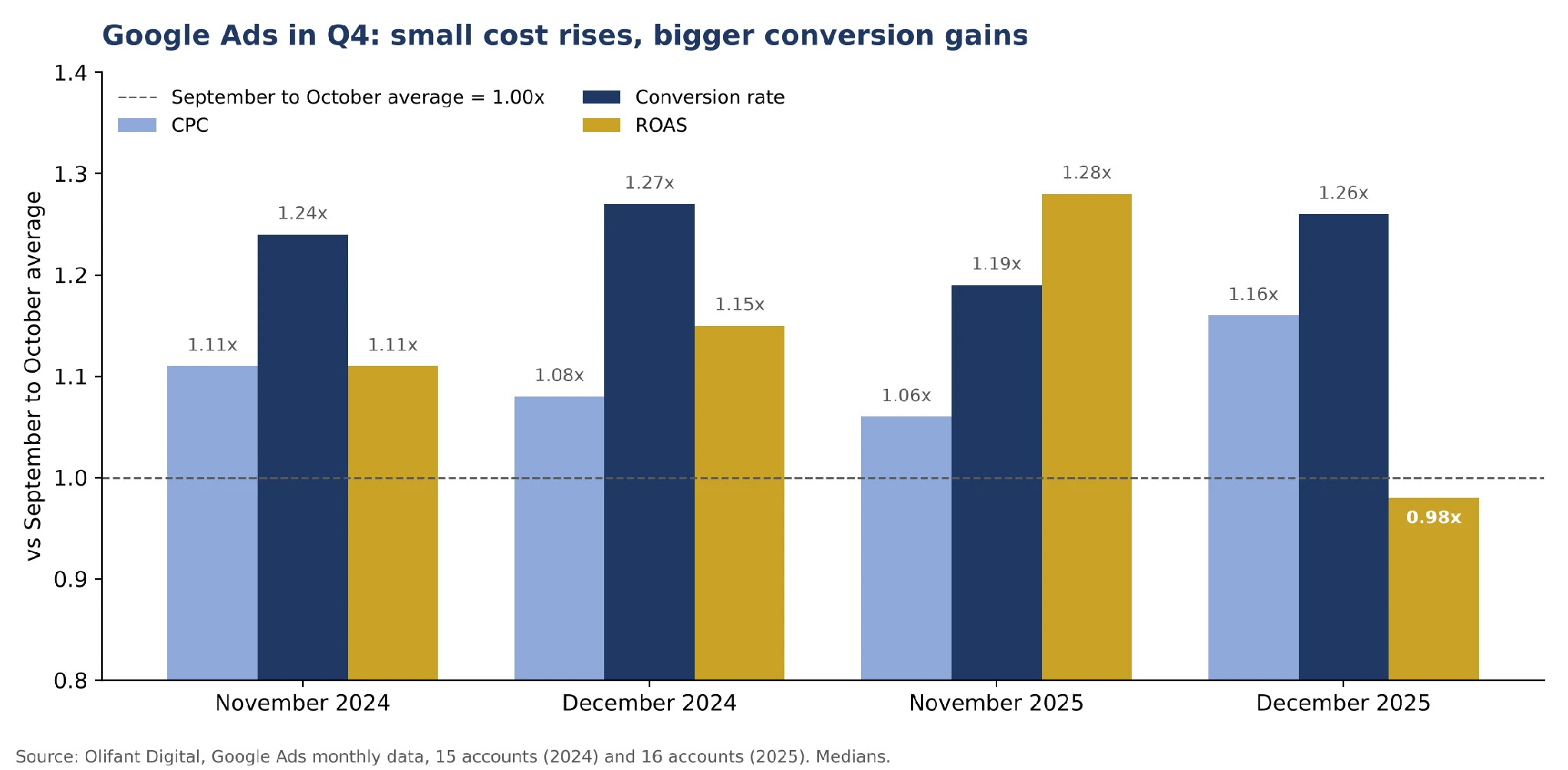
In 2025, CPC rose 6% in November and 16% in December, while conversion rates were 19% and 26% higher than in autumn. ROAS rose 28% in November. November was the stronger month, because cheap clicks and high buying intent came together.
December, on the other hand, is a different picture. The clicks got more expensive in almost every account (14 of 16), and even though the shoppers were converting well, the returns slipped just below the autumn level (0.98x). So December on Google needs more attention than November.
The main point is this. On Google, the price for a click moved a little, while on Meta, the price of reaching people roughly doubled on Black Friday. People on Google are already searching for a product, which is why their intent stays high through the whole quarter, and that makes Google the steadier channel in Q4.
A clean product feed makes a big difference here, because your Shopping ads are only as good as the product data behind them. Our guide to Google Merchant Center feed optimization walks you through it. If you want a team to run this channel for you, see our Google Ads services for ecommerce.
December is cheaper than you think
Many brands opt to cut their Meta budgets right after Cyber Monday. Our 2025 data suggests that this is way too early.
From December 8 to 20, 2025, Meta costs were back to a normal October level (0.98x), and after Christmas, they dropped below it (0.85x). The returns in both those periods stayed higher than in October (1.28x and 1.50x), so the money that you spent in those weeks went further than it did in early autumn.
What usually happens is the big advertisers pull back once the Black Friday weekend is over, and the auction gets quieter. Shoppers don’t stop buying. They are still looking for gifts in mid-December and after Christmas, they spend gift cards and money they received.
2024 looked different, and December costs stayed above October in both of those periods (1.30x and 1.10x). You should check your costs each week rather than assume that December will always be cheap.
How to plan Black Friday ad budget with this data
Here is how we use these findings when we plan Q4 with the ecommerce brands that we work with.
| Period | Meta CPM | Meta ROAS | What we do |
|---|---|---|---|
| October | 1.00x (baseline) | 1.00x (baseline) | Test offers and creative, grow lists |
| Week before Black Friday | 1.72x | 1.20x | Keep prospecting lean |
| Black Friday | 2.12x | 2.29x | Largest daily budget |
| Cyber 5 (Thu to Mon) | 1.78x | 2.10x | Keep budgets high |
| December 8 to 20 | 0.98x | 1.28x | Keep spending |
| December 26 to 31 | 0.85x | 1.50x | Keep spending |
2025 medians against an average October day of the same year.
You should use this table as a quick map of the season, and then check it against your account each week, because your category and your offers will move these lines up or down.
1. Build audiences and creative in October
Since ads cost less in October, you should use that month to test your offers and creative while mistakes are still cheap.
It is also the right time to grow your email and SMS lists and your retargeting pools, because those are the people who buy first once the deals go live. Our Shopify Black Friday checklist covers the store side of this preparation.
2. Keep prospecting lean in the week before
This is not the week for your biggest prospecting budgets, because you end up paying a lot more for only a small lift in sales. Prospecting means showing ads to new people who are not familiar with your brand yet.
You need to keep teasers and retargeting running so that people remember you, and save the cash for the days when it works harder.
3. Put the largest daily budgets on Black Friday to Cyber Monday
In our accounts, this stretch was when sales gains outpaced the rising ad expenses. Before you scale your spend, make sure your website can turn incoming visitors into buyers.
You can expand basket sizes using bundled offers and spend targets for free delivery (our guide on how to increase AOV on Shopify breaks the process down) and re-engage shoppers who walked away from full baskets (see abandoned cart recovery on Shopify).
4. Keep spending through mid-December and after Christmas
In 2025, Meta costs went back to October levels or below (0.98x and 0.85x), and the returns stayed above October (1.28x and 1.50x). You should not switch off your ads on the Tuesday after Cyber Monday because the cheaper weeks that follow are when many brands miss out on easy sales.
5. Watch MER, not only platform ROAS
Platform ROAS is what Meta and Google report, and both of them claim credit for the same sales. In peak weeks, the situation tends to become worse because shoppers click ads on both platforms before they buy.
MER (marketing efficiency ratio) is your total revenue divided by your total ad spend, and tracking it shows you what you really earn from your ads. If you want a team to run this plan on Meta, make sure you see our Facebook ads agency services for ecommerce.
Methodology
- Sample: This study uses ad accounts that Olifant Digital manages for ecommerce brands that sell on their website.
- Data: For Meta, we used daily data from 7 ad accounts in 2025 and 4 in 2024 from October 1 to December 31.
- Google Ads data: Monthly data from 16 accounts in 2025 and 15 in 2024.
- Baselines: Meta daily figures are compared with the average October day of the same year. Google monthly figures are compared to the average of September and October. A figure of 2.12x means 2.12 times the baseline.
- Medians: All numbers are medians across accounts, so one large or small account doesn’t skew the result.
- What ROAS means here: The figure is a platform-reported purchase value that is divided by the spend. It reflects what Meta or Google reports it drove, not a complete review of your sales, which is why we also recommend tracking MER.
- Limits: This figure is not an industry benchmark, but it is what we see in the ecommerce accounts that we manage, so you should use it as a guide and compare it with your data.
Frequently asked questions
How much does CPM increase on Black Friday?
In our Meta accounts, CPM on Black Friday was about 2 times higher than on a normal day in October in both 2024 and 2025 (2.04x and 2.12x). The easiest way to prepare for the event is to look at your own CPM for October now and work out what double that number would mean for the reach you plan to buy, so the higher bill doesn't catch you by surprise.
When should you start Black Friday ads?
Grow your audience and test your creative in October, then ramp up on the actual days. If you do early access deals, it’s a good idea to send them to your email list and past buyers first, because you don’t pay the higher auction price to reach those people.
Is it worth advertising on Black Friday?
Yes, based on our data, because on Black Friday 2025 returns rose 2.29x while costs rose 2.12x. The brands that benefit most from it are the ones with a clear offer, enough stock and a store that loads fast on mobile. This extra traffic only pays off if you can turn it into orders.
Do Google Ads get more expensive on Black Friday?
A bit, but it’s nowhere near the scale of Meta: across 16 Google Ads accounts, CPC rose 6% in November 2025 and 16% in December 2025. If your Meta costs are rising too quickly during the peak week, Google is usually the safer place to shift some budget, provided you have a solid product feed and Shopping campaigns.
Is December cheaper for Facebook ads?
In 2025, yes. Costs were back to a normal October level by mid-December (0.98x) and lower after Christmas (0.85x). In 2024 they stayed above October, so check your own costs each week. To get the most out of it, schedule gift-focused creative in mid-December and a different set of ads for after Christmas when people are shopping for themselves, not others.
Every store has its own Black Friday pattern and your costs and returns may be different from ours. Our team can examine your Meta and Google accounts and advise you on which weeks to spend more and where to hold back. Get your free marketing plan and have a clear Q4 plan in place before the busiest weeks arrive.

Alex is the founder and CEO of Olifant Digital, where his team manages over $100M in annual client revenue across 50+ brands on Amazon and ecommerce. He sets the agency's strategy and methodology, audits client accounts, and reviews the team's work to make sure every brand is on track to hit its growth and profitability goals. He also leads team training, so the performance data and lessons from across all accounts shape how every account manager runs their clients.