

Introduction
Most sellers treat Amazon SEO as an afterthought something to fix after the ads are running. That's backwards.
Organic rank is what determines whether your product shows up when someone searches without clicking an ad. And unlike paid traffic, it compounds. Every keyword you rank for organically is revenue you're not paying for on a per-click basis.
But Amazon SEO works nothing like Google SEO, and agencies that don't know the difference will apply the wrong playbook to your account. This article breaks down exactly what a specialist Amazon SEO agency does, how the algorithm actually works, and what separates agencies that move the needle from those that just optimize on paper.
Short answer
Amazon SEO agencies help sellers to rank higher in the Amazon search results. This is done by optimizing everything the algorithm uses to decide which products to show shoppers.
SEO agencies usually handle keyword research, listing optimization (which includes titles, bullets, descriptions), and handle backend search term fields which include A+ Content, Brand Store builds, organic rank integrations and performance reporting.
Unlike Google SEO, Amazon SEO is built around the purchase intent signals such as (keyword relevance, conversion rate, and sales velocity).
These are far more important than backlinks or domain authority. The goal of SEO agencies is to help brands get organic visibility that compounds over time, so the brand can sell more without relying entirely on paid ads.
Amazon SEO vs Google SEO: Why they’re not the same
Many brand owners assume that Amazon SEO is just Google SEO but in a different tab. However, that’s not correct. Besides the shared name, they don’t share anything else.
Amazon’s A9/A10 algorithm is not measuring domain authority, backlinks or publishing frequency. Instead, it is measuring the buyer’s behavior, click-through rate on the search results page, conversion rate once the shopper lands on the listing, and sales velocity over recent weeks. These are the three signals that matter the most.
The optimization surface is also different. On Google, all the SEO work happens in HTML, page structure, internal linking and backlinks.
On Amazon, this is not relevant, and all the optimization lives inside the listing itself. This includes the title, bullet points, product description and backend search term fields, A+ Content modules and images. There is no meta description, H1 tag strategy or link profile.
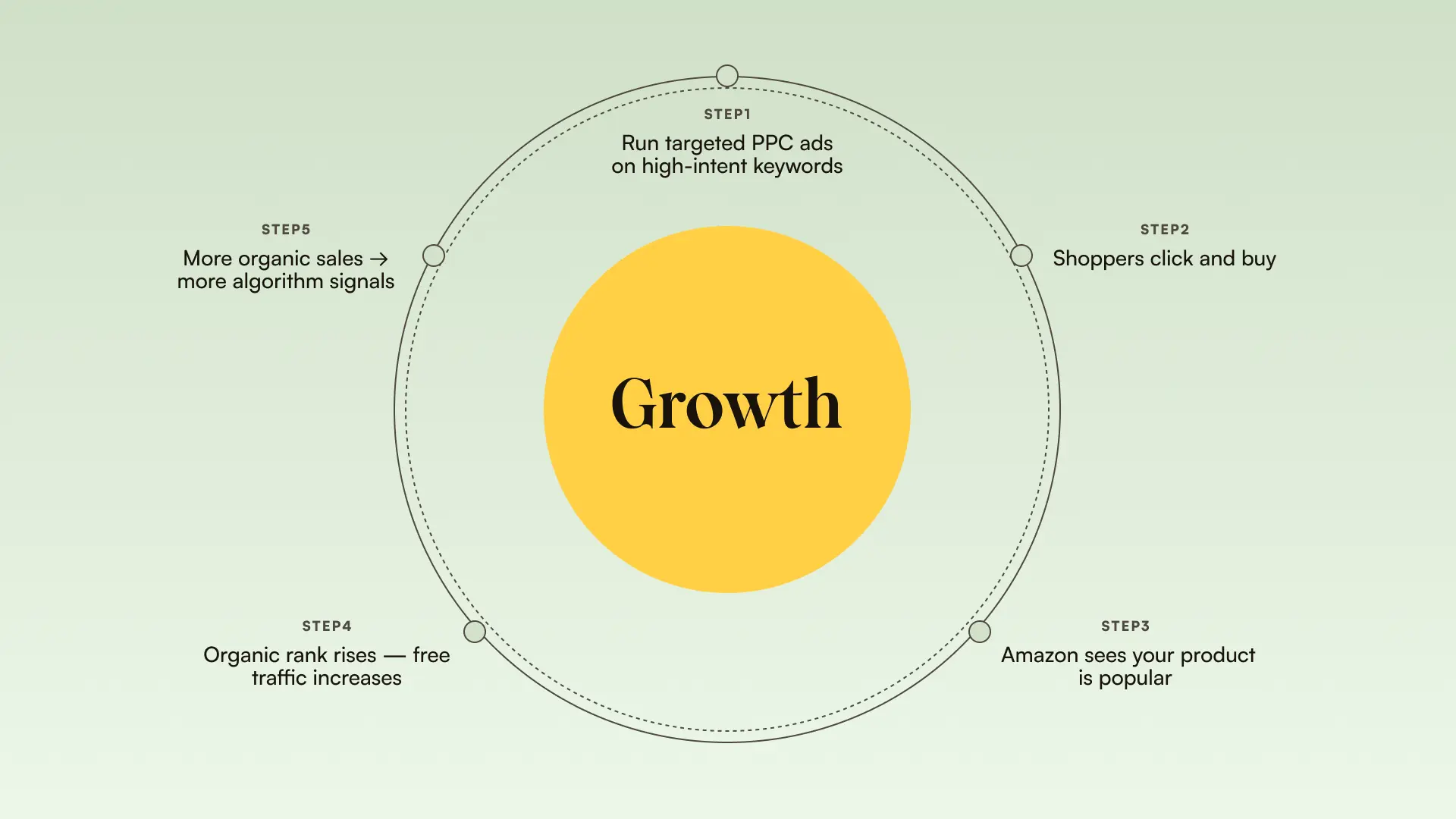
The biggest difference is the PPC-organic flywheel, which works in the following way.
On Amazon, you run paid ads, and when someone clicks it and buys your product, this tells Amazon's algorithm that your product is popular. The algorithm then rewards you with a higher spot in the free search results, meaning you keep the sales, even when you stop paying for ads.
Google has no equivalent. The paid ads and organic ads run on completely separate systems.
How the A9/A10 algorithm ranks products
Amazon's ranking algorithm, called A9 (with an updated version known as A10), looks at three main things. The first is keyword relevance and whether your listing actually includes the words shoppers type into the search bar.
The second is the conversion rate which is how many people that have clicked on the listings actually bought the product. And the third one, includes sales velocity which is how many products you have sold lately, especially in comparison to similar products in your category.
Why standard SEO agencies struggle on Amazon
Google SEO agencies are trained to win with content strategy, backlinks and technical site health.
This doesn't translate to Amazon, so agencies that don't have the specific knowledge in Amazon, will try to apply blog-style keyword stuffing to product titles, while ignoring the back end search terms. They will treat PPC as a separate thing that is not connected with organic ranking.
This is one of the reasons why hiring a specialist is important. Amazon rewards those who understand how to create the right listings, how to run the ad account and the ranking algorithm. These are all part of one connected system, not three separate departments.
The 6 core services an Amazon SEO agency delivers
Every serious Amazon SEO agency will deliver a version of the six services below. The quality and depth is what separates a cheap $1,500 a month agency, from a senior one that actually moves the numbers.
1. Keyword research and mapping
Keyword research is the main foundation of everything else, and a good agency will have to build a keyword map that sorts the keywords in four different groups such as: primary keywords (which are the most common phrases that shoppers use), secondary keywords (which explain the features of the product), long-tail keywords that are specific and low-volume but have a stronger buying intent, and backend keywords which are used by Amazon to decide what you show up for.
All of these specific keywords become a blueprint which is used for everything that the agency will write.
2. Listing optimization (titles, bullets, description)
Listing optimization is what turns keywords into actual sales
A strong agency will write the title using your brand name, main keyword and two or more details that will influence the buying decision of shoppers (such as size, material and quantity).
Bullet points should be written in feature-benefit style, and secondary keywords should read naturally to a real person.
The description and A+ Content go deeper in the story, and answer all the common questions about the product. And here is the important part. A good listing copy has to do two things at once: to include the right keywords so Amazon can rank it, and it needs to convince a real human to buy.
3. Backend search term optimization
Backend search terms are one of the most overlooked parts of Amazon SEO. These are hidden keyword fields inside the Seller Central and while most shoppers never see, Amazon still uses them to decide what your product shows up for.
A lot of sellers have these fields blank, which is like throwing away free rankings. So, the rules here are very simple: 250 bytes total (about 250 characters), don’t repeat words that are already in your title or bullets, no commas are needed and only use real search terms (not brand names or competitor names).
4. A+ Content and brand store optimization
While the A+ Content will not immediately improve your keyword ranking, it still has a big impact on the conversion rate, which over time, improves the ranking indirectly.
A good agency will create A+ layouts that tell your brand's story and answer common buyer questions and visually compare product options. The newer A+ Premium format adds extra interactive modules such as video, and larger images for brands that qualify for this.
The Brand Store works hand in hand with A+ Content. Think of it as your own mini-website which is built inside Amazon, with multiple pages that you can showcase your full product catalog, tell your brand story and group products into categories.
When A+ Content is well-built and works simultaneously with Brand Store, the end result is usually an increased conversion rate by 3% to 10%. This is the characteristic lift that tells Amazon's algorithm that your product is worth showing to more shoppers.
5. PPC and SEO integration
One of the most misunderstood parts of Amazon SEO are the paid ads (PPC) and organic rankings. These are not two separate channels, but they both feed into the same ranking system.
Here is how this works: your ads bring shoppers to your listing, those shoppers buy and the sales tell which Amazon product is popular. Then, Amazon rewards you with a higher organic rank, and then you start getting sales without paying for ads.
Over time, your TACoS will drop once you get more sales that come from free traffic. Agencies that run PPC and SEO together can set this cycle up on purpose by running targeted ads on high-intent keywords to push organic rank.
Agencies that treat ads and SEO as separate services miss this cycle and in the end, their clients pay for traffic that should have come up for free.
6. Rank tracking and performance reporting
| Metric | What it measures | What it tells you about organic |
|---|---|---|
| Keyword rank | Position for target search terms | Direct proof of ranking movement |
| Organic sessions | Traffic arriving without ads | Whether free visibility is growing |
| Conversion rate | Share of visitors who buy | The signal that moves rank fastest |
| TACoS | Ad spend against total revenue | Falling means the SEO work is compounding |
| ACoS and ROAS | Ad performance in isolation | Nothing — the organic picture stays hidden |
Good tracking is what separates agencies which deliver results from those that just look busy. The numbers that matter are: keywords rank over time, growth in organic sessions, conversion rate changes by listing, impressions and TACoS.
Agencies that only provide ROAS or ACoS reports are not giving you the full picture of your account. These numbers only show how your ads are doing, and hide the real organic situation. TACoS, on the other hand, is a metric that compares your ad spend with your total revenue, and gives you a clear signal of whether your organic rank is actually growing or not.
At Olifant Digital, we do TACoS reporting as a primary metric for every Amazon account that we manage, because it shows the real profitability across both paid and organic combined.
How Olifant Digital handles Amazon SEO
At Olifant Digital, we treat Amazon SEO as a foundation of every account. Our Amazon SEO service includes keyword mapping and listing structure as a first thing we do for the account before any ads go live.
By the time this happens, our listings are already set up to rank for the right keywords, and to convert ad clicks into sales.
Keyword strategy is planned from start to finish, before a single word of copy gets written. Primary keywords are added in places where they have the biggest impact: title and bullet points.
Long-tail keywords and backend fields extend the reach, so your product shows up for related searches, not just those that are obvious. Every part of the listing is tied to a specific ranking goal before any writing begins.
A/B testing is built into the SEO process. Testing different hero images and titles directly affects two things: click-through rate (which is how many shoppers click your listing) and conversion rate (which is how many of those people actually buy).
These are the two signals that move the organic rank the fastest, and every winning test keeps adding to the rankings in the weeks that follow.
PPC runs alongside SEO as an organic accelerator. Daily campaign work is focused on driving sales on target keywords which then lift those same keywords in the organic rankings. Ads are not a separate service, but the engine that powers the SEO flywheel.
TACoS is what ties everything together. If your TACoS levels are dropping over time, it means the SEO work is compounding the way it should. If it's flat or going up, something in the system is broken and needs attention right away.
We apply the same SEO methodology on every client account, and Olifant AI, our own platform, tracks ranking and keyword coverage daily, so every approach we recommend has been tested across live accounts.
What real Amazon SEO results look like
| Brand | Result | What drove it |
|---|---|---|
| Elite Jumps | 124% revenue growth, 51% CVR lift | Keyword setup and listing structure rewritten, then A/B tested |
| Spade to Fork | 46% revenue growth in 44 days | Listings fixed before ad spend scaled; ACoS dropped 19% |
| OneRoot | 40% sales growth in Japan | Keywords and copy localized to how Japanese shoppers search |
Amazon SEO results show up in very specific ways such as higher conversion rates, better keyword ranking, faster revenue growth and dropping TACoS. Three client examples show how that plays out in real numbers.
Elite Jumps: 51% CVR lift and organic ranking improvements
When we partnered with Elite Jumps, their revenue grew by 124% through a coordinated SEO and PPC build.
We rewrote their entire keyword setup and listing structure from scratch. The 51% jump in the conversion rate came from A/B testing titles and bullets which then fed back into organic rankings by showing Amazon that shoppers really wanted this product.
Once their listings started to convert well, we scaled their ads without wasting spend, and their organic rank climbed steadily on the target keywords.
Spade to Fork: 46% revenue growth via listing and PPC SEO flywheel
Spade to Fork grew their revenue by 46% in just 44 days. We fixed their listings before scaling their ad spend.
The original copy wasn’t converting well, so instead of pouring more money into ads that would have burned their budget, we rewrote their listings which lifted their conversion rate.
Targeted ad campaigns were launched on high-intent keywords, to build up sales velocity on the phrases that mattered most. From there, organic rank followed, ACoS dropped by 19% a the flywheel kicked in.
OneRoot: Profitable international expansion via SEO localization
OneRoot grew their sales by 40% after their expansion into the Japanese Amazon marketplace.
This required proper SEO localization, not just translated copy-paste. This meant researching keywords which are specific to the Japanese market, writing listing copy that fit their local culture, and adjusting their positioning which is based on how Japanese shoppers actually search.
The outcome shows that Amazon SEO is not just keyword stuffing, but it’s about understanding how a local audience talks about what they want, and then building the listing around that language.
How to choose the right Amazon SEO agency
Not every agency that states “Amazon SEO” as their service, actually knows how to run it properly.
This is why before signing any contract it’s important to ask the following questions which will tell you whether the agency is run by a real specialist or just a generalist with a nice landing page.
- Do you optimize the listings before running the ads, or do you launch PPC directly?
- Do you manage backend search terms as part of your SEO work?
- Do you report TACoS, or only ACoS and ROAS?
- Do you do A/B testing on the listing elements and treat conversion rate as an SEO signal?
- Do you have real, documented experience in my specific product category?
- Can you show me actual keyword ranking improvements from past clients?
An agency that can’t provide results and answers for all six is probably not the right fit. All the answers should be specific and based on an actual process, and backed up with examples.
Olifant Digital offers a free marketing plan for brands doing $500K or more in annual revenue. If you want a senior-led SEO audit with a 60-day guarantee, get yours today.
Frequently asked questions
What does an Amazon SEO agency do?
An Amazon SEO agency helps sellers to rank higher in Amazon’s search results by optimizing every part of their product listing that the algorithm uses to decide what to show shoppers.
This includes keyword research, writing and fixing product listings (titles, bullets, descriptions), filling in backend keyword fields, building A+ Content and Brand Stores, connecting PPC to organic rank, and tracking performance over time.
The final goal is to build organic visibility that grows on its own, so the brand can rely less on paid ads as time goes on.
How is Amazon SEO different from Google SEO?
Amazon ranks the products based on a buying behavior including: how many shoppers click, how many buy and how many sales you have made recently. Google ranks pages based on backlinks, domain authority and content quality.
On Amazon, all the optimization happens inside your product listing and backend fields, and not in the page code or meta tags.
Amazon also has PPC organic flywheel where paid sales directly lift the organic rank, and that’s the dynamic that doesn’t exist on Google.
How much does an Amazon SEO agency cost?
Amazon agencies charge between $1,500 and $5,000 per month, depending on how many products you have, what services you need and how many marketplaces you’re in.
At Olifant Digital, we charge a montly fee of $2,000 per month which reflects a senior-led service model. For that investment, you get a full SEO work which includes keyword strategy, listing optimization, PPC integration and TACoS free reporting.
While cheaper looking agencies look often like a bargain, they usually end up wasting more in ad spend and rankings they never build.
How long does Amazon SEO take to show results?
Listing optimization can lift your conversion rate within days of going live. Real organic ranking improvements take anywhere between 30 to 90 days which depends on how competitive your category is, and how much PPC is backing up the SEO work.
The big payoff where TACoS drops as more of your sales come from organic traffic usually takes three to six months to build. In this process, it’s important to be patient, and careful with any agency that might promise overnight rank jumps.
Can you do Amazon SEO without running PPC?
Technically you can, but it leaves a lot of ranking gains on the table.
On Amazon, paid ads and organic rankings feed into each other in a cycle that is often called the flywheel: ads drive sales, sales tell Amazon which of your products is popular, and then Amazon rewards you with better organic rankings.
Brands that treat SEO and PPC as separate things, miss this cycle and usually see slower results. The strongest results come from agencies that run both together, so every paid click also helps your organic ranking over time.
What metrics should I use to measure Amazon SEO performance?
To measure Amazon SEO performance there are four metrics you should use, including: keyword rank over time, organic sessions, conversion rate and TACoS. Only looking at ROAS or ACoS gives you half of the picture about your account because these numbers only cover what your ads are doing.
TACoS is the cleanest signal of whether your ad spend is building organic rank or is just padding revenue. If TACoS is dropping while revenue is growing, the SEO work is compounding the way it should.
.webp)
Alex is the founder and CEO of Olifant Digital, where his team manages over $100M in annual Amazon client revenue across 50+ brands, and he runs a 7-figure Amazon brand of his own. That operator background shapes how the agency works: every tactic is tested with his own money before it reaches a client account. He oversees PPC methodology, creative, and conversion rate across all client accounts to make sure Olifant Digital scales brands profitably.


.png)
Mike reviews every Amazon article on this blog for strategic and technical accuracy before it publishes. As Director of Amazon Growth at Olifant Digital, he sets marketing strategy across client accounts and personally audits PPC at every stage of growth. He brings 8 years of daily Amazon operations across 7 and 8-figure brands including Beauty by Earth, Ekster, and Bullstrap, the kind of hands-on depth most agency directors delegate away.