

What “account structure” actually means - and why it determines everything else
Account structure is the way you organize campaigns, ad groups, keywords, match types, and ASINs. It determines whether your data is readable, whether your budgets are controllable, and whether scaling decisions rest on evidence instead of guesswork.
Poorly structured accounts produce ambiguous data. If three products share one campaign and one keyword drives 80% of the spend, you cannot tell which product converted and which ones cost you money. You get a blended signal that tells you almost nothing.
The consequences are clear. Aggregate ACoS looks healthy while two or three products run at a loss, subsidized by the third. The account looks successful while the brand is bleeding.
These structural mistakes are predictable, and they show up in the majority of accounts run by agencies.
The 5 most common Amazon PPC structural mistakes agencies make
1. Grouping multiple ASINs into a single campaign
A brand with 12 products has 4 different campaigns that contain 3 products. Their budget is split between them based on which ad wins the auction and not by margin or strategic priority.
Without product-level separation, you can’t tell which ASIN is actually earning its budget, and you can’t allocate the spend on TACoS per product. Every time you try to scale a winner, you will end up dragging the budget towards the products that don’t deserve it.
When Spade to Fork came to us at Olifant, they had no product-level profitability tracking, which left the brand with a one-size-fits-all approach. This left them unable to prioritize winners or fix underperformers.
2. Running all match types in the same ad group
Broad, phrase, and exact match serve different purposes, with different bids and different negative keywords. When they share one ad group, broad match steals impressions and spend from exact match. You lose the ability to read or steer performance by intent.
3. Chasing broad, high-volume keywords instead of high-intent long-tails
Broad, high-volume keywords look attractive because of their search volume. Across the accounts we manage, they carry the highest competition, the highest CPCs, and the lowest purchase intent. In our accounts, high-intent long-tail keywords convert at a higher rate for less money.
When Balanced Tiger came to us, previous agencies had chased broad, ultra-competitive keywords that drained the budget. After we rebuilt their account structure and shifted to high-intent long-tail keywords, ACoS dropped 50% and revenue grew 171% in two months.
4. No negative keyword strategy
Most agencies run no systematic process for negative keywords, so wasted spend accumulates. A brand spending $100K per month can leak $20K per month on irrelevant search terms. Treat your negative keyword list as a living document, and update it from the search term report every day.
5. Reporting on ACoS instead of TACoS
ACoS measures ad cost against ad revenue. TACoS measures total ad cost against total revenue, including organic sales. ACoS-only reporting hides products that lose money, because a healthy blended number masks them.
When Onsen Secret came to us, ACoS-only reporting had hidden the real problem across their catalog. Once we reported on TACoS per product, the losing products became visible and the account tripled profit, adding $95,934 per month. Use our TACoS calculator to see total ad cost against total revenue for your catalog.
How 7–8 figure brands actually structure Amazon PPC accounts
ASIN-level campaign architecture
Every product gets its own portfolio. A brand with 10 products needs 10 portfolio structures, one per ASIN. This gives you budget control, profitability tracking, and clean data at the product level.
The 1-1-1-1 Method: One campaign, one ad group, one keyword, one ASIN
The 1-1-1-1 method means one campaign, one ad group, one keyword, and one ASIN. Each keyword maps to exactly one product, so every result is attributable. You see which keyword drives which sale for which ASIN, with no blending.
A clean account structure is the foundation that makes profitable scaling decisions obvious rather than uncertain. When we rebuilt MatchaBar on the 1-1-1-1 method, they added $114,305 in monthly Amazon revenue. Balanced Tiger grew revenue 171% and cut ACoS 50% in two months after the same rebuild.
Match type segmentation across separate campaigns
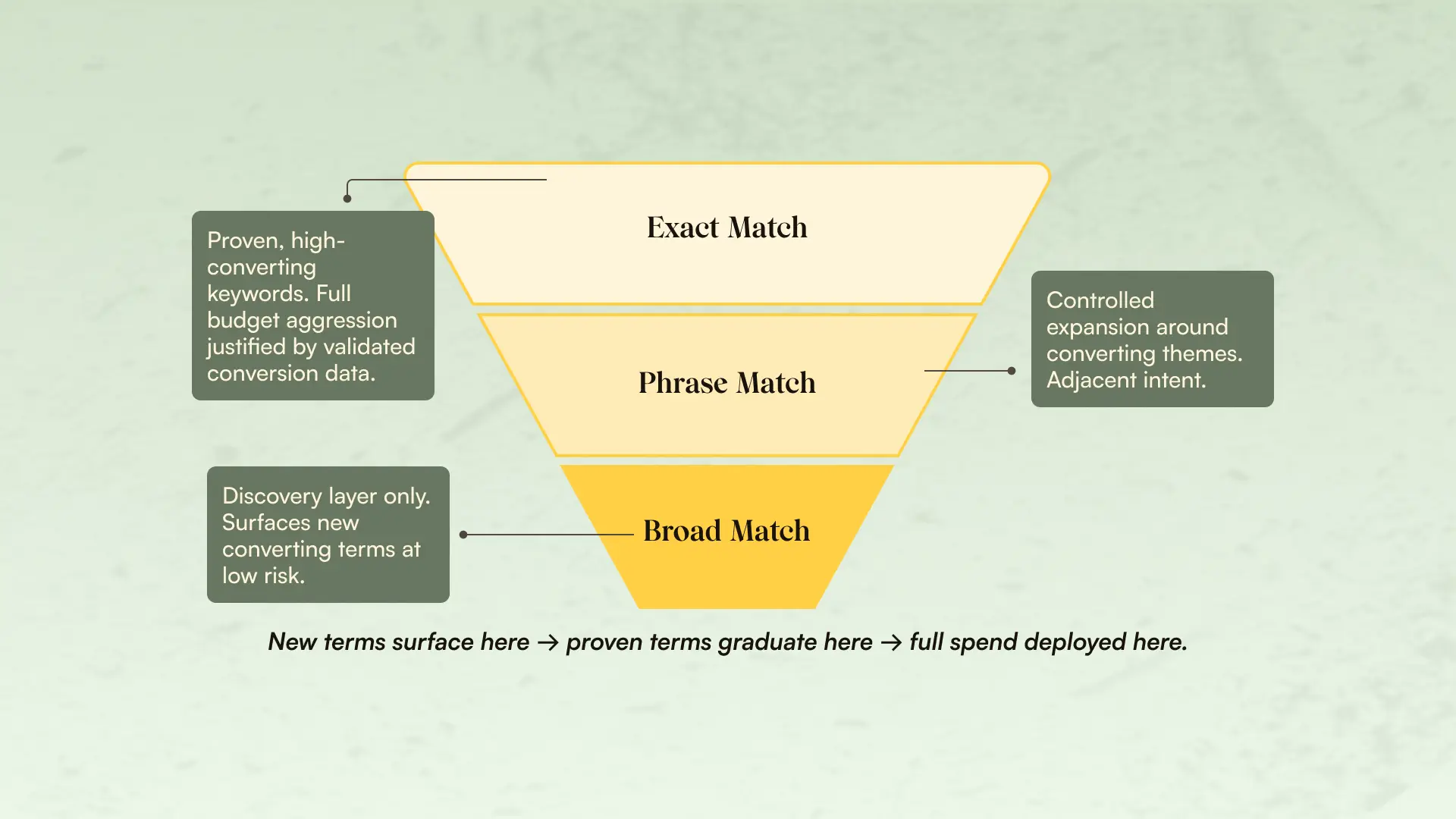
Give each match type its own campaign. Broad match handles discovery, phrase match handles controlled expansion, and exact match takes the full budget on proven terms. Separate campaigns let you set distinct bids and budgets per match type, as defined in Amazon Ads keyword targeting documentation.
Competitor ASIN targeting as a standalone campaign layer
Run competitor ASIN targeting as its own campaign layer. This places your product on competitor listings, following the Amazon Ads product targeting guide. These shoppers have already searched, clicked, and are evaluating a product in your category, which gives them higher purchase intent than the average visitor.
For Spade to Fork, competitor ASIN targeting grew ad sales by 132% on its own.
How to use sponsored display as a retargeting layer
Sponsored Display works as a retargeting layer. Use it to re-engage shoppers who viewed your product and did not buy, following the Amazon Ads views remarketing guide. This compounds CVR without inflating your keyword CPCs, because you reach warm viewers instead of bidding harder on search.
The match-type budget split: 60/30/10 across exact, phrase, and broad
Split the budget 60/30/10 across match types. Send 60% to exact match, 30% to phrase and competitor ASIN targeting, and 10% to broad discovery. This split governs match-type allocation inside a structured account and is separate from any campaign-type budget split.
What Olifant’s 1-1-1-1 method delivers in practice
MatchaBar: $114,305 added in monthly Amazon revenue
- Problem: multiple agencies left poorly structured campaigns with no clear architecture, an unprofitable ACoS, and no performance visibility.
- Fix: we rebuilt every campaign with the 1-1-1-1 method, then ran daily optimization and weekly A/B testing on hero images.
- Result: $114,305 added in monthly Amazon revenue.
"Working with Olifant has transformed our business. They have a marketing strategy for every quarter, and it's clear what we should be working on together." Graham Fortgang, Founder, MatchaBar
Balanced Tiger: 171% revenue growth with ACoS cut 50% in two months
- Problem: previous agencies chased broad, ultra-competitive keywords that drained the budget.
- Fix: we eliminated non-converting keywords, rebuilt around the 1-1-1-1 method with high-intent long-tail targeting, and added bundles to lift AOV.
- Result: 171% revenue growth, ACoS cut 50%, and AOV doubled in two months.
"Extremely effective! Excellent communication and project management on their side to implement widespread changes over a short period of time." Adriano Bordoli, CEO, Balanced Tiger
Wedge Guys: 391% Amazon sales growth with a 17% ACoS reduction
- Fix: we rebuilt the account structure.
- Result: 391% Amazon sales growth with a 17% ACoS reduction.
Frequently asked questions
How should a 7-8 figure Amazon brand organize its PPC campaigns?
Organize PPC at the ASIN level using the 1-1-1-1 method: one campaign, one ad group, one keyword, and one ASIN. Give each product its own portfolio so budget, data, and profitability stay separated. This structure lets you scale winners without dragging spend toward products that do not earn it.
Why do most Amazon PPC agencies get account structure wrong?
Most agencies never rebuild the structure an account launches with. They keep optimizing bids inside bloated campaigns that group multiple ASINs and mix match types. That produces blended data, so they cannot tell which product converts, and the account plateaus.
What is the difference between ACoS and TACoS in Amazon PPC?
ACoS measures ad spend against ad-attributed revenue. TACoS measures total ad spend against total revenue, including organic sales. TACoS shows whether advertising is building organic rank or quietly eroding profit.
How often should Amazon PPC campaigns be optimized?
Optimize daily. Review bids and the search term report every day, and run structured A/B tests weekly. Daily management catches wasted spend before it accumulates, which is why we work every account daily rather than launching campaigns and letting them run.
How much does it cost to have an agency rebuild an Amazon PPC account structure?
Management starts at $2,000 per month, with custom pricing based on catalog complexity. The rebuild is part of onboarding, not a separate fee. Every engagement is backed by our 60-day money-back guarantee on management fees.
Ready to see what your current structure is costing you?
If your account still runs on the same structure it launched with, the ceiling you are hitting is structural and not a budget problem. Get a free marketing plan with Olifant Digital, and we will break down your current campaign architecture and identify exactly what it is costing you.
.webp)
Alex is the founder and CEO of Olifant Digital, where his team manages over $100M in annual Amazon client revenue across 50+ brands, and he runs a 7-figure Amazon brand of his own. That operator background shapes how the agency works: every tactic is tested with his own money before it reaches a client account. He oversees PPC methodology, creative, and conversion rate across all client accounts to make sure Olifant Digital scales brands profitably.


.png)
Mike reviews every Amazon article on this blog for strategic and technical accuracy before it publishes. As Director of Amazon Growth at Olifant Digital, he sets marketing strategy across client accounts and personally audits PPC at every stage of growth. He brings 8 years of daily Amazon operations across 7 and 8-figure brands including Beauty by Earth, Ekster, and Bullstrap, the kind of hands-on depth most agency directors delegate away.