

Introduction
Are you getting ready to launch a product on Amazon and wondering what tools can help?
A product launch tool is software designed to help you plan, execute, and optimize your product launches. Many of the best product launch tools offer a free tier, allowing you to try out basic features before committing to a paid plan.
In this article, we’ll cover 10 of the best tools on the market that can help. Plus, some added tips to make sure you’re on the right track.
What Are Amazon Product Launch Tools And How Do They Work?
When you’re launching a product on Amazon, you can either do all the legwork manually or use Amazon tools.
Some Amazon tools help you complete the product, audience, and competitor research more quickly and accurately. Other tools will help you to implement the strategy you’ve decided on. Many of these Amazon tools are a powerful tool for managing and optimizing product launches, providing robust capabilities for sellers.
They work by pulling and aggregating data directly from the marketplace and then sharing that data to help you make more educated choices. In addition, many of the tools can make changes on your behalf, like repricing tools. Many product launch tools are user friendly, making them accessible even for beginners.
Workflow automation is a key feature of many tools, helping to streamline repetitive tasks and save time. These tools provide actionable insights by analyzing marketplace data, allowing you to make informed decisions. Marketing automation is often included, enabling automated campaigns and communications across multiple channels.
Integration features enable users to connect with other platforms and automate data flows seamlessly. Key features of these product launch software solutions include analytics, automation, and integration, all designed to streamline the launch process.
The platform enables users to manage listings, track performance, and optimize campaigns efficiently. Analytics tools are part of the suite of features offered, providing deep data analysis. Customer relationship management is also a benefit, helping you track and optimize customer interactions throughout the launch.
Customizable templates are available to help tailor workflows to your specific needs and brand objectives. Some tools serve as an all in one solution for product launches, combining multiple functionalities in a single platform. Additionally, a project management platform can help coordinate launch activities and team collaboration for a smoother process.
Almost any task you need to do successfully on Amazon can be completed and complemented by using a tool.
Product Launch Budgeting and Cost Management
A successful product launch starts with a solid financial foundation. Product launch budgeting and cost management are essential for ensuring that every aspect of your launch from market research and product development to marketing campaigns and team operations receives the resources it needs.
By establishing a comprehensive budget, product managers can allocate funds strategically, track progress, and make informed decisions throughout the launch process.
Leveraging project management tools can make budgeting more efficient and transparent. These platforms often include features for expense tracking, financial reporting, and resource allocation, allowing you to monitor spending in real time and adjust as needed.
This not only helps keep your launch on track financially but also highlights areas where costs can be optimized without sacrificing quality.
Effective budgeting is about more than just controlling expenses; it’s about maximizing your return on investment. By planning ahead and using the right project management tools, you can ensure that your marketing campaigns, market research, and product development efforts are all properly funded, setting the stage for a successful product launch.
Product Launch Risk Management and Mitigation
Every product launch comes with its share of risks, but proactive risk management can make the difference between a smooth rollout and a costly setback.
Identifying potential risks early whether they’re market-related, technical, or operational allows product managers to develop strategies that minimize their impact and keep the launch process on course.
Market research and customer feedback are invaluable for uncovering market risks, such as shifting consumer preferences or unexpected competition. Technical risks, like product malfunctions or software bugs, can be addressed through thorough testing and quality assurance.
Operational risks, including supply chain disruptions or logistical challenges, are best managed with contingency planning and clear communication among stakeholders.
Modern product launch tools offer features like risk assessment templates, scenario planning, and collaborative workspaces, making it easier for teams to anticipate and respond to challenges.
By integrating these tools into your launch process, you gain valuable insights and can act quickly to mitigate issues, increasing the likelihood of a successful product launch.
Product Launch Quality Assurance and Testing
No product launch is complete without rigorous quality assurance and testing. Ensuring your product meets high standards and functions flawlessly is critical for customer satisfaction and long-term success.
Quality assurance is a systematic process that verifies your product aligns with both internal requirements and customer expectations, while testing uncovers and resolves any issues before your product goes live.
A robust QA and testing strategy should include functional, performance, security, and usability testing. Utilizing specialized QA tools can automate repetitive tasks, track defects, and facilitate collaboration between development and QA teams.
Incorporating customer feedback through beta testing or user acceptance testing (UAT) provides valuable insights into real-world usage, allowing you to make final adjustments before launch.
By investing in comprehensive QA and testing, product managers can minimize post launch issues, boost customer satisfaction, and ensure a smooth, successful product launch.
This attention to detail not only protects your brand reputation but also sets the stage for positive reviews and repeat business.
10 Best Product Launch Tools In 2026
Let’s take a look at some of the top Amazon tools available to help you launch your product.
1. SMARTSCOUT
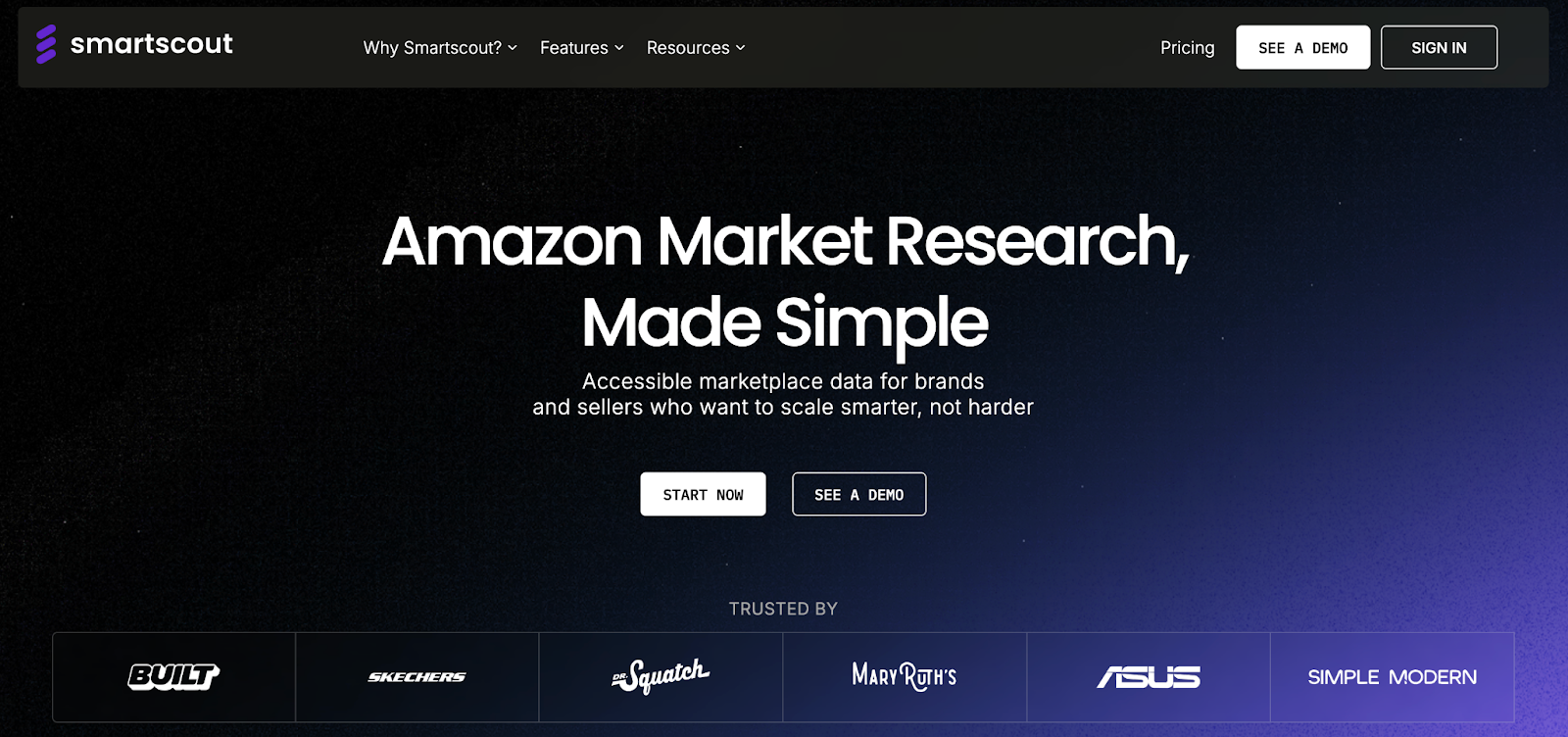
SmartScout is a market intelligence suite built for Amazon sellers who want more than basic product scouting. Instead of only showing single-ASIN metrics, it helps you analyze brands, subcategories, sellers, and products so you can validate demand, understand competitive pressure, and spot where the real opportunities live.
One of SmartScout’s standout features is Traffic Graph, which visualizes Amazon’s “frequently bought together” connections to uncover cross-sell and bundling angles. It also includes AI Listing Architect to help you generate keyword-informed listing copy faster.Pricing starts at $25/month. Offers a 7-day money-back guarantee.
Features of SmartScout:
- Subcategories explorer to size up niches and category momentum
- Brand database for competitor and brand-level research
- Seller Tools / Seller Map for seller discovery and analysis
- Traffic Graph for “frequently bought together” product relationships
- AI Listing Architect for faster listing creation
- UPC Scanner + FBA Calculator for quick profitability checks
- Ad Spy to open any brand's advertising playbook
2. HELIUM 10

Helium 10 offers a full suite of Amazon tools that will help you sell on Amazon whether you are just starting or have been selling on the marketplace for a while now. Helium 10 stands out for its user friendly interface and customizable templates, making it easy to tailor your workflow and product launch process to your brand.
Helium 10 has over 20 tools to help you research, develop better listings, and optimize your PPC ads.
You can test the tools for free, but to get full use, you’ll need to sign up for a monthly or annual plan. The lowest plan starts at $37/month.
3. ZONGURU
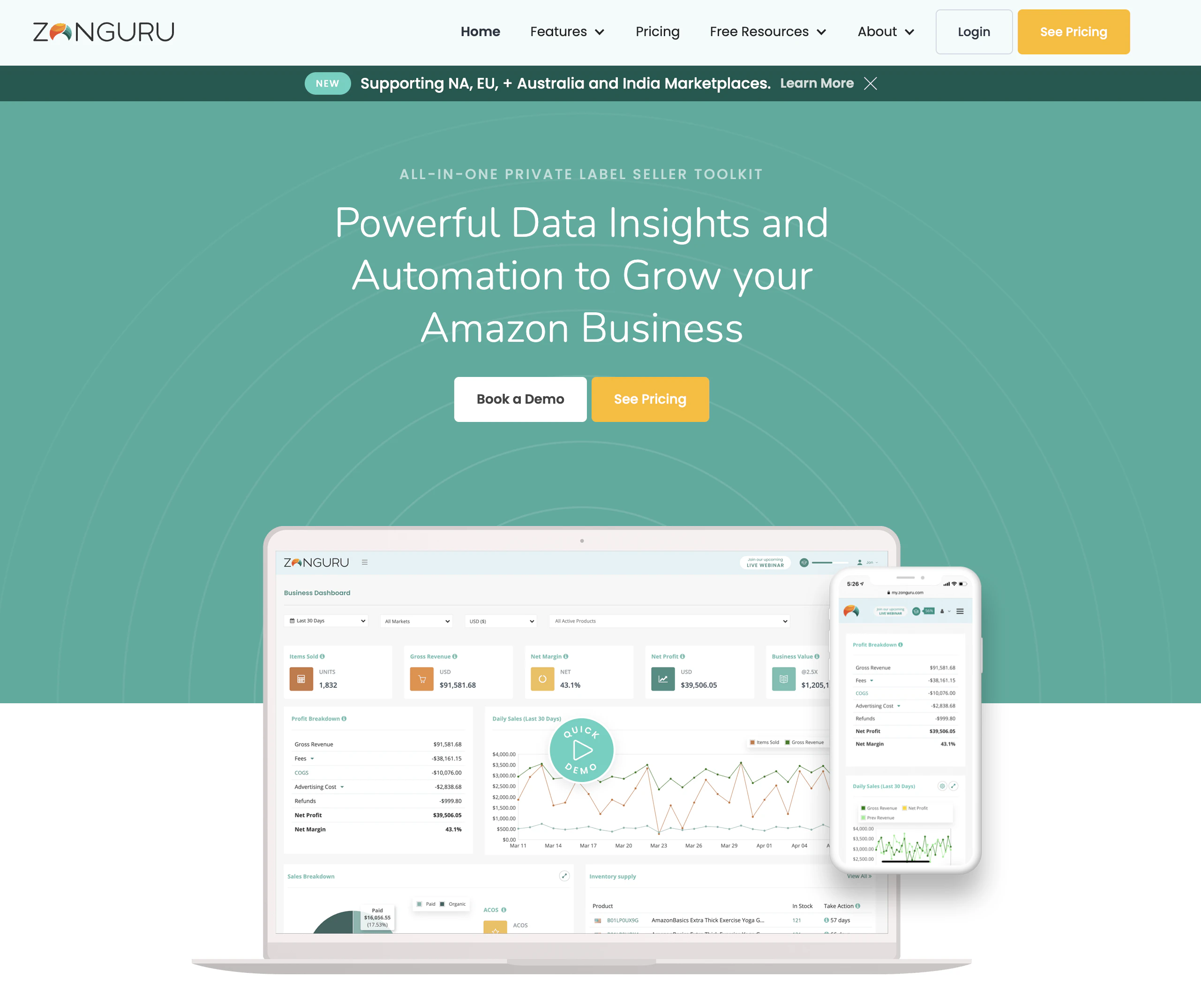
ZonGuru is another option if you are looking for a full stack of Amazon tools.
On top of your standard tools, ZonGuru stands out because they make it easy to source new products from Alibaba through their collaboration. The niche finder feature is also great if you are focusing on one audience. ZonGuru offers workflow automation features to streamline your processes and enables you to gather feedback from customers to improve your product offerings.
There are two plans available, the researcher for $39/month when billed monthly or the seller for $49/month when billed monthly. Free trials are available for both plans.
4. JUNGLE SCOUT

Jungle Scout helps you research your products and your competitors with ease.
Jungle Scout provides a wealth of educational materials that go along with its tools to help both new and advanced sellers. It features robust analytics tools and data analysis capabilities, offering actionable, data driven insights to inform your product launch strategy.
It even comes with a Chrome extension that lets you do your research right from Amazon.
You can get the basic plan for as low as $29/month if you bill annually, plus a 14-day free trial.
5. VIPON
Vipon helps sellers reach more customers by advertising their discounted products.
You sign up and submit your deal to Vipon, and they send it out to their audience of shoppers willing to try new products at the right price. Vipon also supports running email campaigns and promoting your offers through social media posts to maximize your product’s visibility. The standard plan is $100 per month, plus your discount must be at least 50% off.
6. VIRAL LAUNCH

Viral Launch has a suite of tools that focus on helping sellers hit the ground running.
Viral Launch features marketing automation to streamline your campaigns, and the platform enables users to optimize every aspect of their product launch, from research to advertising.
Viral Launch will help you with your product, keyword, and competitor research for $69 billed monthly.
If you opt for the most expensive plan at $199 billed monthly, Viral Launch will also help you get your PPC ads going.
7. REPRICEREXPRESS.

If pricing is a major part of your strategy, you’re going to need a repricing tool to avoid stalking your competitor listings at all hours.
RepricerExpress is a top-notch tool to help you automatically reprice your products based on your strategy. Its key features include automation and tracking key metrics to ensure your pricing remains competitive.
The tool isn’t cheap, with the lowest plan starting at $79 per month when billed annually ($99 per month if billed monthly), but it does come with a 14-day free trial.
8. FEEDBACK EXPRESS

Feedback Express will help you manage your feedback without the headaches.
With Feedback Express, you can automatically send requests for feedback, and the tool will alert you if any negative feedback is received. It enables you to gather valuable feedback and supports customer relationship management to improve your seller reputation.
You can try it for free for 28-days, and after that, you can send up to 5,000 feedback request emails per month for $55/month when you pay annually.
9. SONAR

Sonar is a free keyword tool offered by Sellics (additional paid tools are available from the company). Sonar offers a free tier and serves as a product launch software for keyword research, helping you identify the best keywords for your campaigns.
There are over 180 million keywords indexed, and you can also track your competitors’ keywords with the reverse ASIN lookup feature.
10. AMAZON SELLER APP
If you haven’t downloaded the Amazon Seller App yet, do it now.
You can use the app to help edit your product photos, manage your listings, track sales, and even respond to customer questions and feedback. The Amazon Seller App is an all in one solution for managing your online business, tracking product offerings, and supporting content creation for your listings.
The Amazon Seller App lets you stay on top of your product launch no matter what else you are doing as long as you have your phone.
Bonus: 11 Things You Should Do When Launching A Product On Amazon
Now that you know what tools are available to help you launch on Amazon, it’s time to learn what actions you need to focus on.
1. DO YOUR RESEARCH FIRST.
An Amazon business is like any other business in the fact that if you go into it blind, you’re likely going to fail.
You need to do your homework to know what you’re getting into. Thorough research helps you identify your target market and tailor your strategy accordingly.
Not only do you have to understand how Amazon works: what Amazon is looking for, how the algorithm works, and how customers use the marketplace: but you also need to know what’s going to make your product listings stand out.
An analysis of your competitors, their products, and the keywords they use is an excellent place to start.
Once you’ve looked at your competitors, you’ll know what they lack that you can capitalize on for your product.
You’ll want to continue to prioritize research because things can change rapidly on Amazon, and you have to keep up. Using research tools can provide data driven insights to inform your decisions.
2. GET YOUR PRODUCT AN AMAZON PRIME BADGE.
Making your products eligible for Amazon Prime will get you access to a larger audience.
The Prime program continues to grow as Amazon continues to push it heavily. The customers paying for Prime want to take full advantage of it and gravitate to products that are eligible for the perks like free two-day (or sooner) shipping.
For your product to be Prime eligible, though, you’ll probably need to let Amazon warehouse and ship your products for you.
If you aren’t already familiar with the Fulfilled-By-Amazon (FBA) program, it allows you to ship your pre-packaged products to Amazon warehouses so that when a customer orders, they pack and ship it for you.
It does come with some associated fees, but Amazon favors the products enrolled.
I said probably because Amazon does allow some products to be Prime eligible and fulfilled by the seller, but it isn’t easy to maintain.
Unless you want to spend your life chained to getting your inventory out the door the same day it’s ordered for every single order.
3. PRICE WISELY.
Your customers want to feel like they are getting the best price for their items, and Amazon makes it convenient to compare prices.
When you sell on Amazon, you have no choice but to consider how similar products are priced because your customers are.
But pricing wisely isn’t necessarily setting the lowest price.
If you’ve ever studied pricing psychology, you know that consumers like to go with the middle-of-the-road option most of the time.
However, they will only stick with that logic if your product is distinguished from your competitors in some way.
Whether it’s an additional feature or your package, or your brand, you need to demonstrate how your product is even slightly better.
Because if they compare products and everything is exactly the same, they will go with the lowest price.
When you first start selling on Amazon, it’s going to be hard to command the highest price in your category, but you can work your way up to the higher mid-end at least once you’ve built up your listing.
4. PLAN YOUR NEXT PRODUCT LAUNCH.
Every launch needs its own plan in place. Some of the steps will be the same every time, but the details will vary.
And the details matter when it comes to competing on Amazon.
Assuming that you’ve already determined how your products will be delivered to your customers, you need to focus on how you will get your products in front of the right customers as quickly as possible. Developing a content strategy such as planning an editorial calendar, blog posts, social media updates, and email marketing campaigns will help you effectively reach and engage your chosen audience during your product launch.
You probably have a pretty good idea of what audience you are looking to target, but if you haven’t labeled your persona profiles yet, now is the time. Campers looking for outdoor stoves is not a persona.
Are those campers hardcore outdoors enthusiasts who will need a stove that can withstand all the elements for a week, or is it a father looking for an outdoor stove for his family to use one weekend a year?
There will be essential marketing distinctions between those two groups. You need to decide which one you are going after because marketing to all is often as effective as marketing to no one.
5. PERFECT YOUR BRAND CONTENT.
Now that you know who you are speaking to with your listing and marketing, you need to hone it.
Your content needs to focus on your target audience, whether it be how you set up your product photos or your product title, or your PPC ads. Content creation tools can help you produce high-quality product photos, compelling titles, and effective ad copy to optimize your listings for better search engine rankings and marketing results.
Go look at your competitor listings with the same target audience and see how they talk about their products. You don’t have to look only on Amazon; you should look at their sites if they have them and any of their social channels.
But don’t just stop at reviewing what your competitors say in their marketing.
What are the customers saying?
Read product reviews, look in niche forums, and if you know anyone that would be the perfect fit for your product, ask them what they would need to know about your product before they would feel comfortable buying.
Once you’ve gathered your data, you will use it throughout your listings and ad campaigns.
6. SET COMPETITIVE OFFERS.
Amazon shoppers rely on reviews from other customers to guide their purchasing decisions, but your new product doesn’t give them anything to go on.
Even if your listing is perfect, your target customers might still be leery of taking the chance on a product without a proven track record. This is where offering another type of incentive can help you get ahead.
The incentive you have at your disposal is pricing.
You could set your product price at the lower end of the range in your product category. Or you could instead use coupons and other deals to give the impression that your customers are getting to try a superior product at a bargain price.
Not all sellers are eligible to run coupons, but luckily Amazon doesn’t exclude new sellers.
You can still run coupons even if you have no feedback. But if you have five or more reviews, you need to have an average rating of 3.5 stars to be able to run coupons. Products with only 1-4 reviews can have a lower average of 2.5 stars to be eligible.
7. USE PROMOTIONS.
At this point, there are no unicorn products on Amazon that have lots of searches but no competition. Sorry, but you’re going to have to work a little harder to get sales.
You’re going to need to run promotions for your new product.
You can choose to run all your promotions through Amazon, or you can mix it up and run promotions on other platforms as a compliment. Many sellers have found success using Facebook and Google ads in addition to ads on Amazon. Leveraging social media channels can help you reach a wider audience and gather more comprehensive customer touchpoints. Alternatively, you could use influencer marketing with your ad campaigns to give them a boost.
Remember, though, that influencer marketing is much tougher to measure and optimize, so you likely don’t want to use it on its own without other paid efforts. The right path for your product will depend on how your target audience seeks out information about products they need.
Do they search on Google, ask friends for recommendations on Facebook, or do they go straight to Amazon?
8. MANAGE YOUR ACCOUNT METRICS.
Amazon favors accounts that maintain strong metrics. If you want the algorithms to show your listings, you must stay on top of your ratings.
One of the most basic things you can do is to keep your products in stock. There may be one-off times where there is a rush of sales you weren’t expecting, but for the most part, you should be paying attention to your inventory levels and getting orders into your suppliers in advance to account for hiccups that may occur.
Amazon also looks at your:
- Buyer Feedback
- Cancellation Rate
- On-Time Delivery Rate
- Valid Tracking Rate
- Order Defect Rate
- Late Shipping Rate
If any of these metrics start to dip, you need to take immediate action to find out why and how to fix it. Amazon can and will suspend your account if you don’t.
The best way to avoid running into issues with anything shipping and delivery related is to enroll your products in the FBA program. Using FBA takes half of these metrics out of your hands so you can focus on tasks like marketing and customer service.
9. BROADEN YOUR TARGETED KEYWORDS.
At the product launch stage, you need to go wide with your keywords.
You don’t yet know what keywords will be successful, so you need to be trying out lots of potential winners.
For instance, what some may call a wallet, another may call a billfold. You don’t want to miss out on a customer base because you didn’t address a full range of keywords in your listing. By using both wallet and billfold, you just doubled the volume of keywords you can test for your listing.
Take the time to think about regional and even generational variances in terminology, as well as slang terms that could be used for your products.
If you are selling internationally, seek out possible search terms from native language speakers to the locations you are targeting. Find out what brands are the biggest competitors for your products in their country and look at the keywords they are using.
Of course, you will be limited to how many keywords you can include, but it’s best to be armed with a list you can pull from to swap with any keywords that aren’t performing without having to go back to the drawing board.
10. TARGET NEGLECTED KEYWORDS.
Once your competitors have established their listing, they don’t need to be scrappy and think outside the box anymore.
This opens up an opportunity for you to target what they are missing.
Now that you know all the keywords available, you go comb through your competitors’ listings and determine what keywords they aren’t capitalizing on. Look specifically for long-tail keywords the listing could include but doesn’t.
You can use these neglected keywords to try to sway your competitors’ customers to your listing instead.
Keep in mind, though, the listings that are performing well have likely put in the time to test multiple keywords until they’ve found their sweet spot. They may be omitting certain keywords for a good reason. It’s going to be up to you to figure out if the keywords will work for your listing or if you should leave them out as well.
The keywords may be a good fit but just have a lower search volume your competitors’ listings have outgrown.
11. GO AFTER LONG-TAIL KEYWORDS.
Before you launch your product, you need to develop an extensive list of potential long-term keywords for your product.
Long-term keywords don’t have the massive search volumes of broad terms, but they are more valuable to your new products for two reasons.
1. Less competition
2. Higher purchase intent
When you target ultra-specific keywords, you reach customers who know exactly what they want and are likely ready to buy the moment they find a product that fits their needs. There are fewer products that fit each long-tail keyword, so there is less competition and fewer listings for shoppers to browse before deciding.
This will give your new product that can’t stand up against the established listings that crowd the broad keywords a chance to gain traction.
If you don’t have enough long-tail keywords to target, in the beginning, your listing is going to struggle to grow organically. Plus, you’ll have to spend more on your paid strategy to win the higher search volume terms.
Next Steps After Launching On Amazon
So, you’ve launched your product, but what’s next?
Here are a few next steps to help your product pick up steam.
Work toward an Amazon Best Seller or Amazon Choice badge.
Getting your product an Amazon stamp of approval can go a long way with customers.
To get an Amazon Best Seller badge, you’re going to have to build up a decent sales volume for your category first because it is based solely on sales.
But the Amazon Choice badge is more attainable for new sellers.
If you want to increase your odds of getting an Amazon choice badge, you should enroll in the FBA program, focus on building positive reviews and maintaining a competitive price for your product.
Test everything.
You cannot set up your listing and walk away hoping for the best.
Every aspect of your listing should be strategically tested. What you choose to test will depend on your metrics and customer feedback.
Are you getting a lot of customer questions? If so, you need to re-write your product description to answer the most common ones. If you are getting clicks but no conversions, you could first change up your product photos, and if that doesn’t help, you could change your bullet points.
You will also want to periodically swap out your low-performing keywords for new keywords.
After a product release, using product management tools can help you assign tasks and coordinate activities among your team, ensuring that testing, optimization, and follow-up actions are organized and completed efficiently.
The critical piece to remember is that you should only test one element and that you need to establish a long enough time frame for the test to yield results.
Perfect your Amazon PPC strategy.
Your PPC ads have a lot of moving pieces, and to help guide your choices, you’re going to need a strategy.
Before you set up any ads, you have to know what your maximum ads budget is.
From there, you can decide on keywords, bid types and amounts, and the types of ads that best fit your products and brand goals. It’s a lot to learn and manage, so you need to decide how involved in the strategy and execution you want to be.
If you prefer a more hands-off approach, we can set up and manage your Amazon campaigns for you.
Keep looking for new keyword opportunities that develop.
As we discussed earlier, you should be looking for new opportunities your competitors have missed.
But you should also look for keyword opportunities that develop as your product listing and brand grows.
At some point, you need to start going after the big keywords with high search volumes. You should also test branded keywords if you’ve been putting forth brand-building efforts.
It’s hard to pinpoint exactly when your listing will be able to compete for the broad terms, but you won’t know until you try.
Find additional products that enhance your catalog.
After your product is up and running without too much help, it’s time to start expanding your catalog.
You want your satisfied customers to have something else to purchase from you. And you want that next product to fit the same market, so you aren’t starting from scratch again.
Take what you know from your original research and dig deeper into a few of your runner-up products.
Don’t wait too long before you start building out, or the market could change.
Now, when you’re getting ready to launch your next product, you know what you need to do.
You don’t need to use every tool on the market; you just have to decide what your strategy is and find the tools that help you research and implement it.
Frequently asked questions
How much does SmartScout cost?
SmartScout pricing starts at $25 per month and includes a 7 day money back guarantee. It offers features like Traffic Graph for bought together insights, AI Listing Architect for listing copy, a seller map, UPC scanner, FBA calculator, and ad spy tools for researching competitor advertising strategies.
What is the cheapest way to try Jungle Scout?
Jungle Scout's basic plan starts as low as $29 per month if billed annually, and it comes with a 14 day free trial. It includes research tools, educational materials, analytics, and a Chrome extension so you can research products directly from Amazon while browsing listings.
Can new sellers run coupons on Amazon without reviews?
Yes, new sellers with no feedback can still run coupons on Amazon. Once you have five or more reviews, you need an average rating of 3.5 stars to qualify, but products with only one to four reviews can have a lower average of 2.5 stars and still remain eligible to run coupons.
Why should sellers target long tail keywords during a product launch?
Long tail keywords have less competition and higher purchase intent, so they reach shoppers who already know what they want and are ready to buy. Fewer listings compete for these terms, giving new products a better chance to gain traction before they can compete for high volume broad keywords.
What metrics does Amazon track that can affect account health?
Amazon monitors buyer feedback, cancellation rate, on time delivery rate, valid tracking rate, order defect rate, and late shipping rate. If any of these metrics dip, sellers need to act quickly to fix the issue, since Amazon can suspend accounts that fail to maintain strong performance.
Final Thoughts
Now, when you’re getting ready to launch your next product, you know what you need to do.
You don’t need to use every tool on the market; you just have to decide what your strategy is and find the tools that help you research and implement it.
Related articles
.webp)
Alex is the founder and CEO of Olifant Digital, where his team manages over $100M in annual client revenue across 50+ e-commerce brands. He sets the agency's strategy and methodology, audits client accounts, and reviews the team's work to make sure every brand is on track to hit its growth and profitability goals. He also leads team training, so the performance data and lessons from across all accounts shape how every account manager runs their clients.


.png)
Mike reviews every Amazon article on this blog for strategic and technical accuracy before it publishes. As Director of Amazon Growth at Olifant Digital, he sets marketing strategy across client accounts and personally audits PPC at every stage of growth. He brings 8 years of daily Amazon operations across 7 and 8-figure brands including Beauty by Earth, Ekster, and Bullstrap, the kind of hands-on depth most agency directors delegate away.